10 Best AI Search Tools in 2026
Updated November 7, 2026
The short answer
The strongest AI search tools for product discovery are Constructor, Findify, and Klevu, each built for ecommerce retailers. Constructor suits retailers focused on conversion and AI shopping agents, Findify suits growing catalogs with low search conversion, and Klevu suits brands that also need to manage feeds for Google Shopping and marketplaces. Other tools on this list target data teams, engineers building retrieval systems, researchers, and travelers.
The shortlist, at a glance
Read the comparisons ↓ KlevuCustom quoteOnline retailers and brands that want better on-site product discovery and also need to manage product feeds for Google Shopping and marketplaces.
 FindifyNot publishedEcommerce brands with a growing catalog and low search conversion that want search and category pages to rank without hand-curation.
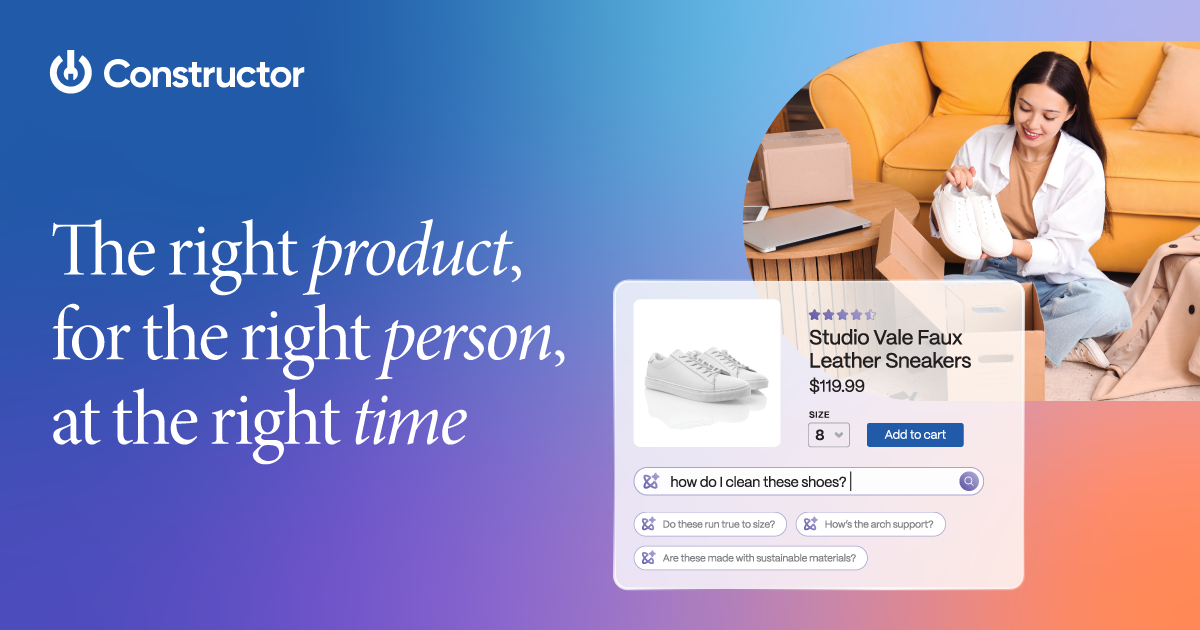 ConstructorNot publishedEcommerce retailers that want search and product discovery tuned to conversion and revenue KPIs, especially those interested in AI shopping agents.
 SecodaNot publishedData teams that need one place to search, document, and govern data across a warehouse and BI stack
 ExaFree tier, then $12/1kEngineering teams building AI agents or coding assistants that need fresh web, code, or company data inside their own product
 AndiNot publishedIndividuals and small teams who want conversational answers to web questions without ad-driven or tracked search
 UndermindNot publishedScientists and R&D teams who need thorough literature reviews across complex, multi-part research questions
StardriftFree on iOSFrequent flyers and travelers planning multi-city or complex trips who want research, itinerary, and bookings in one iOS app
 ZeroEntropyFrom $0.025/MM tokensEngineering teams building RAG pipelines or AI agents that need accurate retrieval over large document sets, such as health research or enterprise data.
 MorphikFree plan, then tieredEngineering teams building AI applications that need to search across text and images and want an open-source core they can inspect.
About AI Search Tools
AI search tools use machine learning to understand what a person means when they search, rather than matching exact keywords. They rank results, answer questions directly, or retrieve relevant content from large collections of products, documents, papers, or web pages. The job differs by buyer: some tools help shoppers find products on a store, some help teams find and govern data, and some supply search to engineers building AI applications.
The products on this list differ mainly in their approach and who they are built for. Constructor, Findify, and Klevu all focus on retail search and merchandising, with Klevu adding feed management and Constructor adding shopping agents. Secoda and Exa serve data and engineering teams, while Undermind targets scientific literature and Andi targets individual web questions. Pricing models also vary, from usage-based API billing at Exa and ZeroEntropy to quote-based enterprise plans at most ecommerce tools.
The 10 best AI Search Tools, compared
- Custom quote
1.Klevu
Best for: Online retailers and brands that want better on-site product discovery and also need to manage product feeds for Google Shopping and marketplaces.
- Pricing
- Custom quote
- Category
- E-commerce
Klevu is an AI ecommerce search and merchandising platform, now part of Athos Commerce alongside Searchspring and Intelligent Reach. It covers on-site search, personalization, and product recommendations, plus offsite feed management for channels like Google Shopping and Amazon. Over 2,700 global brands are listed as customers on the site.
Where it is strong
- Covers on-site search, merchandising and recommendations, plus off-site feed management in one platform.
- Modular plans let you start with onsite or offsite discovery and upgrade later without losing data or configuration.
- Includes AI agents such as a conversational shopping assistant and a GEO assistant for AI shopping platforms.
Where it falls short
- Pricing is not published, so you need to request a quote to compare costs.
- The product range is broad and spread across three brands, which can make it harder to tell which plan fits a small store.
- Pricing:
- Pricing is not published on the site. Plans are quoted on request, with standalone Onsite and Offsite annual plans and a combined Intelligent Discovery Platform.
- Not published
2.Findify
Best for: Ecommerce brands with a growing catalog and low search conversion that want search and category pages to rank without hand-curation.
- Pricing
- Not published
- Category
- E-commerce
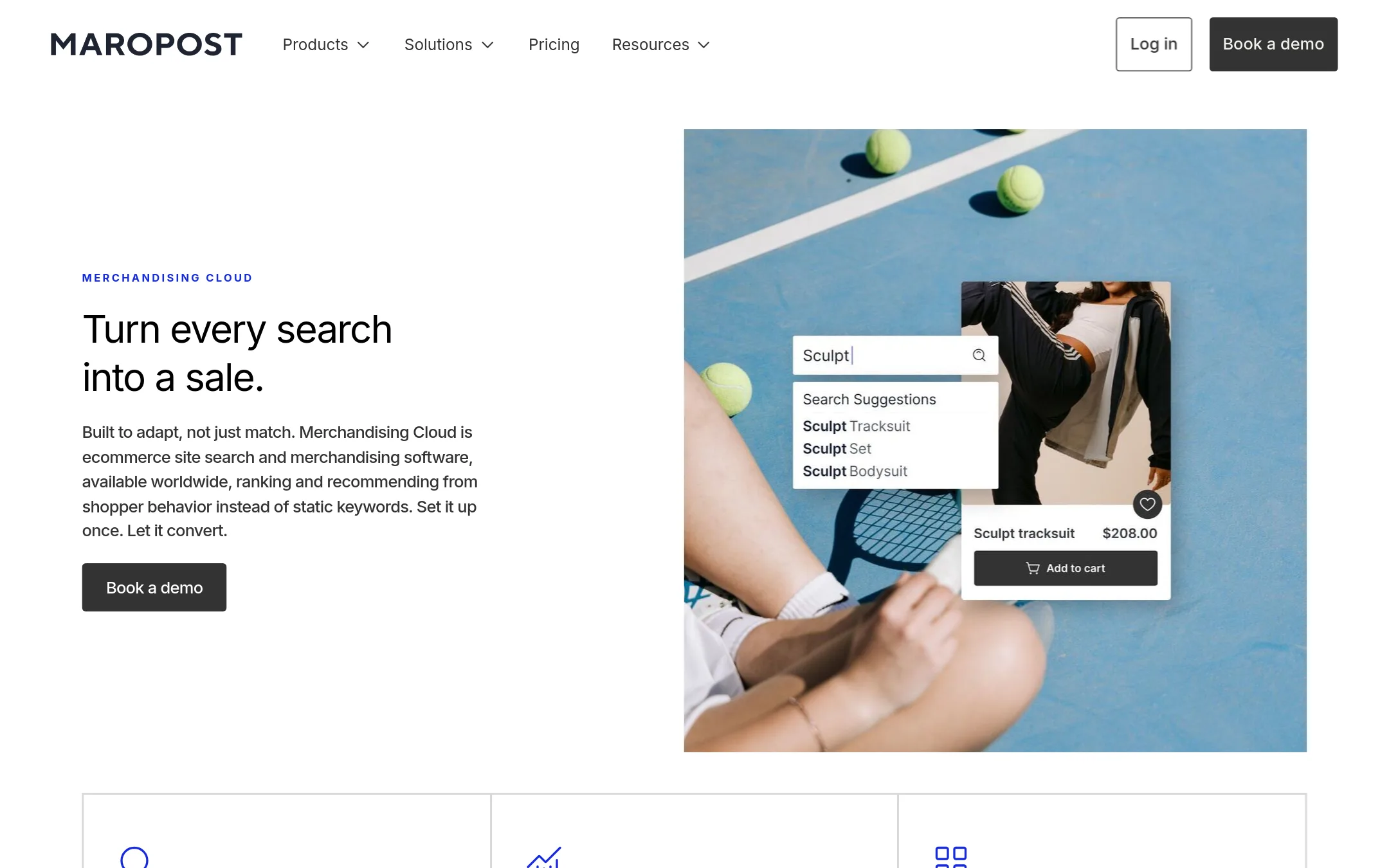
Merchandising Cloud is Maropost's ecommerce search and merchandising engine. It ranks search results from shopper behavior instead of exact keywords, so typos and vague queries still land on the right product. It also builds Smart Collections that sync in real time with Shopify, BigCommerce, Neto, or Norce.
Where it is strong
- Ranks search on shopper behavior, so typos and plain-language queries still find products
- Smart Collections reorder by popularity, margin, inventory, and performance and sync with Shopify, BigCommerce, Neto, or Norce
- Merchandising rules let you boost, bury, pin, or exclude products and schedule campaigns that start and end automatically
Where it falls short
- Built for ecommerce storefronts, so it does not fit content sites or non-retail search needs
- Pricing sits behind a quote or demo request, so cost is unclear until you talk to sales
- Pricing:
- Pricing is not published on the site.
- Not published
3.Constructor
Best for: Ecommerce retailers that want search and product discovery tuned to conversion and revenue KPIs, especially those interested in AI shopping agents.
- Pricing
- Not published
- Category
- E-commerce
Constructor is a product discovery platform for retailers that covers onsite search, autosuggest, browse, and recommendations from one reasoning engine that reads behavior, context, and intent. It also extends into AI shopping agents and offsite visibility in answer engines like ChatGPT. Its claim to credibility is focus: it builds only for commerce discovery, and its homepage cites Petco reporting a 13% lift in ecommerce conversions.
Where it is strong
- Covers search, browse, recommendations, and shopping agents under one reasoning engine
- Includes merchandiser controls, dashboards, and experiments for tuning results
- Cites a Petco case with a 13% lift in ecommerce conversions
Where it falls short
- Pricing is not published, so budgeting requires a sales conversation
- Built specifically for retailers, so it is not a fit for non-commerce search needs
- Pricing:
- Pricing is not published on the site.
- Not published
4.Secoda
Best for: Data teams that need one place to search, document, and govern data across a warehouse and BI stack

- Pricing
- Not published
- Category
- Analytics & Data
Secoda is an AI platform for data and analytics that connects directly to your data sources to map lineage, documentation, and metadata. Its AI search, catalog, monitoring, and governance tools all draw on that shared context. It supports Snowflake, BigQuery, and dbt, and includes a Chrome extension for finding data in the browser.
Where it is strong
- Search, catalog, and lineage share one metadata base
- Integrates with Snowflake, BigQuery, Redshift, and dbt
- Chrome extension for finding data while working in other tools
Where it falls short
- Pricing is not published, so cost needs a sales conversation
- The Enterprise tier with self-hosting and custom roles is aimed at large, security-heavy teams
- Pricing:
- Pricing is not published on the site.
- Free tier, then $12/1k
5.Exa
Best for: Engineering teams building AI agents or coding assistants that need fresh web, code, or company data inside their own product
- Pricing
- Free tier, then $12/1k
- Category
- AI & Machine Learning
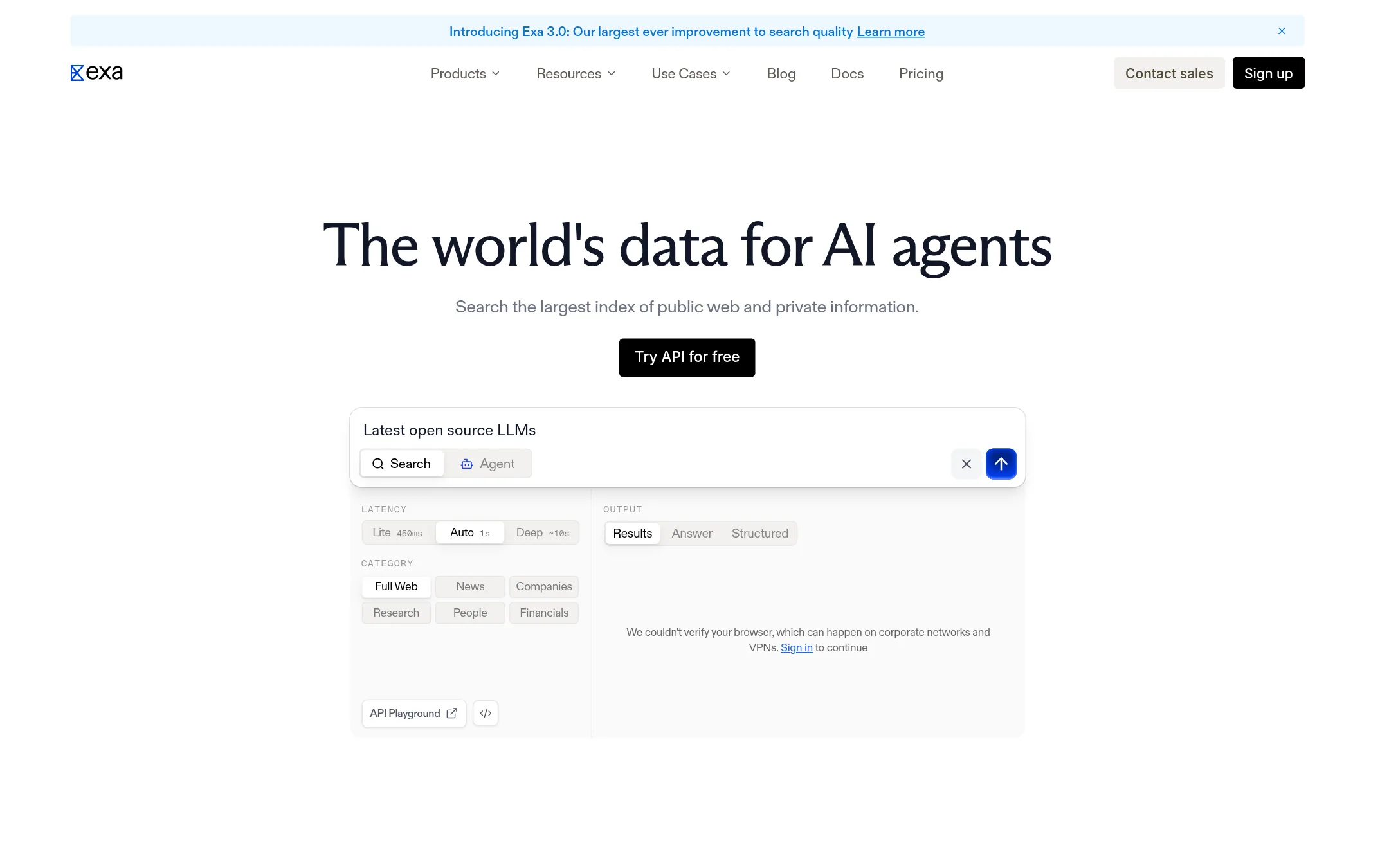
Exa is a search API built for AI agents, returning real-time web data, deep research runs, and structured content from one endpoint. Its token-efficient highlights pass only concise excerpts to the model, which cuts context costs. Teams can choose latency from 450ms to 1s, and the API covers people, company, and scholarly indexes alongside the general web.
Where it is strong
- Highlights extract relevant excerpts so agents use fewer tokens per query
- Latency is configurable from 450ms to 1s, with deep research runs for slower, cited answers
- Offers SOC 2 Type II, zero data retention and HIPAA with a BAA on enterprise plans
Where it falls short
- Enterprise features like SSO, SCIM and HIPAA sit behind custom pricing, so smaller teams may not reach them
- Non-developers without API experience will find it hard to use directly, since it is built for engineers and agents
- Pricing:
- Free tier gives $10 in credits each month plus a $10 onboarding bonus, pay-as-you-go Search API bills per request starting at $12 per 1k requests for Lite Search, and enterprise plans are custom quoted.
- Not published
6.Andi
Best for: Individuals and small teams who want conversational answers to web questions without ad-driven or tracked search
- Pricing
- Not published
- Category
- AI & Machine Learning
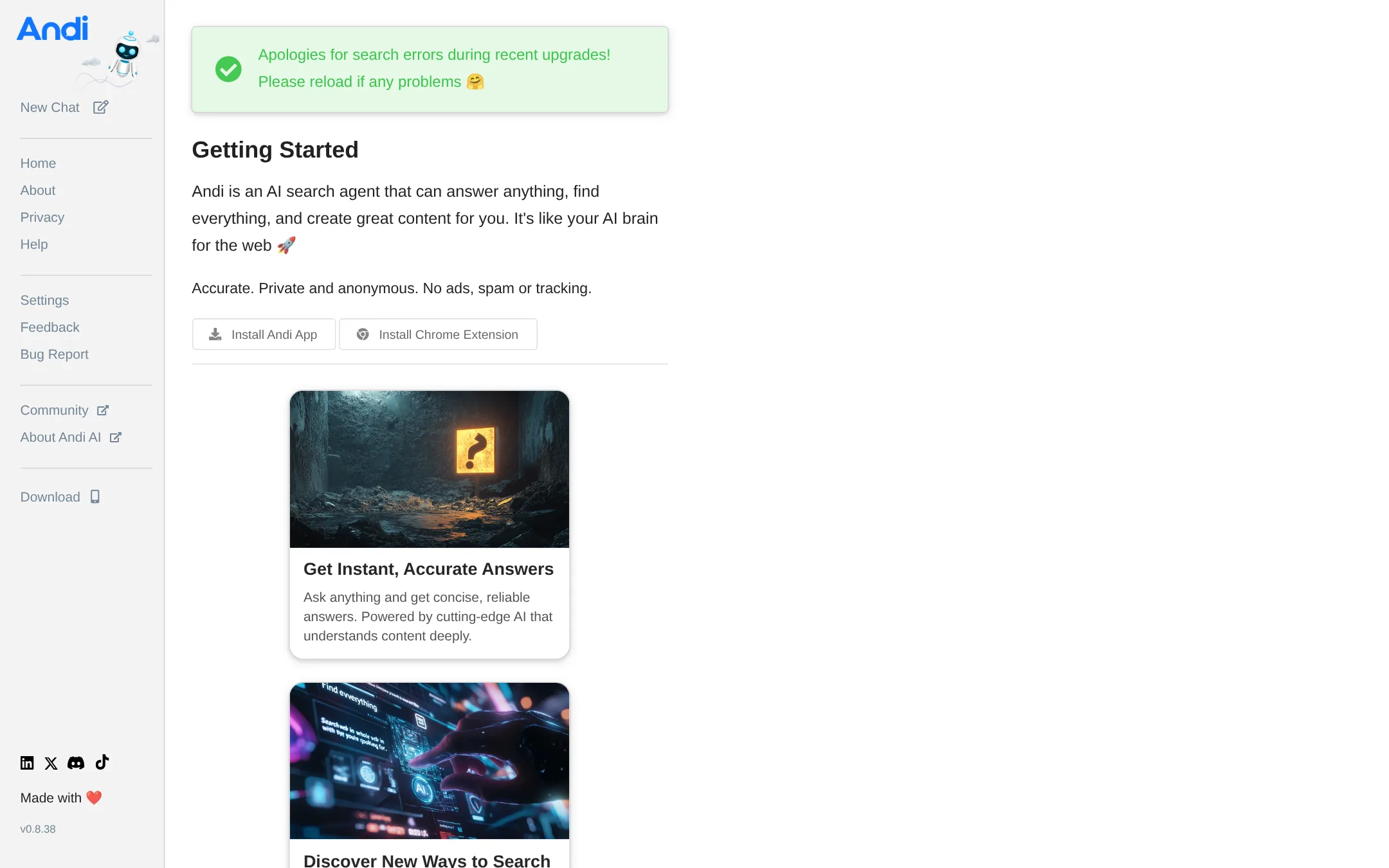
Andi is an AI search agent that answers questions directly instead of sending you a list of links. It says it runs without ads, spam, or tracking, and it can also generate content for you. That pairing of direct answers with a privacy stance makes it a reasonable pick among AI search tools for people who want a cleaner way to look things up.
Where it is strong
- Gives direct answers instead of a page of links
- Private and anonymous, with no ads, spam, or tracking
- Can also generate content, not just find it
Where it falls short
- The site does not publish pricing, so cost is unclear before you sign up
- The listing is unverified and the site notes recent search errors during upgrades
- Pricing:
- Pricing is not published on the site.
- Not published
7.Undermind
Best for: Scientists and R&D teams who need thorough literature reviews across complex, multi-part research questions

- Pricing
- Not published
- Category
- AI & Machine Learning
Undermind is an AI research agent that reads and evaluates hundreds of papers, follows citation trails, and cites every source inline so you can trace claims back to the original work. Its credibility rests on a published retrieval benchmark, where it reached 73% recall at ten minutes against 39% for the best GPT-6.1 Sol run, and on GSK publicly naming it as a discovery tool.
Where it is strong
- Reads full texts and figures, not just abstracts
- Cites every claim inline so you can verify sources
- Notifies you when new relevant papers appear
Where it falls short
- Its benchmark is self-reported and the gold standard was built with the vendor's own retrieval systems
- Aimed at scientific literature, so it is not a fit for general web research
- Pricing:
- Pricing is not published on the site.
- Free on iOS
8.Stardrift
Best for: Frequent flyers and travelers planning multi-city or complex trips who want research, itinerary, and bookings in one iOS app

- Pricing
- Free on iOS
- Category
- Other
Stardrift is an AI travel planner that researches flights, hotels, and activities through chat, then builds a daily itinerary with an interactive map linked to each stop. It can pull places from Reels and TikToks and connect to Gmail to organize bookings, which is useful for multi-city trips. The app is free on iOS and can generate a PDF to share with travel companions.
Where it is strong
- Interactive map tied to each day of the itinerary
- Saves places from Reels and TikToks into trips
- Connects Gmail to organize flights, stays, and reservations
Where it falls short
- Available on iOS only, based on the listing
- Real-time pricing claims are not backed by published figures or a stated booking partner
- Pricing:
- Pricing is not published on the site.
- From $0.025/MM tokens
9.ZeroEntropy
Best for: Engineering teams building RAG pipelines or AI agents that need accurate retrieval over large document sets, such as health research or enterprise data.

- Pricing
- From $0.025/MM tokens
- Category
- AI & Machine Learning
ZeroEntropy trains small, specialized models for search and retrieval, including the zerank-2 reranker and zembed-1 embedding model. Its pitch is higher accuracy and lower latency than generalist models, with one example being Assembled, which reported a 2.8x cost reduction after switching while improving latency and retrieval accuracy.
Where it is strong
- zerank-2 reranker has weights available on HuggingFace for self-serve use.
- Python and TypeScript SDKs are available for quick integration.
- Deployment options include AWS Marketplace, Azure, and on-premises within your VPC.
Where it falls short
- Embedding model weights are available only on request, and fine-tuning and on-prem pricing require contacting sales.
- Enterprise features such as the 99.99% SLA and dedicated support sit behind a custom-quoted plan, so smaller teams may find the cost unclear
- Pricing:
- Models are billed per million tokens, with zerank-2 at $0.025 and zembed-1 at $0.050, and the Search API is usage-based with pay-as-you-go rates for OCR, indexing, storage and queries.
- Free plan, then tiered
10.Morphik
Best for: Engineering teams building AI applications that need to search across text and images and want an open-source core they can inspect.

- Pricing
- Free plan, then tiered
- Category
- AI & Machine Learning
Morphik is an open-source multimodal search platform for AI apps, letting teams ingest and query text, images and other data types. The core is public on GitHub under morphik-org/morphik-core, so buyers can inspect the code before committing. It also ships community graph templates to get a search setup running faster.
Where it is strong
- Open-source core on GitHub, so the code can be reviewed
- Handles multimodal ingestion and queries across text and images
- Free plan with 200 pages to test before paying
Where it falls short
- Usage is metered by page, so large document sets can get costly quickly
- The site does not clearly show which features need the higher-tier plans beyond support and backups, so compare plans before buying
- Pricing:
- The free plan includes 200 pages and 3 research-agent calls per month, with paid tiers that add pages, priority GPU queues and overage at $0.03 per page.
How to choose AI Search Tools
Start with pricing structure, because most tools on this list do not publish prices. Constructor, Findify, Klevu, and Secoda all require a sales conversation, so budget time for quotes before comparing. Exa and ZeroEntropy use usage-based billing, which can be easier to forecast for small volumes but can grow quickly with large document sets, as Morphik's per-page metering also shows.
Match the tool to the job it was built for. Retail-focused products such as Constructor and Findify are designed for ecommerce storefronts and do not fit content sites or general search needs. Engineering-focused products such as Exa, ZeroEntropy, and Morphik need an in-house developer to integrate them, while Andi and Stardrift are consumer tools that need no setup.
Check integrations with the platforms you already use. Findify's Smart Collections sync with Shopify, BigCommerce, Neto, and Norce, Secoda connects to Snowflake, BigQuery, Redshift, and dbt, and ZeroEntropy offers SDKs for Python and TypeScript. Confirm your stack is covered before you commit.
Review data handling and compliance terms. Exa lists SOC 2 Type II, zero data retention, and HIPAA with a BAA on enterprise plans, while ZeroEntropy offers deployment inside your own VPC. Andi says it runs without tracking, and Undermind cites every source it uses, which helps with verification. Ask each vendor for its current certifications and data policies in writing.
Finally, look at support and contract terms. ZeroEntropy's 99.99% SLA and dedicated support sit behind a custom plan, and Exa's SSO, SCIM, and HIPAA features are also reserved for enterprise contracts. Smaller teams should confirm which features are included at their tier before signing.
FAQ
Questions about AI Search Tools
What are AI search tools?
AI search tools use machine learning to understand meaning and intent, not just keywords. They rank results, answer questions directly, or retrieve relevant content from products, documents, papers, or the web. Their job depends on the buyer, from helping shoppers find products to helping engineers build retrieval into applications.
Which AI search tool is best for an online store?
Constructor, Findify, and Klevu are built for ecommerce retailers. Constructor suits retailers focused on conversion and AI shopping agents, Findify suits growing catalogs with low search conversion, and Klevu suits brands that also need to manage feeds for Google Shopping and marketplaces.
How is pricing usually structured for these tools?
Pricing varies by product. Constructor, Findify, Klevu, and Secoda do not publish prices and require a sales conversation. Exa and ZeroEntropy use usage-based billing, with Exa charging per request and ZeroEntropy charging per million tokens, while Morphik meters usage by page.
Do I need developers to use these tools?
It depends on the tool. Engineering-focused products such as Exa, ZeroEntropy, and Morphik need developers to integrate them into an application. Andi and Stardrift are consumer tools, and Undermind is a research agent, so these need no technical setup.
How do I check whether a tool meets my data and compliance needs?
Ask each vendor for its current certifications and data policies in writing. Exa lists SOC 2 Type II, zero data retention, and HIPAA with a BAA on enterprise plans, and ZeroEntropy offers deployment inside your own VPC. Enterprise features often sit behind custom pricing, so confirm what your plan includes.
Last updated November 7, 2026.