
BitBoard alternatives
8 products compared · Updated November 22, 2026
The short answer
Julius suits analysts and creative teams that want data analysis alongside presentations, websites and images in one AI workspace. ThoughtSpot suits mid-size and large data teams that need one governed set of metrics shared across business users and embedded products. Databox suits agencies and growing businesses that need one governed set of metrics across many clients and data sources.
Your shortlist, at a glance
Read the comparisons ↓ HexNot publishedData teams at companies that want business users to self-serve analysis under governance and model choice
JuliusNot publishedAnalysts and creative teams that need data analysis plus presentations, websites and images in one AI workspace
- DDataboxNot publishedAgencies and growing businesses that need one governed set of metrics across many clients and data sources
- RRecordBookNot publishedSmall businesses that want a record-keeping app on Android instead of AI analysis of connected data sources
- TTableauSee websiteData visualization and analytics platform
Microsoft Azure CycleCloudNot publishedEngineering teams running HPC or compute-heavy workloads that need scalable clusters on Azure
 ThoughtSpotFrom $25/user/moData teams at mid-size and large companies that need one governed set of metrics shared across business users and embedded products
 ModeNot publishedData teams that already write SQL and Python and need a shared hub where analysts and business users work from the same queries and reports.
About BitBoard and its alternatives
BitBoard is an AI tool for analyzing business data. According to its site, it lets users get answers with proof from connected data sources, build live dashboards for recurring analysis, and share results with a team. The site stresses that answers stay traceable, with sources and queries attached to each result.
When comparing alternatives in this category, weigh the pricing structure first, since some vendors publish plan prices while others keep them behind a sales conversation. Check which regions and data sources each tool connects to, and whether it integrates with the tools your team already uses. Look at the level of support and contract terms, especially for larger teams where per-user costs and usage limits can grow quickly.
Explore the alternatives
- Not published
1.Hex
Best for: Data teams at companies that want business users to self-serve analysis under governance and model choice
- Pricing
- Not published
- Category
- Analytics & Data
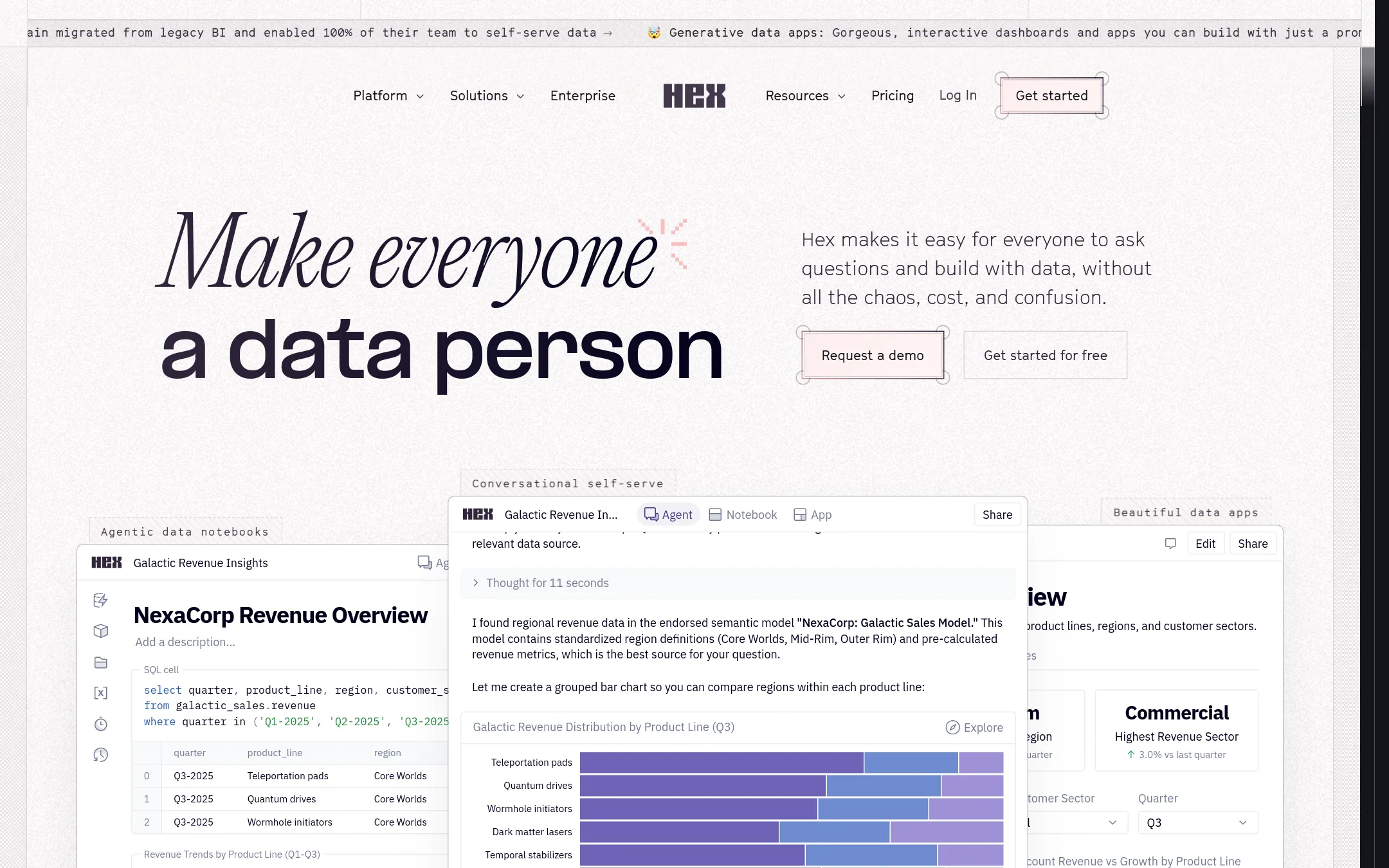
Hex is an analytics platform where teams ask questions in plain language, get answers tied to connected data, and share dashboards and data apps. It also offers a context layer, evals and observability over AI spend, so data teams can see how answers are produced. Teams would pick it over BitBoard when they need governed, semantic-model-based analysis across a broader data stack.
Where it is strong
- Context Studio and Evals show what people ask and whether answers are right
- Works with Slack, Claude, Cursor and other tools while keeping a shared data layer
- Lets you choose and compare AI models and track token spend by project
Where it falls short
- Aimed at data teams with a broader stack, which may be more than a small team needs
- Advanced compute and enterprise features are gated behind paid plans and sales conversations
- Pricing:
- Pricing is not published on the site for the Professional, Team and Enterprise plans, but Medium compute is included on paid plans, and pay-as-you-go compute runs from free for extra small up to $2.93 to $4.06 per hour for GPU profiles.
- Not published
2.Julius
Best for: Analysts and creative teams that need data analysis plus presentations, websites and images in one AI workspace
- Pricing
- Not published
- Category
- AI & Machine Learning
Julius is an AI workspace for analyzing data and research, and also for building presentations, reports, dashboards, websites, images and video. Someone would pick it over BitBoard when they want one tool that covers both data analysis and content creation, such as decks and images, rather than only answering questions and building dashboards from connected data.
Where it is strong
- Covers presentations, websites, images and video alongside data analysis
- Connects to Google Drive, OneDrive and SharePoint on paid plans
- Enterprise tier includes SOC 2 Type II compliance and single sign-on
Where it falls short
- Free plan file storage is limited to 7 days
- Data connectors to Snowflake, BigQuery and Postgres are only on the Enterprise plan
- Pricing:
- Pricing is not published on the site.
- DNot published
3.Databox
Best for: Agencies and growing businesses that need one governed set of metrics across many clients and data sources
- Pricing
- Not published
- Category
- Other
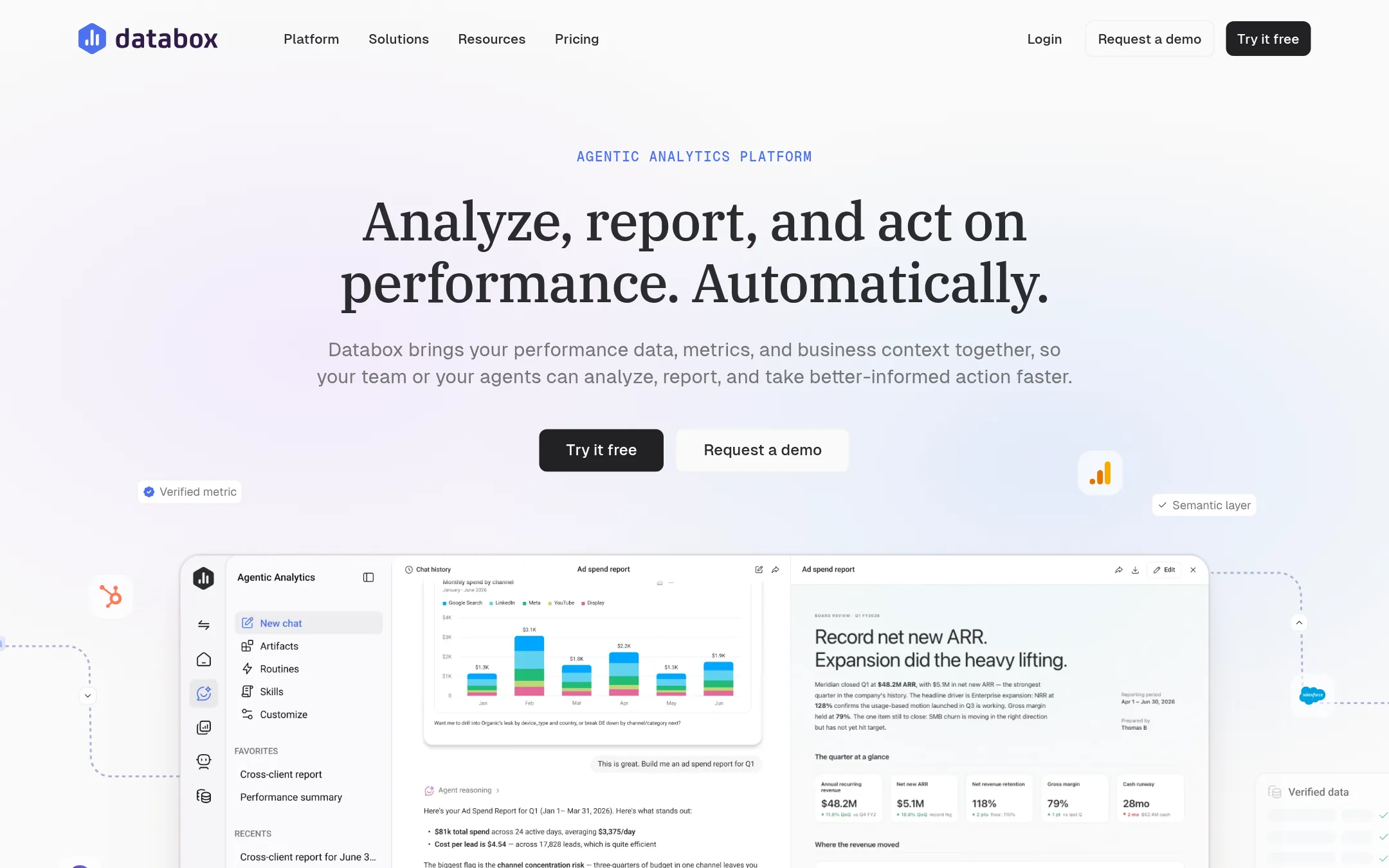
Databox is an agentic analytics platform for teams that own a number and must explain it. It connects business data, defines each metric once, and uses an AI analyst to answer questions, build reports, and automate follow-up. Teams would pick it over BitBoard when they need one governed set of metrics shared across tools, dashboards, and AI answers.
Where it is strong
- Connects 130+ tools, spreadsheets, databases, and APIs
- Defines each metric once so reports and AI answers use the same numbers
- Offers a done-for-you implementation option alongside self-serve
Where it falls short
- Built around performance reporting, so it is a weaker fit for general spreadsheet-style analysis than BitBoard's focus
- The most hands-on option is scoped to each client rather than priced as a standard plan
- Pricing:
- Pricing is not published on the site.
- RNot published
4.RecordBook
Best for: Small businesses that want a record-keeping app on Android instead of AI analysis of connected data sources
- Pricing
- Not published
- Category
- Productivity & Project Management
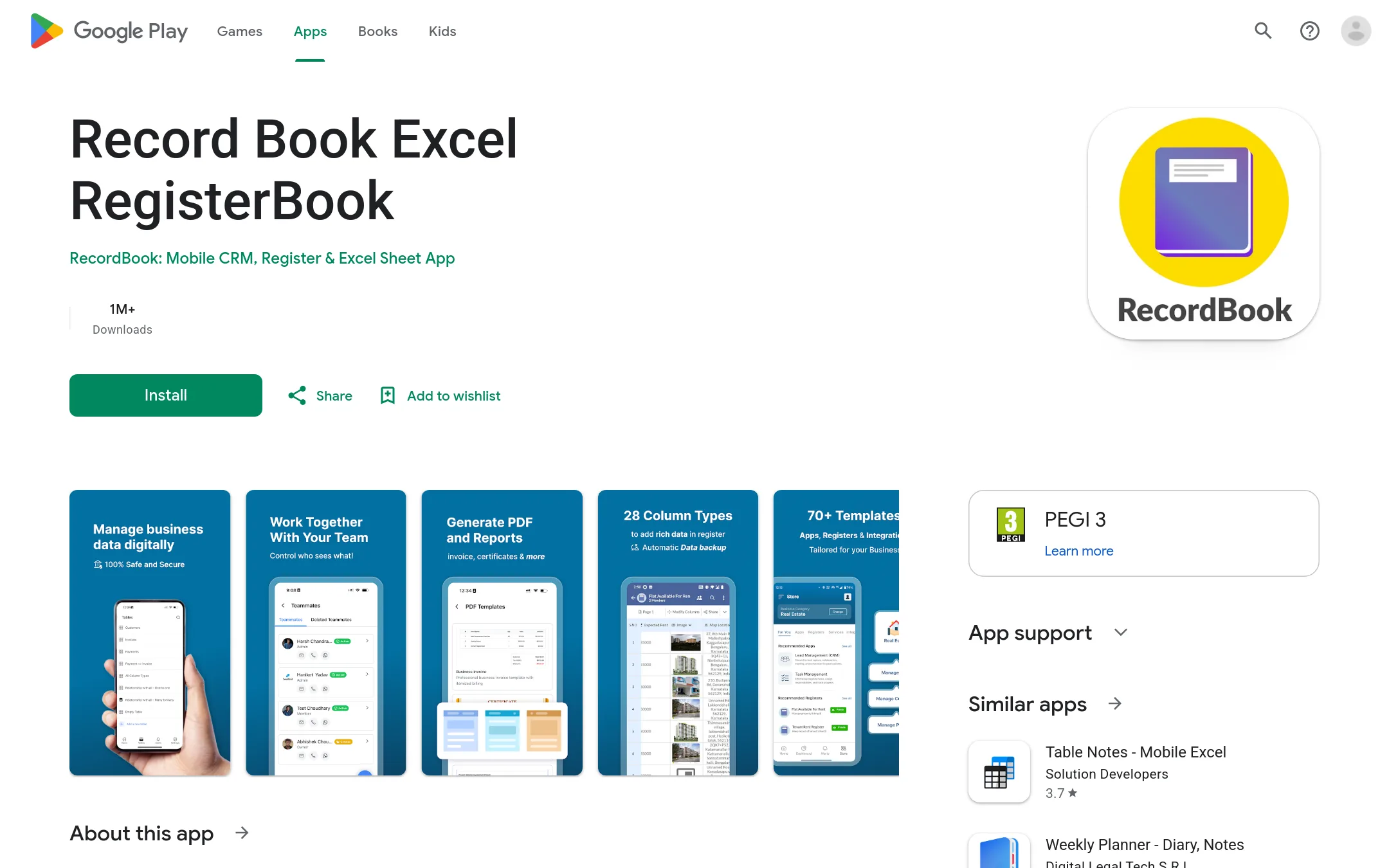
RecordBook is a Google Play app that describes itself as Airtable for small businesses. The listing is mostly page code, so the features it offers are not clear from the facts available. Someone would pick it over BitBoard if they want a database-style record tool on Android rather than AI-driven analysis of connected business data.
Where it is strong
- Positioned as an Airtable-style tool for small businesses
- Available through the Google Play Store
- Aimed at record and data tracking rather than AI analysis
Where it falls short
- No pricing information is available to check
- Its listing does not show AI analysis, dashboards or data source connections like BitBoard offers
- Pricing:
- Pricing is not published on the site.
- TSee website
5.Tableau
Analytics & Data
A widely used visual analytics platform for building dashboards and exploring business data, with AI-assisted features.
- Not published
6.Microsoft Azure CycleCloud
Best for: Engineering teams running HPC or compute-heavy workloads that need scalable clusters on Azure
- Pricing
- Not published
- Category
- Developer Tools
Azure CycleCloud is an orchestration tool for running and managing HPC clusters on Azure, with the site listing Azure HPC orchestration for scalable cluster management. It fits teams that run compute-heavy workloads and need to spin up and scale clusters on Azure infrastructure, rather than a tool for analyzing business data with AI. Someone would pick it over BitBoard when the real need is cluster management for simulation or large compute jobs.
Where it is strong
- Built for managing HPC clusters that scale up and down on Azure
- Sits inside the broader Azure platform, so it works alongside other Azure services
- Covers compute-heavy workloads that a spreadsheet or data analysis tool would not handle
Where it falls short
- Not designed for AI-driven analysis of business data or building dashboards
- Requires familiarity with Azure infrastructure and cluster management
- Pricing:
- Pricing is not published on the site.
- From $25/user/mo
7.ThoughtSpot
Best for: Data teams at mid-size and large companies that need one governed set of metrics shared across business users and embedded products
- Pricing
- From $25/user/mo
- Category
- Analytics & Data
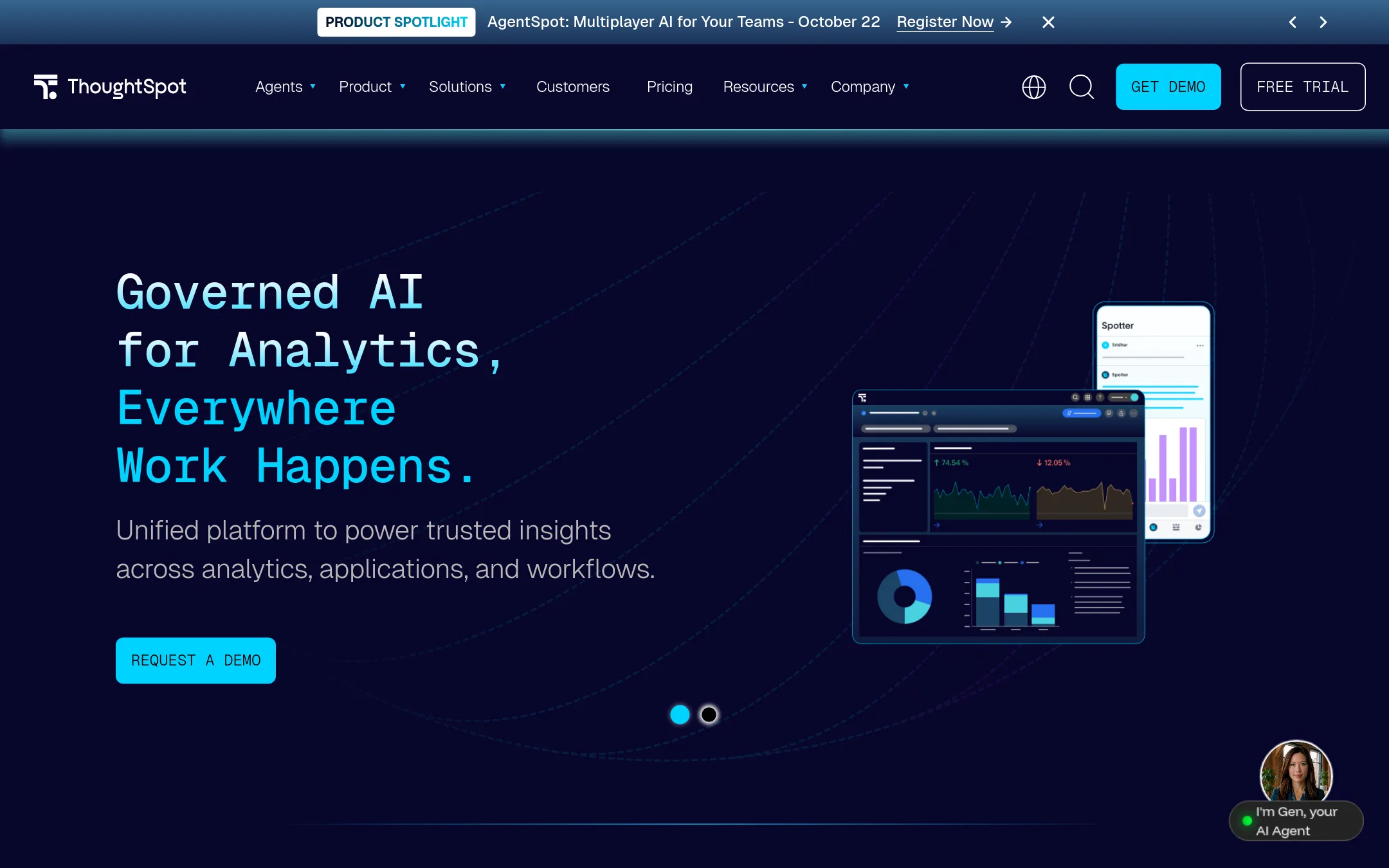
ThoughtSpot is an agentic analytics platform that answers natural-language questions over governed business metrics, and it can be embedded into apps and workflows. Teams pick it over BitBoard when the main need is a semantic layer with centrally defined metrics and security that many departments and customer-facing products must share. It is built for enterprise-scale data stacks rather than a lightweight workspace for a few people.
Where it is strong
- Semantic layer lets teams define metrics once and reuse them across every dashboard and query.
- Analytics can be embedded into internal apps, portals and customer-facing products through an API and SDK.
- Natural-language Spotter agents can surface anomalies and drivers across governed data models.
Where it falls short
- Enterprise tier requires custom pricing and a sales conversation, so the cost is not visible up front.
- Per-user pricing and query limits on the lower tiers can add up as headcount grows.
- Pricing:
- Pricing is published by plan: Developer starts at $25 per user per month billed annually for 5 to 50 users, Pro is $50 per user per month billed annually with Spotter AI agents at 25 queries per month per user, and Enterprise is custom priced.
- Not published
8.Mode
Best for: Data teams that already write SQL and Python and need a shared hub where analysts and business users work from the same queries and reports.
- Pricing
- Not published
- Category
- Analytics & Data
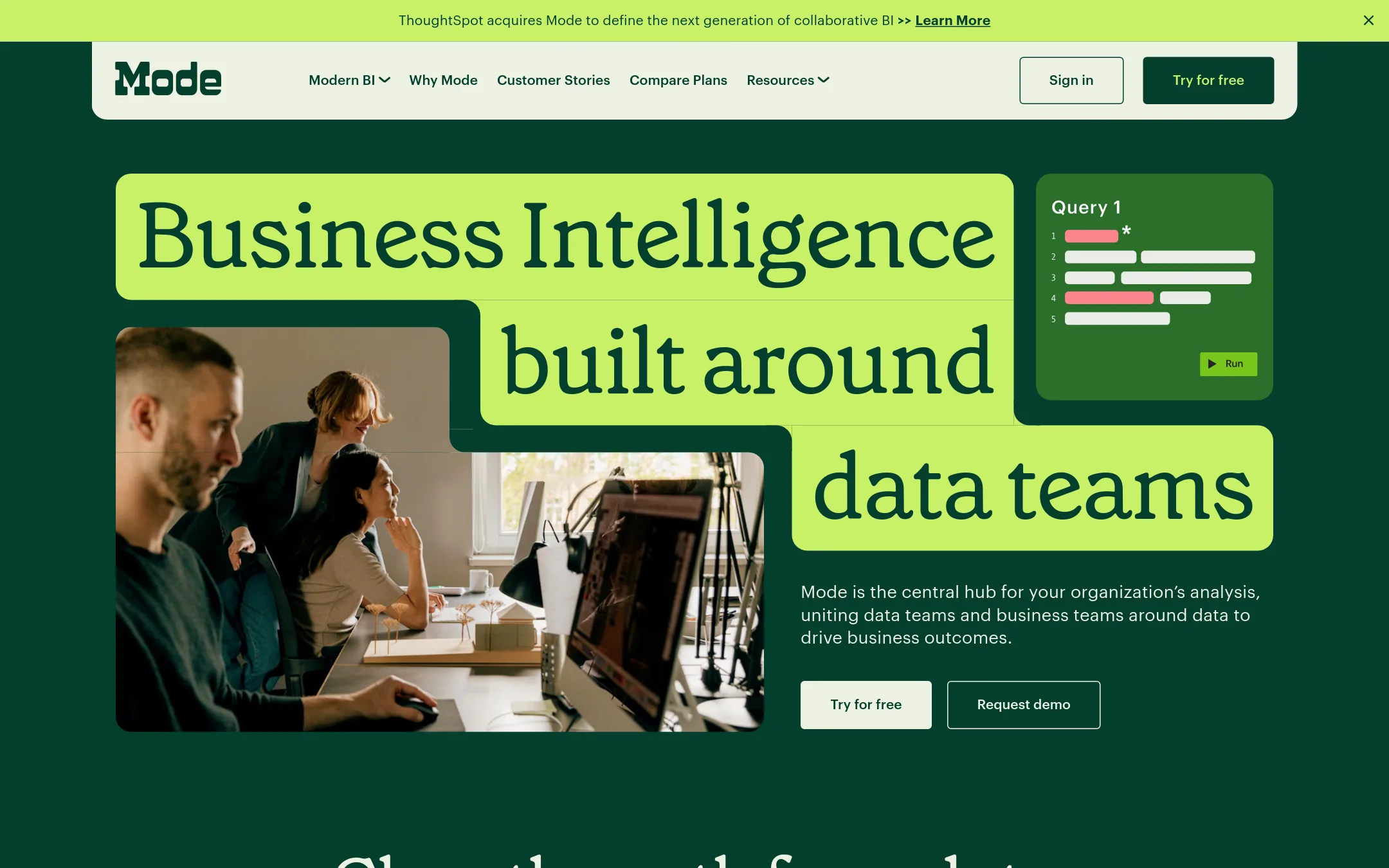
Mode is a collaborative analytics platform where data teams write SQL, R, and Python next to visualizations in one place, then share the results with business users. Teams pick it over BitBoard when they want analysts to work directly in code and query languages rather than rely on natural-language answers from an AI agent.
Where it is strong
- SQL, R, and Python sit alongside visual analytics in one platform.
- Analysts can run complex ad hoc analysis and business users can run simple self-service reports on the same data.
- The site says a team can be up and running in 30 minutes or less.
Where it falls short
- The site does not describe AI-driven natural-language answers the way BitBoard does.
- Pricing is not published, so cost has to be checked directly with the vendor.
- Pricing:
- Pricing is not published on the site.
- Switching from BitBoard:
- The site says Mode has been acquired by ThoughtSpot, which may affect the product's future direction, and it offers a free trial and a demo request.
See more comparisons in Productivity & Project Management alternatives.
FAQ
Questions about BitBoard alternatives
Which BitBoard alternative is best for a small business on Android?
RecordBook is a Google Play app that describes itself as Airtable for small businesses. Its listing does not show pricing or AI analysis features, so it is mainly a record-keeping option rather than a direct substitute for BitBoard.
Which alternative should a data team choose if it needs governed metrics?
ThoughtSpot and Databox both focus on a single governed set of metrics. ThoughtSpot uses a semantic layer that can be embedded into apps, and its Enterprise tier is custom priced. Databox defines each metric once so reports and AI answers use the same numbers.
Is there an alternative that covers both analysis and content creation?
Julius is an AI workspace that handles data analysis as well as presentations, reports, dashboards, websites, images and video. Its data connectors to Snowflake, BigQuery and Postgres are limited to the Enterprise plan, and free plan file storage is limited to 7 days.
Which alternative suits teams that write SQL and Python?
Mode is built for data teams that already write SQL, R, and Python next to visualizations. Analysts can run complex ad hoc analysis while business users run simpler reports on the same data. Its pricing is not published on the site.
Which option is not a fit for analyzing business data at all?
Microsoft Azure CycleCloud is an orchestration tool for running and managing HPC clusters on Azure. It suits engineering teams with compute-heavy workloads rather than teams that want AI-driven analysis of business data or dashboards.
Last updated November 22, 2026.