
Golf alternatives
6 products compared · Updated November 22, 2026
The short answer
Golf is a platform for discovering, enforcing policy on, and auditing AI agents and MCP connections across an organization. Lakera Guard suits engineering teams that need runtime protection for the AI applications they build. Noma Security suits enterprise security teams that want policy applied to each agent action at runtime. HiddenLayer suits CISOs and AI teams that build or buy models and need model scanning and attack defense.
Your shortlist, at a glance
Read the comparisons ↓- LLakera Guard$0/mo (Community)Engineering teams shipping LLM-powered applications that need prompt injection and data leakage protection at runtime
- PPrompt SecurityNot publishedSecurity teams that want open-source tools and AI security research before buying a governance platform
- PProtect AINot publishedSecurity teams already on the Palo Alto Networks stack that want AI app, agent and model security under one vendor
- HHiddenLayerNot publishedCISOs and AI teams that build or buy models and need to scan them and defend AI applications against adversarial attacks
- NNoma SecurityNot publishedEnterprise security teams that want runtime control over agent actions across endpoint, SaaS, and cloud environments
- ZZenityNot publishedEnterprises with many homegrown or low-code AI agents that need intent-level runtime control across SaaS, cloud and endpoints
About Golf and its alternatives
Golf is an agentic AI security and governance platform. According to its site, it discovers every AI agent, MCP server, and data connection in an environment, enforces granular policies per tool, team, and data source through an MCP gateway, and keeps a 90-day audit trail mapped to SOC 2, ISO 27001, NIST AI RMF, and FINRA. Its site emphasizes governance of AI tools a company does not control, without changing how employees work.
When comparing alternatives in this category, weigh the core problem each product solves. Some focus on attacks against AI applications you build, some on model supply chain security, and some on runtime control of agent actions. Also check pricing structure, which is often by quote, regional data residency, integrations with your SSO, SIEM, and CI/CD tools, support terms, and contract length.
Explore the alternatives
- L$0/mo (Community)
1.Lakera Guard
Best for: Engineering teams shipping LLM-powered applications that need prompt injection and data leakage protection at runtime
- Pricing
- $0/mo (Community)
- Category
- Other
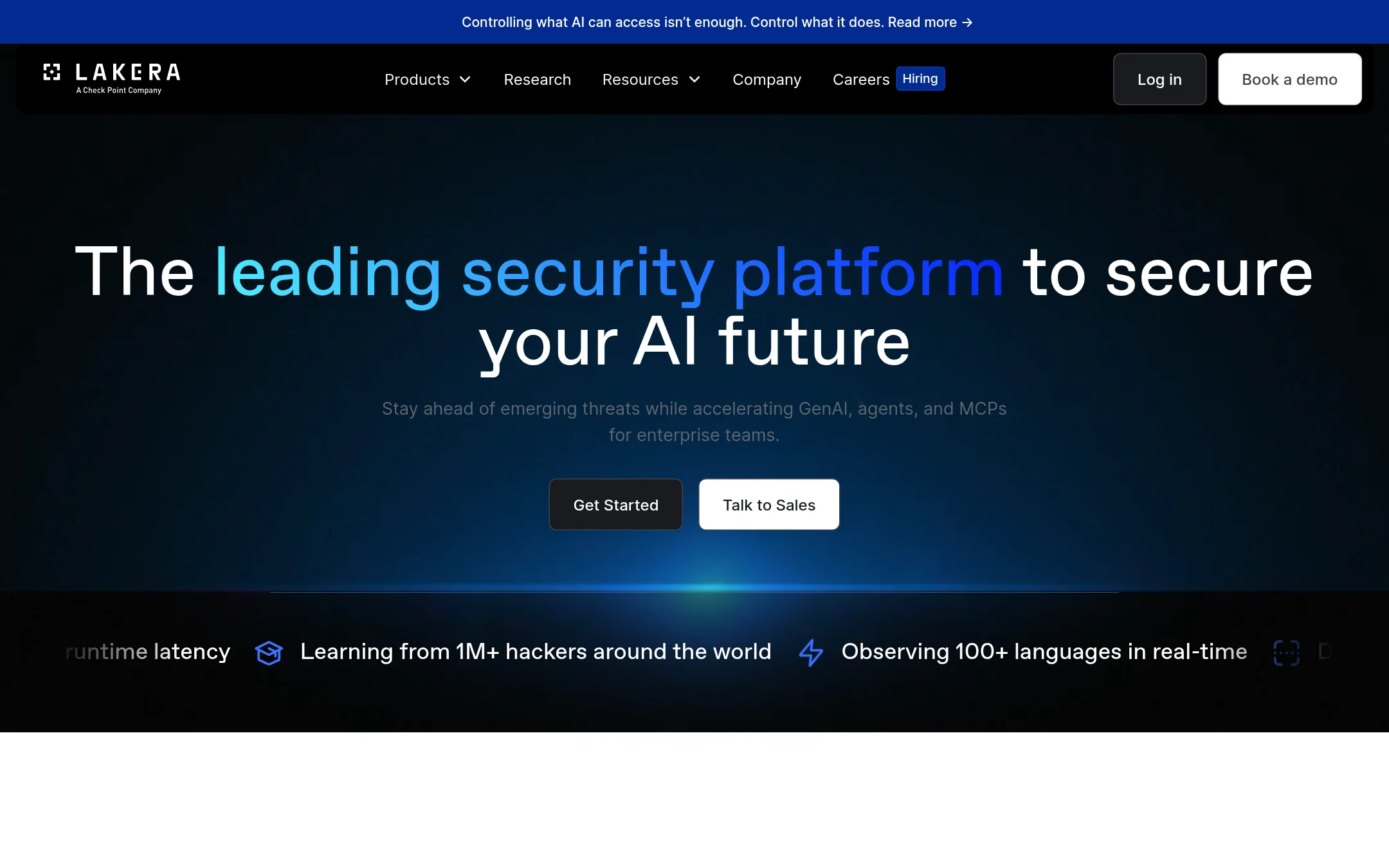
Lakera Guard is a runtime security layer for AI applications. It detects prompt injections, data leakage and jailbreaks in real time, and it has added workforce AI security for employee use of AI tools and AI agent security. Teams pick it over Golf when their main worry is attacks on the AI applications they build, not governance over every AI tool and MCP connection already running across the company.
Where it is strong
- Runtime detection of prompt injections, jailbreaks and data leakage with sub-50 ms latency
- Offers a free Community tier with 10k requests per month and SaaS hosting
- Self-hosted and EU/US data residency options on the Enterprise plan
Where it falls short
- Its core focus is securing AI applications at runtime, while Golf's centre of gravity is discovery and governance of AI agents and MCP conne
- SSO, role-based access control and SIEM integration are listed under Enterprise, not the free tier
- Pricing:
- The Community plan is $0 per month with 10k requests per month and an 8k token prompt limit, and Enterprise pricing is by quote.
- PNot published
2.Prompt Security
Best for: Security teams that want open-source tools and AI security research before buying a governance platform
- Pricing
- Not published
- Category
- Other
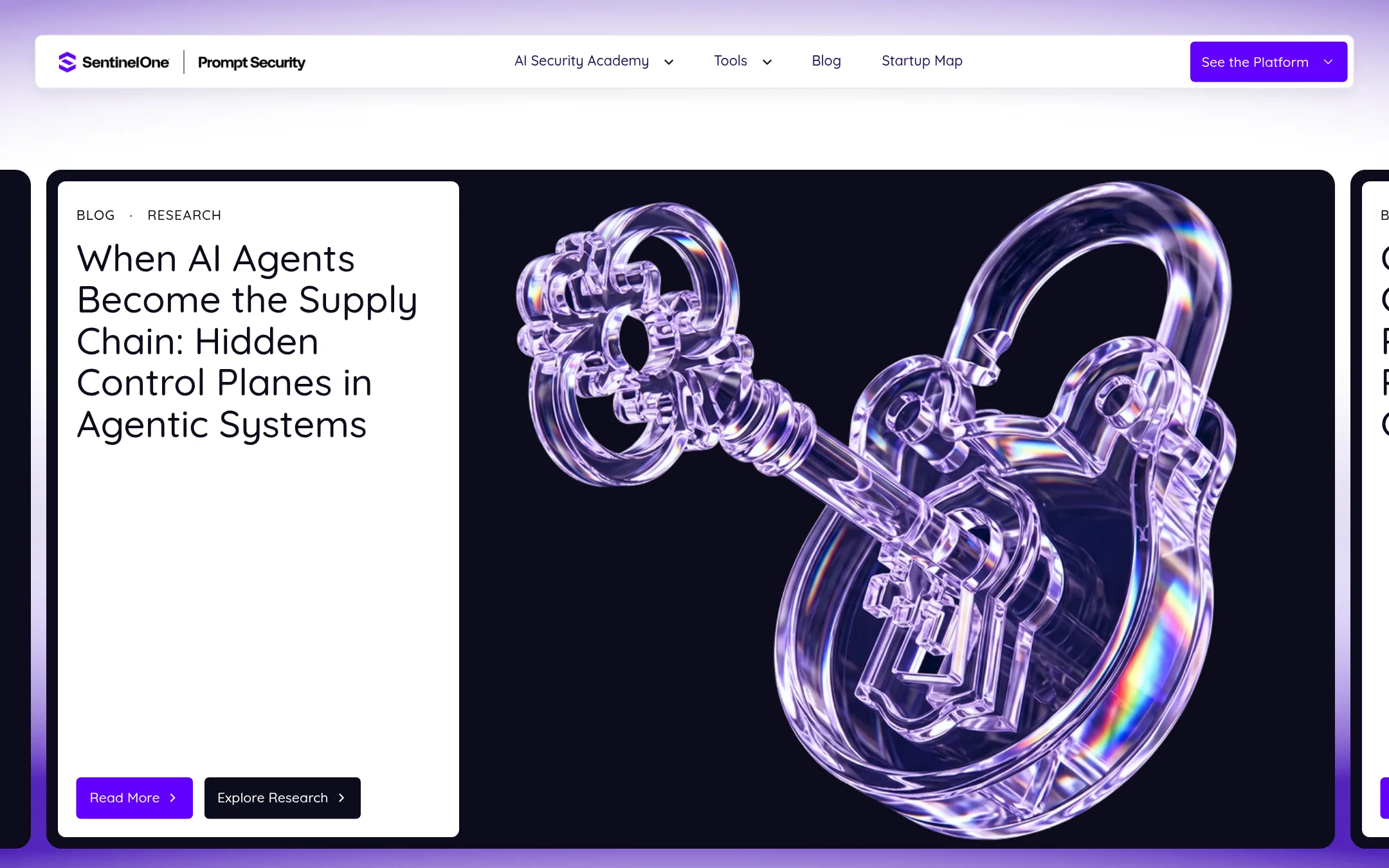
Prompt Security is a site that publishes AI security research, a glossary, and open-source tools such as ClawSec, OneClaw, and ps-fuzz. The homepage shows a resources hub and blog rather than a product that discovers agents and enforces policy across an organization. A team choosing it over Golf would likely want free tooling and research to understand AI risk, not a governance platform.
Where it is strong
- Open-source tools such as ps-fuzz for testing system prompts
- A free, regularly updated library of AI security articles and glossary terms
- OneClaw offers visibility into OpenClaw deployments
Where it falls short
- The homepage does not describe enterprise discovery of MCP connections the way Golf does
- No compliance evidence export or framework mapping is mentioned on the site
- Pricing:
- Pricing is not published on the site.
- PNot published
3.Protect AI
Best for: Security teams already on the Palo Alto Networks stack that want AI app, agent and model security under one vendor
- Pricing
- Not published
- Category
- Other
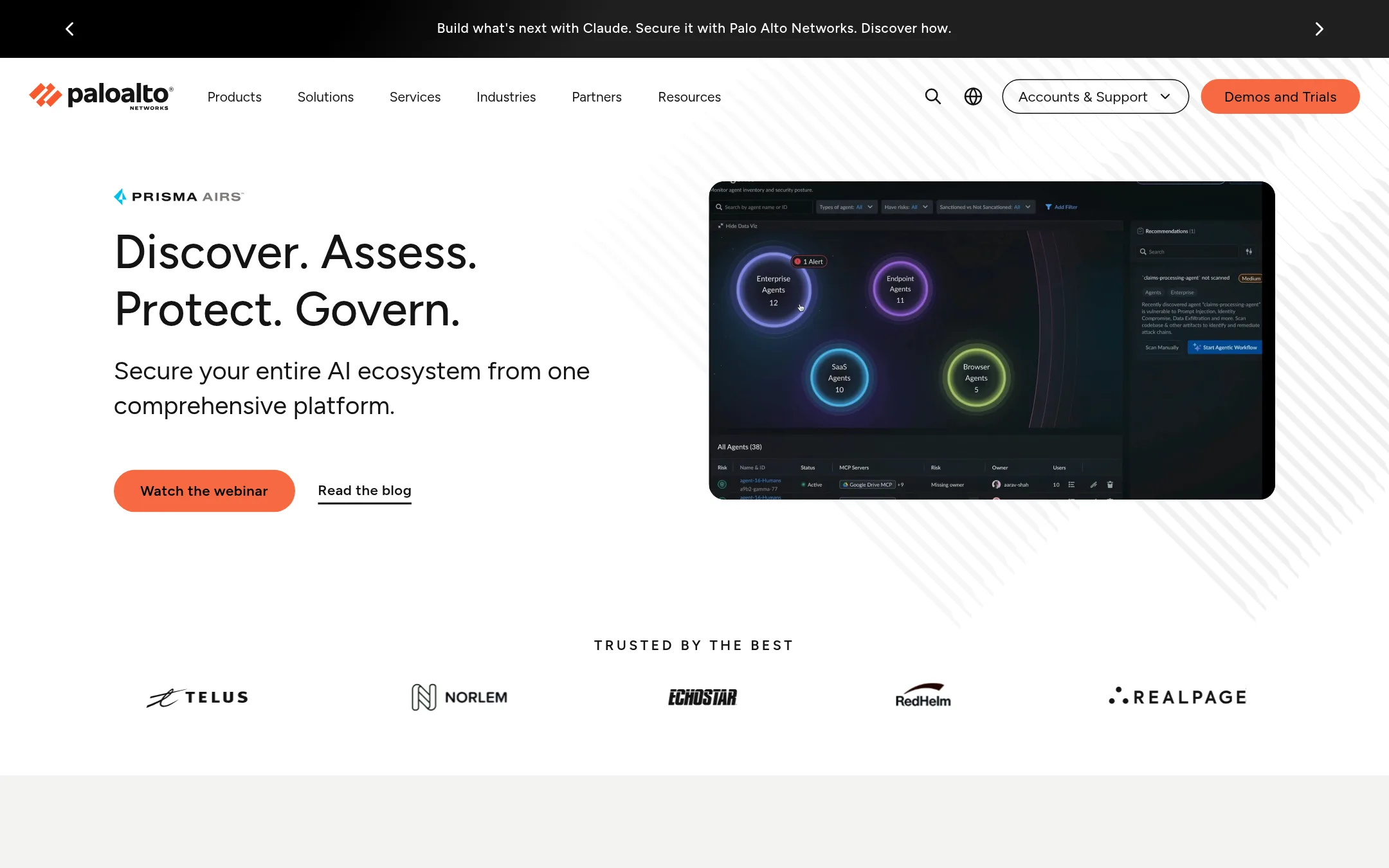
Protect AI is a security platform for AI systems, covering AI apps, agents and models. It fits teams that want broad AI security across their models and applications, and that want it as part of a larger Palo Alto Networks security stack. Golf focuses on governing AI agents and MCP connections at the endpoint and gateway level, so the two overlap less than the name suggests.
Where it is strong
- Covers AI apps, agents and models in one platform
- Comes from Palo Alto Networks, so it can sit alongside existing security products
- Positioned to discover, assess, protect and govern AI systems
Where it falls short
- The page we reviewed does not describe MCP gateway enforcement, which is Golf's core focus
- Scripts and cookie-banner code dominated the captured page, so the feature details are thin in what we could verify
- Pricing:
- Pricing is not published on the site.
- NNot published
5.Noma Security
Best for: Enterprise security teams that want runtime control over agent actions across endpoint, SaaS, and cloud environments
- Pricing
- Not published
- Category
- Other
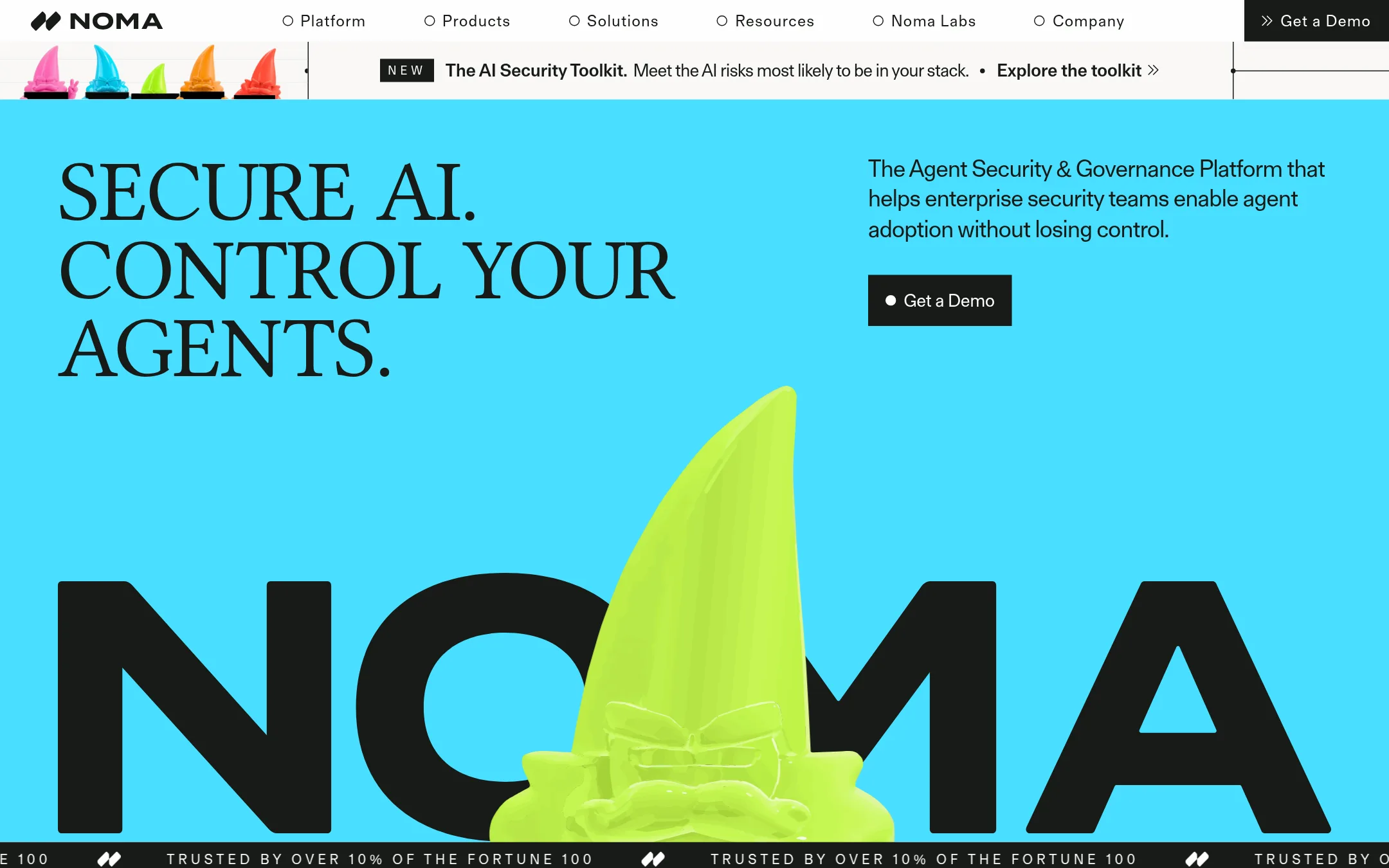
Noma Security is an agent security and governance platform for enterprise security teams. It applies policy at runtime to agent actions, weighing each action against the full session, the user the agent acts for, and the data it can reach. Choose it over Golf when runtime enforcement on each agent action, with options like steering the agent, masking data, or triggering a killswitch, matters more to you than discovery and audit alone.
Where it is strong
- Scores each agent action against the full session, user, data access, and normal behavior
- Can stop destructive actions, steer agents, mask data, alert a human, or trigger a killswitch
- Covers agents across endpoint, SaaS, and cloud, and includes testing for multi-turn attacks
Where it falls short
- The site does not list compliance framework mappings or audit trail details the way Golf's page does
- The site does not mention MCP gateway or SIEM streaming, so check those with the vendor directly
- Pricing:
- Pricing is not published on the site.
- ZNot published
6.Zenity
Best for: Enterprises with many homegrown or low-code AI agents that need intent-level runtime control across SaaS, cloud and endpoints
- Pricing
- Not published
- Category
- Other
Zenity secures AI agents by evaluating each agent action in real time, deciding what the agent can and cannot do and steering it away from harmful moves. It covers external manipulation like prompt injection, internal over-sharing of access, and autonomous agents that improvise beyond what they were given. Pick Zenity over Golf when your main concern is the decisions agents make at runtime and why they make them, rather than mainly discovering and gating MCP connections.
Where it is strong
- Judges each agent action in context of who it acts for and what it touches
- Covers SaaS, homegrown agent platforms and end-user devices in one platform
- Maps detections to OWASP and MITRE ATLAS
Where it falls short
- The site does not describe MCP gateway enforcement the way Golf does, so check that it fits your MCP setup
- Its focus is on agent decisions, so compliance evidence exports and regulator mappings like FINRA or the EU AI Act are less prominent on the
- Pricing:
- Pricing is not published on the site.

See more comparisons in Security & Privacy alternatives.
FAQ
Questions about Golf alternatives
What is the main difference between Golf and Lakera Guard?
Golf centers on discovering and governing AI agents and MCP connections across an organization, including ones IT did not approve. Lakera Guard centers on runtime protection for AI applications, detecting prompt injections, jailbreaks, and data leakage. Teams building their own LLM applications tend to look at Lakera Guard, while teams worried about tools employees already connect tend to look at Golf.
Which alternative suits teams that want to test AI security before buying?
Prompt Security publishes open-source tools such as ps-fuzz, a free library of AI security articles, and OneClaw for OpenClaw visibility. Its site does not describe an enterprise governance platform, so it works better as a starting point for research than as a replacement for Golf's governance features.
Which alternative is best for enterprises that want runtime control over each agent action?
Noma Security scores each agent action against the full session, the user the agent acts for, and the data it can reach. It can stop destructive actions, steer agents, mask data, or trigger a killswitch. Zenity also evaluates agent actions in real time and suits enterprises with many homegrown or low-code agents.
Do these alternatives publish pricing?
Lakera Guard publishes a free Community tier at $0 per month with 10k requests per month, with Enterprise pricing by quote. Prompt Security, Protect AI, HiddenLayer, Noma Security, and Zenity do not publish pricing on their sites, so you will need to request a quote.
Which alternatives cover compliance evidence and audit trails like Golf does?
Golf's site lists pre-mapped compliance frameworks including SOC 2, ISO 27001, NIST AI RMF, and FINRA, with a 90-day audit trail. The alternatives reviewed here do not describe equivalent pre-mapped evidence export on their sites, so confirm audit and compliance reporting directly with each vendor before deciding.
Last updated November 22, 2026.