
Make alternatives
12 products compared · Updated October 30, 2026
The short answer
The strongest alternatives to Make are Zapier for teams needing quick, reliable integrations with a simple task-based model, n8n for technical teams wanting self-hosting and code-level control, and Workato for large enterprises requiring governed AI orchestration. Choose based on your team's technical depth and scale.
Your shortlist, at a glance
Read the comparisons ↓ ZapierNot publishedTeams that need quick, reliable integrations across many apps and prefer a straightforward task-based pricing model.
 n8nCustom quoteTechnical teams and developers who want a self-hostable, code-friendly automation platform with strong AI governance and observability.
- IIntegromat (now part of Make)Not publishedExisting Integromat users who need to migrate to Make before support ends in 2023.
WorkatoCustom quoteLarge enterprises that need governed, scalable AI agent orchestration and integration across thousands of apps.
- TTray.aiFrom $50/moEnterprises that need governed AI agents, MCP management, and integration across 700+ connectors with enterprise-grade security.
Pipedream$99/mo + usageDeveloper teams building AI agents or SaaS products that need to connect to many external APIs with per-user auth.
 Automate.ioNot publishedSmall teams that want basic no-code workflow automation without the complexity of AI agents or extensive integrations.
- MMicrosoft Power AutomateSee websiteOther
 Kissflow ProcurementCustom quoteEnterprises that need to build and manage internal operational apps with strong governance, security, and audit trails.
- PParabolaNot publishedOperations teams in e-commerce and logistics that need transparent, auditable AI agents for reconciliation and exception handling.
100xSee websiteCreate, Share, and Monetize AI Agents
 ActivepiecesSee websiteOpen-source, AI-first and no-code business automation tool
About Make and its alternatives
Make is a visual AI workflow automation platform that connects 3,500+ apps and lets you build automations and AI agents by prompting or drag-and-drop. It is known for its large integration library, visual builder, and governance features like role-based access and audit logs.
When comparing alternatives, weigh pricing structure (credits vs. tasks vs. usage-based), deployment options (cloud vs. self-hosted), integration breadth, support for AI agents, and contract terms. Some tools offer transparent pricing, while others require sales conversations, which affects budgeting.
Explore the alternatives
- Not published
1.Zapier
Best for: Teams that need quick, reliable integrations across many apps and prefer a straightforward task-based pricing model.
- Pricing
- Not published
- Category
- Productivity & Project Management
Zapier is a task-based automation platform that connects 9,000+ apps and supports deterministic workflows, AI steps, and agents. Choose it over Make if you want a simpler, more established tool with a large app catalog and a clear per-task pricing model.
Where it is strong
- Unlimited Zaps on all paid plans, including the free plan.
- Two-step Zaps on free, multi-step on paid plans.
- Built-in AI features like Copilot and AI fields on paid plans.
Where it falls short
- Free plan limited to 100 tasks per month.
- Advanced admin controls and observability only on Enterprise plan.
- Pricing:
- Pricing is not published on the site.
- Custom quote
2.n8n
Best for: Technical teams and developers who want a self-hostable, code-friendly automation platform with strong AI governance and observability.
- Pricing
- Custom quote
- Category
- AI & Machine Learning
n8n is a workflow automation platform that combines AI capabilities with business process automation, giving technical teams the flexibility of code with the speed of no-code. Choose it over Make if you need self-hosting options, deeper code-level control, or a platform that emphasizes transparency and governance for AI agents.
Where it is strong
- Self-hostable with source code on GitHub, ideal for data control
- Code steps in JavaScript/Python and custom API requests for flexibility
- Built-in AI governance with human-in-the-loop approvals and guardrails
Where it falls short
- Business plan is self-hosted only, which may require extra ops effort
- No published pricing, so budgeting requires a sales conversation
- Pricing:
- Pricing is not published on the site. Plans are Starter, Pro, Business, and Enterprise with custom quotes.
- Switching from Make:
- Moving from Make to n8n means rebuilding your workflows in a new visual builder, but n8n's code steps and self-hosting options may reduce lock-in.
- INot published
3.Integromat (now part of Make)
Best for: Existing Integromat users who need to migrate to Make before support ends in 2023.
- Pricing
- Not published
- Category
- Other
Integromat is the previous name of Make. The product has been rebranded and upgraded to Make, with new features like live-stream execution details and parallel webhook executions. Choose this option only if you are an existing Integromat customer who has not yet migrated to Make.
Where it is strong
- Existing Integromat customers can upgrade to Make at the same price they currently pay.
- Make includes live-stream execution details for better visibility into automations.
- Make supports parallel webhook executions for high-volume inbound requests.
Where it falls short
- Integromat is a legacy product. Support ends in 2023.
- New users are redirected to Make, so Integromat is not available for new sign-ups.
- Pricing:
- Pricing is not published on the site.
- Switching from Make:
- Moving from Integromat to Make is an upgrade path, not a switch. Existing customers can migrate at the same price, and support for Integromat ends in 2023.
- Custom quote
4.Workato
Best for: Large enterprises that need governed, scalable AI agent orchestration and integration across thousands of apps.
- Pricing
- Custom quote
- Category
- AI & Machine Learning
Workato is an enterprise-grade integration and automation platform with a strong focus on AI agent orchestration and governance. Choose it over Make when you need centralized control, security, and compliance for AI and automation across a large organization.
Where it is strong
- Enterprise-grade governance and security controls
- 17,000+ pre-built connectors
- Built-in AI agent orchestration and MCP support
Where it falls short
- Pricing is not transparent. Requires contacting sales
- May be overkill for small teams or simple automations
- Pricing:
- Pricing is not published on the site. Contact Workato for a quote based on your contract terms.
- Switching from Make:
- Moving from Make to Workato involves rebuilding your workflows in Workato's recipe model, which may require re-architecting for enterprise governance and scale.
- TFrom $50/mo
5.Tray.ai
Best for: Enterprises that need governed AI agents, MCP management, and integration across 700+ connectors with enterprise-grade security.
- Pricing
- From $50/mo
- Category
- Other
Tray.ai is an enterprise orchestration platform for integration, automation, and AI agents, with governance built in. Choose it over Make when you need strict security, compliance, and visibility across AI agents and MCP tools, especially in large organizations.
Where it is strong
- Built-in governance: RBAC, audit trails, and security across every agent action and workflow run.
- Supports both low-code visual building and code-first development with Claude Code and Codex plugins.
- Includes MCP Gateway for governed access to AI tools and data.
Where it falls short
- Pricing is usage-based and may be higher for heavy usage compared to Make's credit system.
- Some advanced features like SSO and regional hosting are only on Enterprise plan.
- Pricing:
- Starts at $50 a month. Pricing is usage-based with no per-user or per-connection fees.
- Switching from Make:
- Moving from Make involves rebuilding workflows in Tray's canvas or code environment, and reconfiguring integrations and governance policies.
- $99/mo + usage
6.Pipedream
Best for: Developer teams building AI agents or SaaS products that need to connect to many external APIs with per-user auth.
- Pricing
- $99/mo + usage
- Category
- Developer Tools
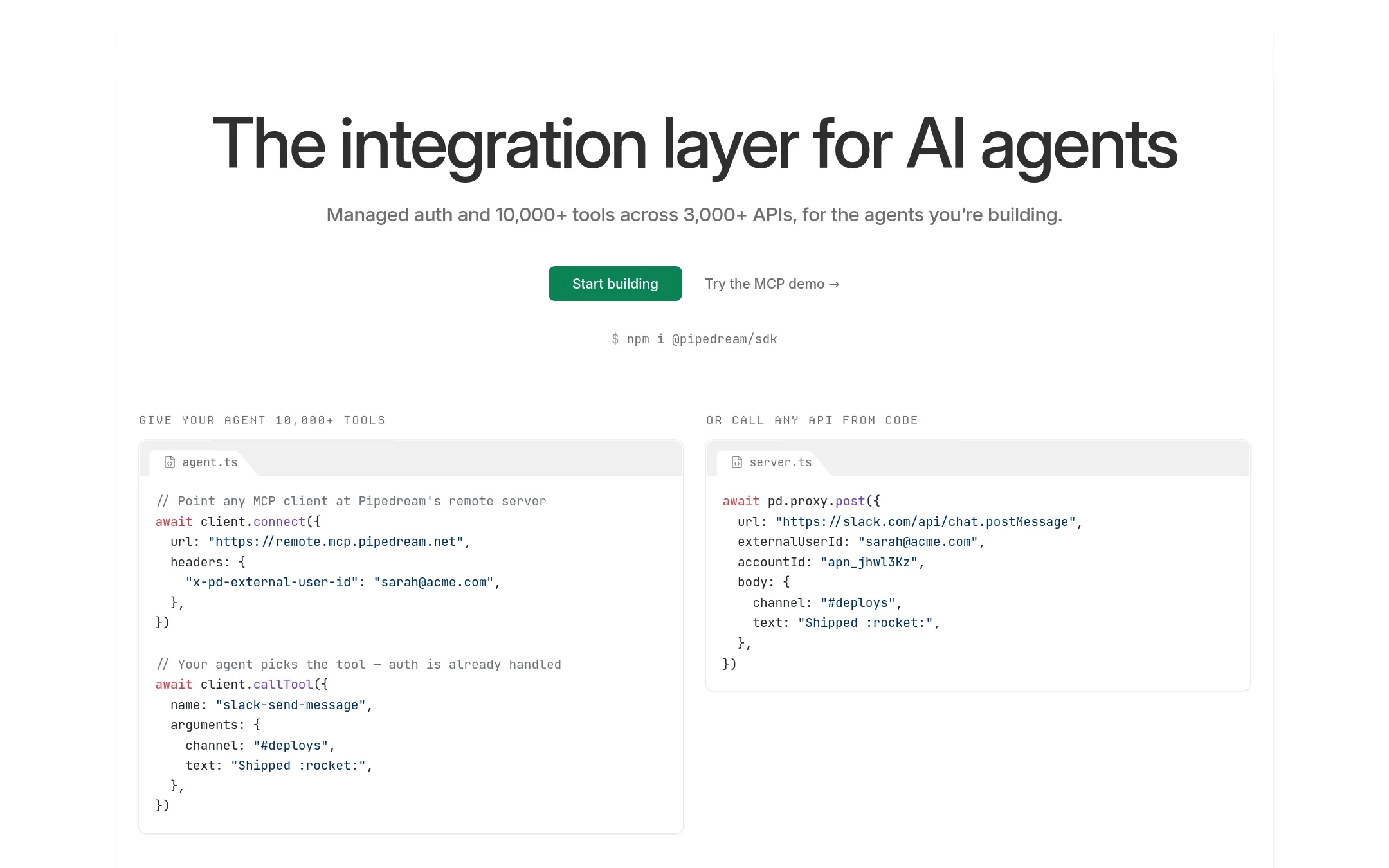
Pipedream is an integration layer for developers building AI agents, offering managed auth, 10,000+ prebuilt tools, and a proxy for 3,000+ APIs. Choose it over Make when you need to embed integrations directly into your product and handle per-user authentication at scale, rather than building internal workflows.
Where it is strong
- 10,000+ prebuilt tools and triggers across 3,000+ APIs
- Managed OAuth, token storage, and refresh for users
- Free development tier with no credit card
Where it falls short
- Production use requires paid Startup plan or higher
- Credits billed per 30 seconds of compute, which can add up
- Pricing:
- Free for development, Startup at $99/month billed annually (or $150 monthly) including 100 users and 10,000 credits, then $2 per additional user and $0.012 per credit. Business is custom.
- Switching from Make:
- Moving from Make means rebuilding workflows as code-based integrations, since Pipedream is developer-focused and doesn't offer a visual drag-and-drop builder.
- Not published
7.Automate.io
Best for: Small teams that want basic no-code workflow automation without the complexity of AI agents or extensive integrations.
- Pricing
- Not published
- Category
- Productivity & Project Management
Automate.io is a no-code automation tool that connects apps and lets you build bots to handle repetitive tasks. Choose it over Make if you need a simpler, more straightforward automation tool and don't require Make's advanced AI agent capabilities or its large library of 3,500+ integrations.
Where it is strong
- Simple no-code bot builder for basic workflows
- Connects common apps for everyday automation
- Free plan available to start
Where it falls short
- No AI agents or advanced AI features
- Fewer integrations compared to Make's 3,500+ apps
- Pricing:
- Pricing is not published on the site.
- MSee website
8.Microsoft Power Automate
Other
A robust automation platform integrated with Microsoft ecosystem, offering AI builder and extensive connectors.
- Custom quote
9.Kissflow Procurement
Best for: Enterprises that need to build and manage internal operational apps with strong governance, security, and audit trails.
- Pricing
- Custom quote
- Category
- Productivity & Project Management
Kissflow Procurement is a low-code platform for building custom enterprise apps and automating workflows, aimed at IT teams and business leaders who need structured applications like procurement, ticketing, or compliance tracking. Choose it over Make when your priority is governed, enterprise-grade app development rather than connecting many external apps and AI models in a visual automation canvas.
Where it is strong
- Build complete enterprise apps in weeks with AI and low-code tools
- Strong governance, security, and audit trails for compliance
- No surcharges for AI or API usage. Fixed annual agreements
Where it falls short
- Pricing is not transparent and requires a sales conversation
- Focused on internal apps, not broad external app integrations like Make
- Pricing:
- Pricing is not published on the site. It is based on fixed annual agreements with no surcharges for AI or API usage.
- PNot published
10.Parabola
Best for: Operations teams in e-commerce and logistics that need transparent, auditable AI agents for reconciliation and exception handling.
- Pricing
- Not published
- Category
- Other
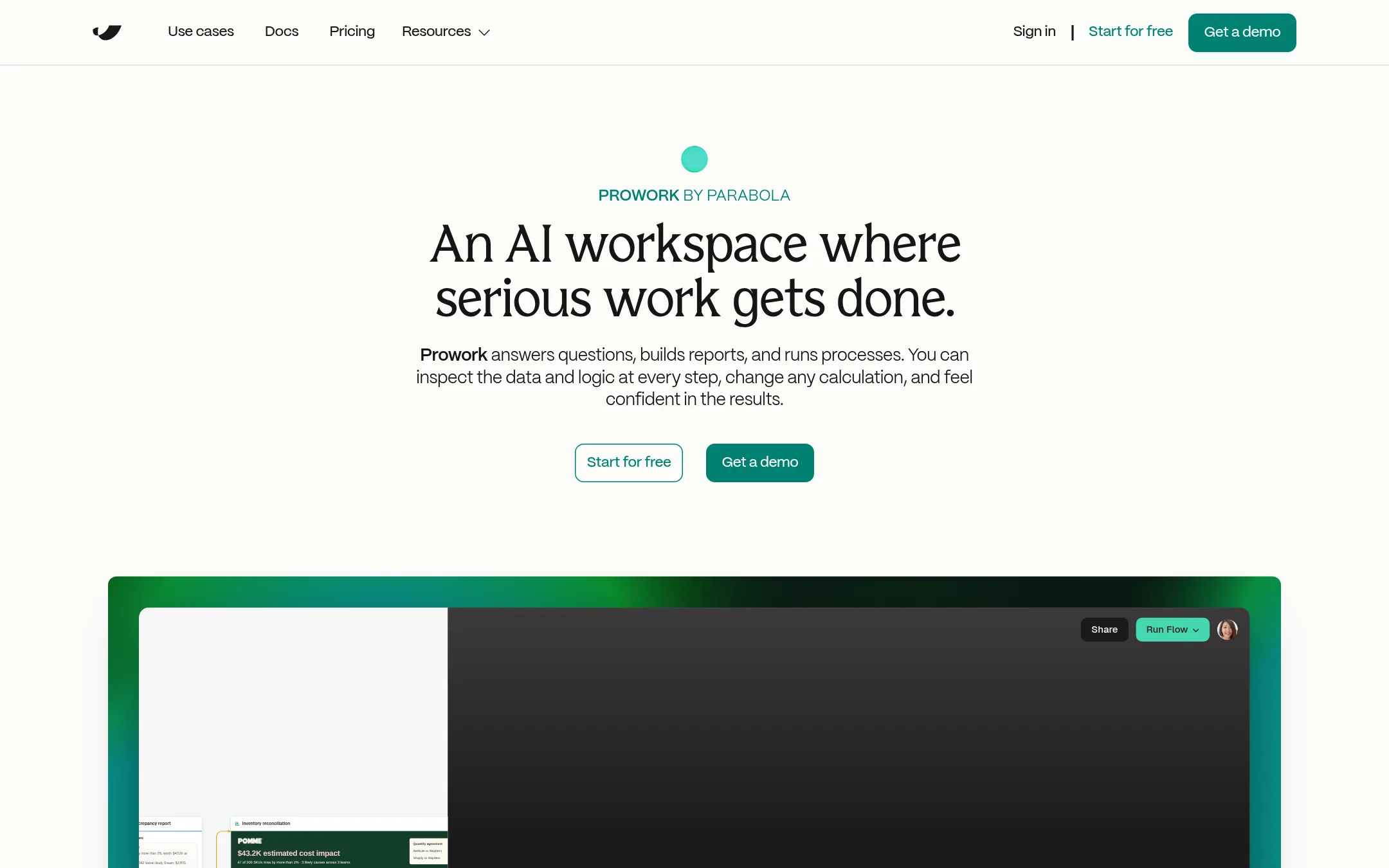
Parabola (Prowork) is an AI workspace for operations-heavy teams that need to reconcile data across ERP, warehouse, spreadsheets, and other systems. Choose it over Make when your work is less about connecting apps and more about inspecting, validating, and fixing data in finance, supply chain, or logistics processes.
Where it is strong
- Inspect data and logic at every step, with the ability to change calculations.
- Pre-built integrations for ERP, warehouse, APIs, email, and file systems.
- Business plans include hands-on deployment support from an Applied AI team.
Where it falls short
- Self-serve plans are designed for individual users, not teams.
- Enterprise features like SSO and audit trails are only on business plans.
- Pricing:
- Pricing is not published on the site.
- See website
11.100x
AI & Machine Learning
Create, Share, and Monetize AI Agents
- See website
12.Activepieces
Productivity & Project Management
Open-source, AI-first and no-code business automation tool
See more comparisons in Productivity & Project Management alternatives.
FAQ
Questions about Make alternatives
What is the best alternative to Make for a small team with basic automation needs?
Automate.io is a simple no-code tool for basic workflows, but it lacks AI agents and has fewer integrations. Zapier is also a strong choice with a large app catalog and a free plan, though its free tier is limited to 100 tasks per month.
Which alternative offers the most transparent pricing?
Pipedream has a free development tier and a Startup plan at $99/month billed annually, with clear per-credit costs. Tray.ai starts at $50/month with usage-based pricing and no per-user fees. Most others, like Zapier and Workato, do not publish pricing.
Can I self-host an automation platform instead of using Make?
Yes, n8n is self-hostable with source code on GitHub, giving you full data control. Airbyte also offers self-hosted deployment for data movement, but it is not a workflow automation tool.
Which alternative is best for building customer-facing integrations?
Alloy Automation is built for embedding integrations into your own product, and Pipedream is designed for developer teams building AI agents with per-user auth. Both focus on product integrations rather than internal workflows.
What should I consider for enterprise-level governance and security?
Workato and Tray.ai both emphasize enterprise-grade governance, with RBAC, audit trails, and security controls. Workato has 17,000+ connectors, while Tray.ai includes an MCP Gateway for governed AI tool access. Both require sales conversations for pricing.
Last updated October 30, 2026.