
MinusX alternatives
6 products compared · Updated November 21, 2026
The short answer
The three strongest MinusX alternatives are Metabase, Hex and Julius. Metabase suits engineering-led startups and data teams that want self-hosted BI with a governed semantic layer and embedded analytics for customers. Hex suits data teams at companies that need enterprise security, governance and shared notebooks across many analysts. Julius suits non-technical founders and operators who want one AI workspace to analyze files and produce slides, reports or websites.
Your shortlist, at a glance
Read the comparisons ↓ MetabaseFree self-hosted, Pro Engineering-led startups and data teams that want self-hosted BI with a governed semantic layer and customer-facing embedded analytics
- RRecordBookNot publishedSmall business owners who want to keep structured records and simple data on their phone rather than run analytics on a data warehouse
 HexCustom quoteData teams at companies that need enterprise security, governance and shared notebooks across many analysts
 ModeNot publishedData teams that want SQL, R and Python analysis alongside shared reporting for business users in one platform
JuliusFree. Paid tiers varyNon-technical founders and operators who want one AI workspace to analyze files, research topics and produce slides, reports or websites.
 DatabricksNot publishedEnterprise data and engineering teams that need one platform for pipelines, warehousing, governance and AI workloads.
About MinusX and its alternatives
MinusX is an agentic BI platform built around an AI data agent. The company says its agent is state of the art and ranked first on DataAgentBench, a benchmark for data tasks from UC Berkeley's EPIC lab. It offers an open source core under Apache 2.0 that can be self-hosted, a managed cloud version, and features for Metabase users, Slack, MCP access, slides, data stories and alerts.
When comparing alternatives in this category, look at how each product is priced, whether it is self-hosted or fully managed, which regions and data sources it supports, how well it connects to your warehouses and tools, what support you get, and what the contract terms require. Pricing models vary a lot, from free self-hosting to per-user plans to per-minute compute, so compare total cost for your team size.
Explore the alternatives
- Free self-hosted, Pro
1.Metabase
Best for: Engineering-led startups and data teams that want self-hosted BI with a governed semantic layer and customer-facing embedded analytics

- Pricing
- Free self-hosted, Pro
- Category
- Analytics & Data
Metabase is open source analytics you can self-host, with AI that answers from your own metrics and shows the query behind each answer. Teams pick it over MinusX when they want a mature, widely adopted BI tool with governed semantic layers, row and column security, and embedding for their own customers.
Where it is strong
- Self-hosting is free, and the open source edition includes unlimited questions, dashboards and data sources.
- Row and column level permissions, SSO and usage auditing are built in for governed access across teams.
- Embedded analytics support multi-tenant customer dashboards with white-label styling.
Where it falls short
- Advanced features like SSO, IP allowlists and row-level security sit on Pro and Enterprise plans rather than the free tier.
- Metabase's AI answers depend on your metrics being defined well in the semantic layer, so setup work is needed before answers are reliable.
- Pricing:
- Open Source is free to self-host, paid Starter and Pro plans are listed with per-user billing, and Enterprise uses custom pricing. AI costs $3.75 per 1M tokens if you use Metabase's service instead of your own key, with 1M tokens included.
- Switching from MinusX:
- Moving from MinusX would mean re-creating your dashboards and metrics in Metabase, since no migration path is described on the site.
- RNot published
2.RecordBook
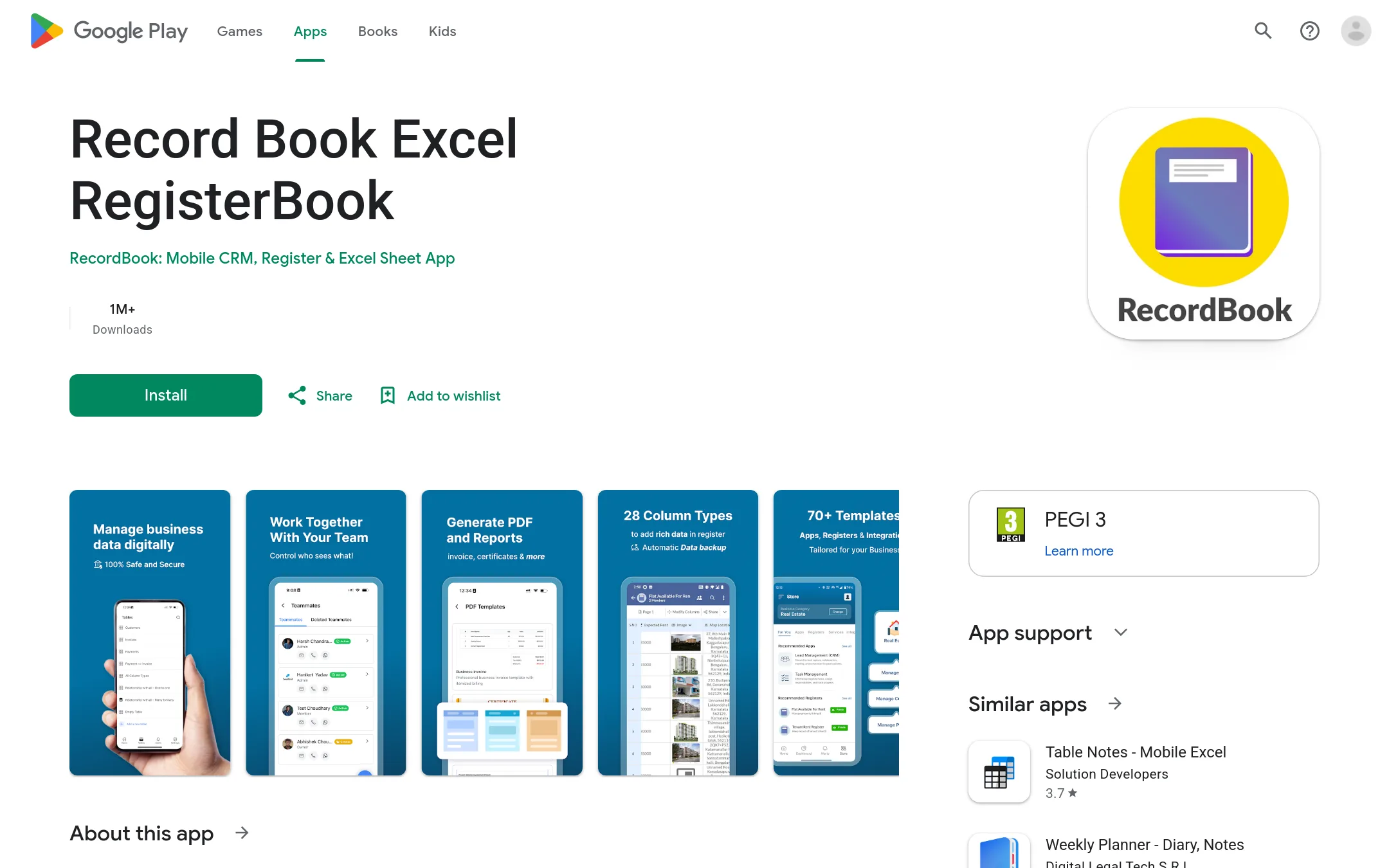
Best for: Small business owners who want to keep structured records and simple data on their phone rather than run analytics on a data warehouse
- Pricing
- Not published
- Category
- Productivity & Project Management
RecordBook is a Google Play app from the Rekord family that positions itself as an Airtable-style tool for small and medium businesses. It suits a founder who wants to track records and simple business data on a phone, rather than run analytics across a warehouse. It does not appear to offer the SQL, dashboards, or AI analysis that MinusX provides.
Where it is strong
- Mobile app available on Google Play
- Aimed at small and medium businesses
- Simple record tracking for non-technical users
Where it falls short
- Not a BI or analytics platform compared with MinusX
- No published pricing information found
- Pricing:
- Pricing is not published on the site.
- Custom quote
3.Hex
Best for: Data teams at companies that need enterprise security, governance and shared notebooks across many analysts
- Pricing
- Custom quote
- Category
- Analytics & Data
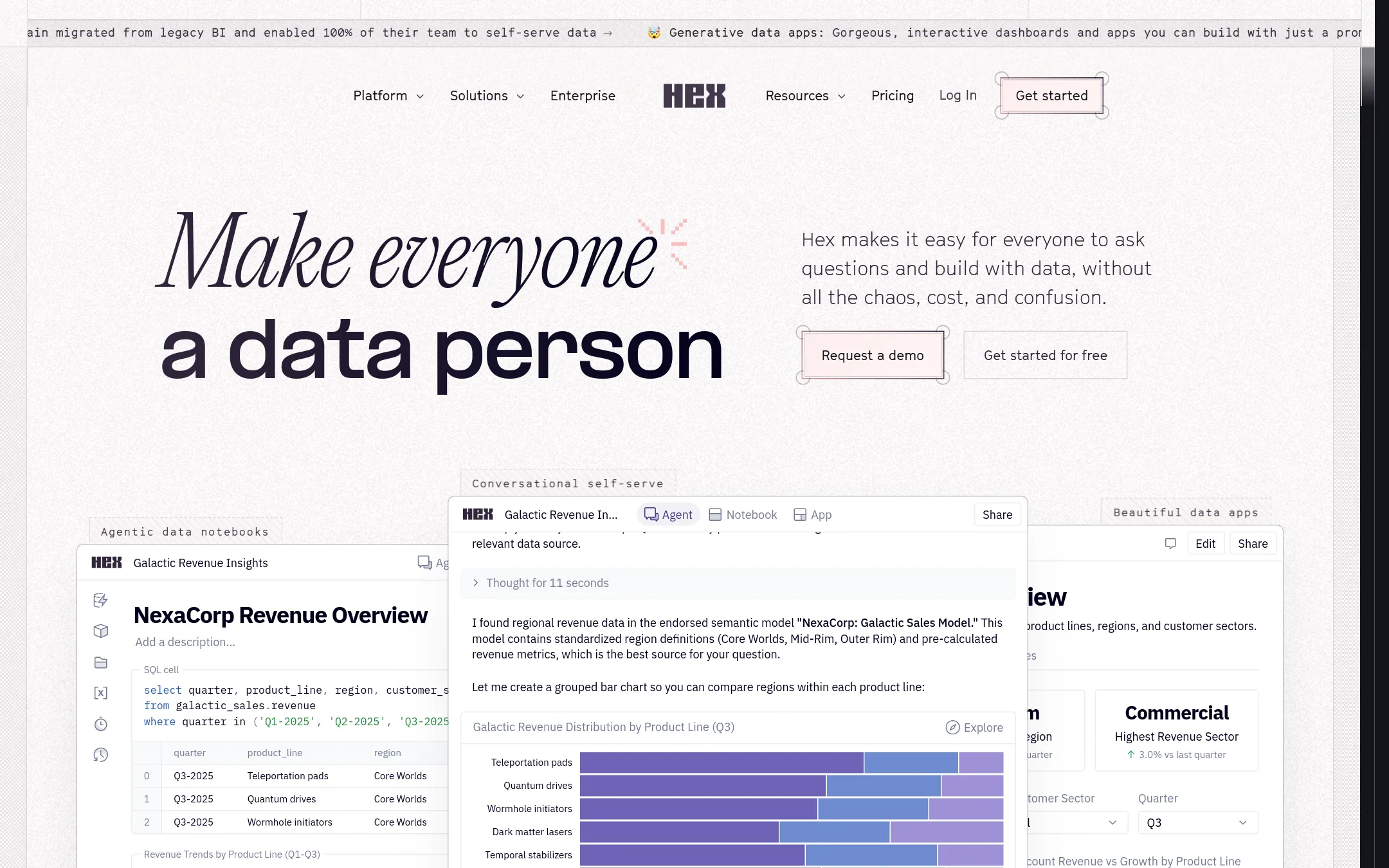
Hex is a collaborative analytics platform with notebooks, dashboards, data apps and AI agents for analysis, built for teams that want governance, enterprise security and a managed environment. Teams pick it over MinusX when they need enterprise-grade permissions, a managed platform with a Context Studio and Evals, and a broad set of collaboration features rather than a self-hosted or open source setup.
Where it is strong
- Notebooks, dashboards and data apps sit in one platform
- Context Studio and Evals show what people ask and whether answers are right
- Enterprise-grade security, governance and organization controls
Where it falls short
- Hosted only in the materials provided, with no self-hosting option mentioned
- Per-minute compute charges add cost for heavy data science work
- Pricing:
- Hex lists a free Community plan, Professional and Team plans, and Enterprise on request, with compute billed per minute beyond the included Medium profile, where an XL profile costs $0.65 per hour and an A10G GPU costs $4.06 per hour.
- Switching from MinusX:
- Moving from MinusX to Hex is not covered by the facts supplied, so no switching details are given.
- Not published
4.Mode
Best for: Data teams that want SQL, R and Python analysis alongside shared reporting for business users in one platform
- Pricing
- Not published
- Category
- Analytics & Data
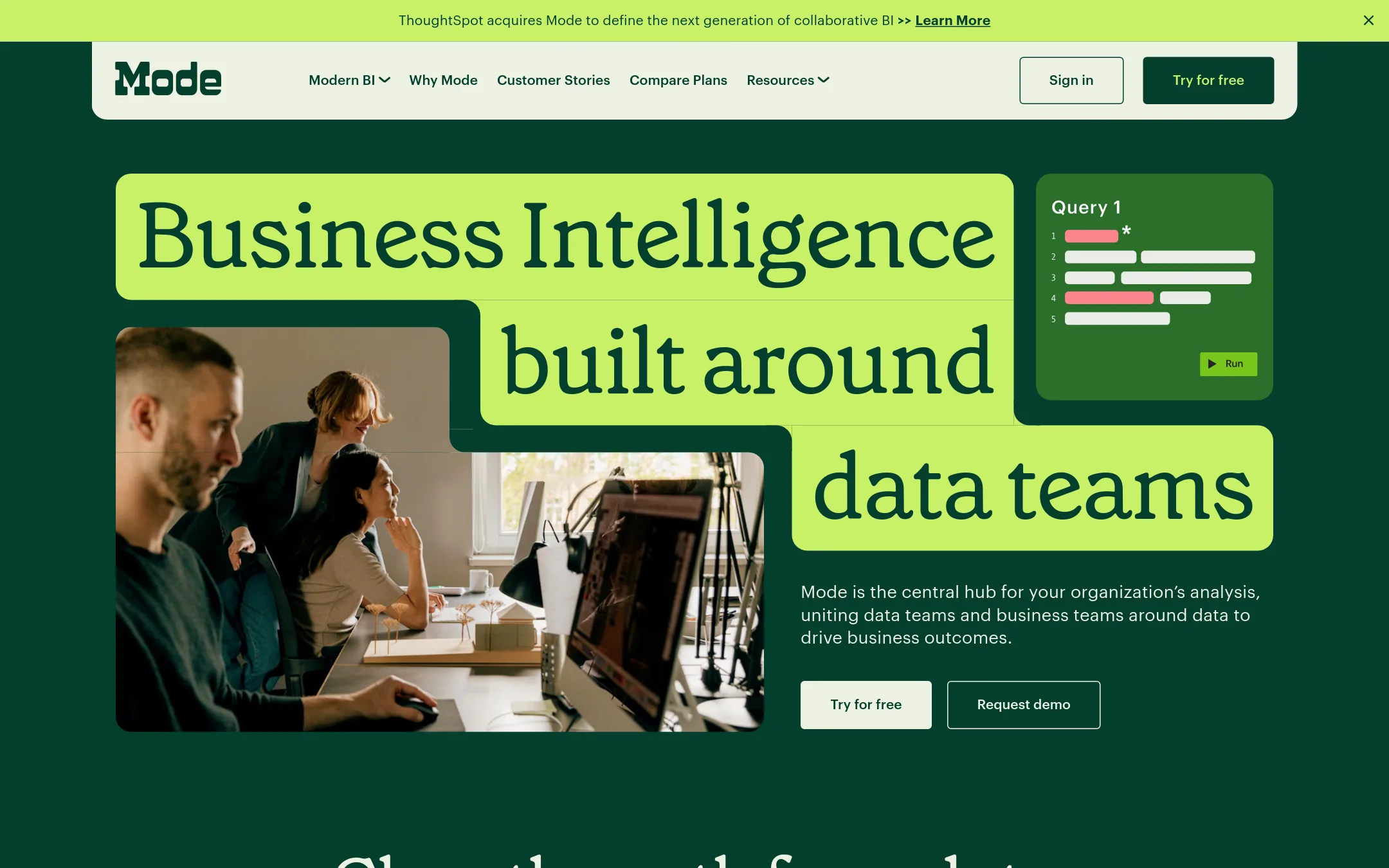
Mode is a collaborative BI platform where SQL, R, Python and visual analytics live together, so data teams can run ad hoc analysis and hand self-service reports to business users. Teams choose it over MinusX when they want a shared workspace built around their own analysts' code and queries, rather than an AI agent doing the analysis for them.
Where it is strong
- Combines SQL, R, Python and visual analytics in one place
- Lets analysts go deep while business users get self-service reports
- The homepage says a team can be up and running in 30 minutes or less
Where it falls short
- The site does not describe an AI agent comparable to MinusX's data agent
- No self-hosting option is mentioned on the site
- Pricing:
- Pricing is not published on the site.
- Free. Paid tiers vary
5.Julius
Best for: Non-technical founders and operators who want one AI workspace to analyze files, research topics and produce slides, reports or websites.
- Pricing
- Free. Paid tiers vary
- Category
- AI & Machine Learning
Julius is a general AI workspace that analyzes data and research, then also builds presentations, reports, dashboards, websites, images and video. Someone would pick it over MinusX when they want one tool for the whole pipeline from analysis to deck to website, rather than a BI platform built around a data agent for Metabase, Postgres and warehouses.
Where it is strong
- Covers analysis, presentations, dashboards, websites, images and video in one place
- Free plan includes daily credits to try the product before paying
- Business plan adds shared workspaces, audit logs and single sign-on
Where it falls short
- Data connectors to warehouses like Snowflake, BigQuery and Postgres appear only on higher tiers, and the free plan is limited to Google Driv
- Lacks MinusX's self-hosting option and open source core
- Pricing:
- Julius offers a free plan with 2,000 credits per month, a Plus plan for everyday work, a Pro plan for advanced analysis, and a Business plan for teams, with the Business tier's price listed on the pricing page only as a custom option. Exact monthly prices for
- Switching from MinusX:
- Moving from MinusX would involve re-creating dashboards and reconnecting your data sources in Julius, since the pricing and feature text does not describe a migration path.
- Not published
6.Databricks
Best for: Enterprise data and engineering teams that need one platform for pipelines, warehousing, governance and AI workloads.
- Pricing
- Not published
- Category
- Analytics & Data
Databricks is a unified data and AI platform for large organizations that need ETL, warehousing, governance and AI on one stack. Teams pick it over MinusX when they need to run data engineering and machine learning at scale, not just answer BI questions on top of existing databases.
Where it is strong
- Covers ETL, warehousing, governance and AI on one platform.
- Built for enterprise-scale data and machine learning workloads.
- Positioned as a data-centric approach to building AI on your own data.
Where it falls short
- Pricing details were not available in the supplied page text.
- Aimed at data teams, so it is heavier than a self-serve BI agent for a founder.
- Pricing:
- Pricing is not published on the site.
See more comparisons in Analytics & Data alternatives.
FAQ
Questions about MinusX alternatives
Is there a free option to compare against MinusX?
Metabase's open source edition can be self-hosted for free and includes unlimited questions, dashboards and data sources. Hex offers a free Community plan, and Julius has a free plan with 2,000 credits per month. MinusX's Open Source tier is also free forever for self-hosting, with you bringing your own LLM keys.
Which alternative is closest to MinusX if I want self-hosting?
Metabase is the closest match on self-hosting, since its open source edition runs in your own environment. Hex and Julius are hosted platforms, and the site materials provided do not mention a self-hosting option for either. Databricks is an enterprise platform aimed at large data teams rather than self-hosted BI for a small team.
Which tool is best if I am not technical?
Julius is aimed at non-technical founders and operators who want to analyze files, research topics and produce presentations, reports or websites in one workspace. RecordBook suits small business owners who want simple record tracking on a phone. MinusX itself also positions its SQL GUI and point-and-click query builder for users who do not write SQL.
How do I choose between Metabase and Hex for a data team?
Metabase suits teams that want self-hosted BI with a governed semantic layer and customer-facing embedded analytics. Hex suits teams that need enterprise security, governance and shared notebooks across many analysts in a managed environment. Metabase's AI answers depend on well-defined metrics, while Hex highlights Context Studio and Evals for checking answer quality.
Do these alternatives support the same data sources as MinusX?
The site materials show MinusX connecting to Postgres, BigQuery, CSVs and Google Sheets. Julius lists data connectors to warehouses such as Snowflake, BigQuery and Postgres, though these appear only on higher tiers and the free plan is limited to Google Drive. Check each product's current connector list before deciding, since the entries reflect only what was published on their sites.
Last updated November 21, 2026.