
Thunder Compute alternatives
6 products compared · Updated November 11, 2026
The short answer
Thunder Compute is a good fit for developers who want long-lived GPU instances and short, per-second GPU sandboxes for agents. The strongest alternatives are Modal for teams that need inference, RL rollouts and batch GPU jobs on one serverless platform, RunPod for teams running production inference endpoints or multi-GPU training with autoscaling, and E2B for teams building agents that need an isolated sandbox per session with network and secrets controls. Vast.ai and Lambda GPU Cloud suit teams with large batch or cluster training needs, and Daytona suits teams running AI-generated code in di
Your shortlist, at a glance
Read the comparisons ↓ Modal$0.001097/sec (H100)Teams that need inference, RL rollouts, and batch GPU jobs on one serverless platform with autoscaling from zero
- DDaytonaFrom $0.0504/vCPU-hrTeams running AI-generated code in disposable sandboxes that need a range of GPU types, including high-end ones.
 RunPodFrom $1.19/hr (GPU)Teams running production inference endpoints or multi-GPU training jobs that need autoscaling and a wide choice of GPU types
- LLambda GPU CloudFrom $0.69/hr (A10)AI labs and ML teams training or serving large models on dedicated multi-GPU clusters
 Vast.aiMarket rate, liveTeams running fault-tolerant batch training that can tolerate interruptions and want the lowest hourly GPU rates
- EE2B$150/mo + usageTeams building AI agents that run untrusted code or use tools, and that need a sandbox per session with network and secrets controls
About Thunder Compute and its alternatives
Thunder Compute is a GPU cloud that describes itself as the GPU sandbox company. According to its site, it offers persistent GPU instances for developers building AI, and isolated Ubuntu GPU sandboxes for agents running RL tasks, evals and CI jobs. Its known features include per-second billing for sandboxes, per-minute billing for instances, snapshots to keep disks between runs, and no data egress fees.
When comparing alternatives in this category, weigh the pricing structure first, since providers bill by the second, by the minute, by the hour or through a market, and the effective cost depends on how long your jobs run. Check which regions and GPU types are offered, whether the platform connects to the tools your team already uses, how support is delivered, and what the contract terms are for reserved or dedicated capacity.
Explore the alternatives
- $0.001097/sec (H100)
1.Modal
Best for: Teams that need inference, RL rollouts, and batch GPU jobs on one serverless platform with autoscaling from zero
- Pricing
- $0.001097/sec (H100)
- Category
- AI & Machine Learning
Modal is a general serverless platform for AI teams that run inference, training, sandboxes, and compute-heavy functions in Python. Teams choose it over Thunder Compute when they need more than GPU rentals, such as hosted model APIs, autoscaling to thousands of GPUs, or a single platform for both serving and batch jobs.
Where it is strong
- Autoscales from zero to thousands of GPUs without quota requests
- Hosted model APIs and training tools sit alongside sandboxes and functions
- Sandboxes can be created in large numbers and run concurrently
Where it falls short
- Per-second serverless billing can cost more than a flat hourly GPU rate for steady, always-on workloads
- Persistent long-lived GPU developer instances are not the main focus compared with Thunder Compute's instance product
- Pricing:
- Modal bills per second for resources, with an H100 SXM5 at $0.001097 per second and a Starter plan that includes $30 per month in free credits, while Thunder Compute lists H100 at $3.20 per hour.
- Switching from Thunder Compute:
- Moving from Thunder Compute means rewriting workloads around Modal's Python functions and sandboxes rather than moving a VM image, and the site does not describe a migration path.
- DFrom $0.0504/vCPU-hr
2.Daytona
Best for: Teams running AI-generated code in disposable sandboxes that need a range of GPU types, including high-end ones.
- Pricing
- From $0.0504/vCPU-hr
- Category
- Other
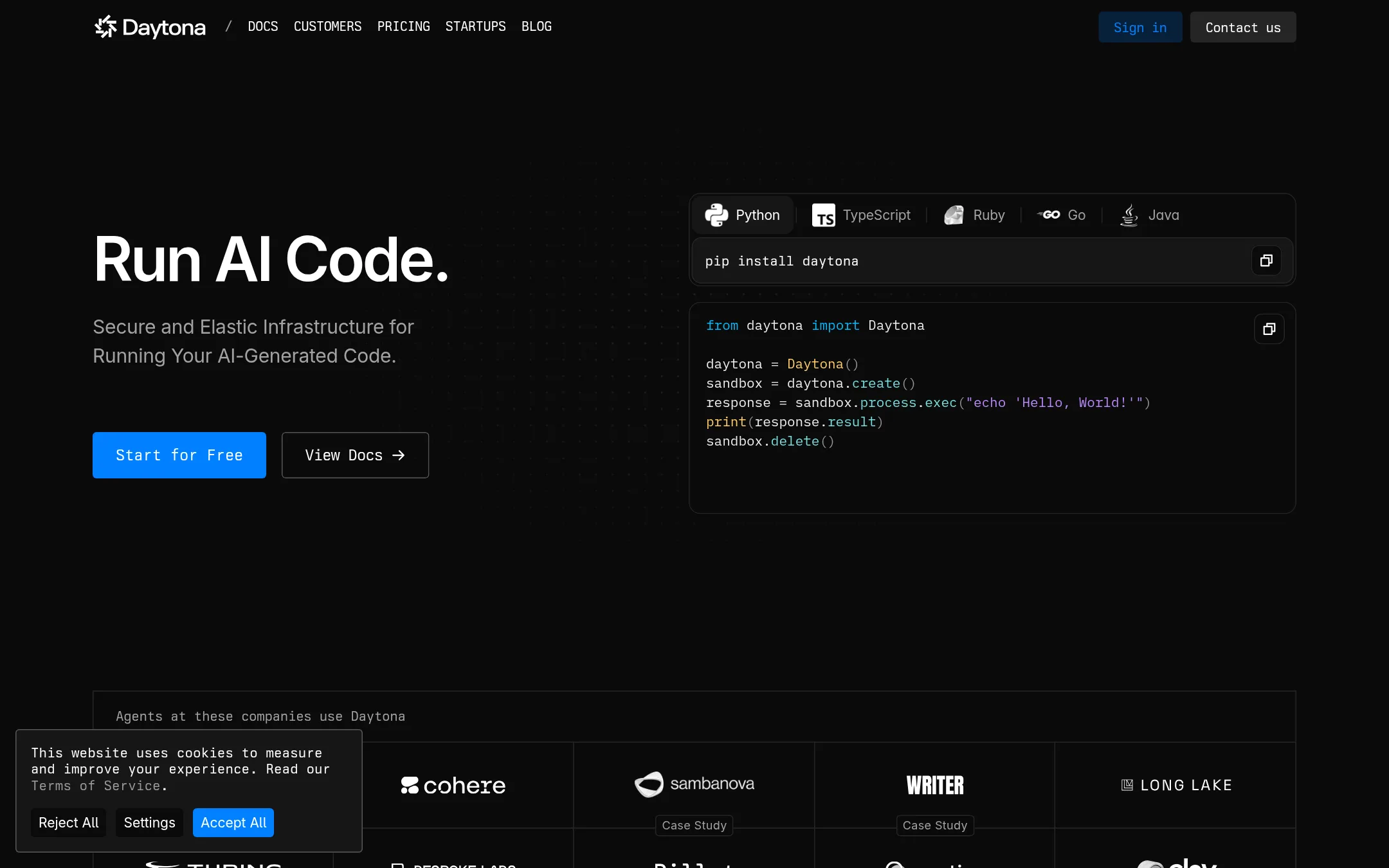
Daytona runs sandboxes for AI-generated code. It spins them up in milliseconds, with on-demand GPU options from L40S to B300 alongside CPU and memory billing. Choose it over Thunder Compute when you need fast, disposable sandboxes for agent code execution, or GPU types Thunder Compute's listed lineup does not show, such as the B200 or MI355X.
Where it is strong
- Sandboxes start in milliseconds and shut down just as fast.
- Offers GPUs from RTX 4090 to B300, with preemptible and on-demand options.
- Billing is per second, and startups can get up to $50k in credits.
Where it falls short
- Preemptible GPU capacity can be interrupted, while Thunder Compute's listed instances and sandboxes are never preempted.
- Daytona's public page does not describe persistent instances with snapshots the way Thunder Compute does.
- Pricing:
- Daytona bills compute per hour: vCPU at $0.0504/h, memory at $0.0162/GiB/h, and GPUs from $0.57/h for an RTX 4090 up to $4.08/h for a B300 on preemptible capacity, with $200 in free compute to start.
- From $1.19/hr (GPU)
3.RunPod
Best for: Teams running production inference endpoints or multi-GPU training jobs that need autoscaling and a wide choice of GPU types
- Pricing
- From $1.19/hr (GPU)
- Category
- AI & Machine Learning
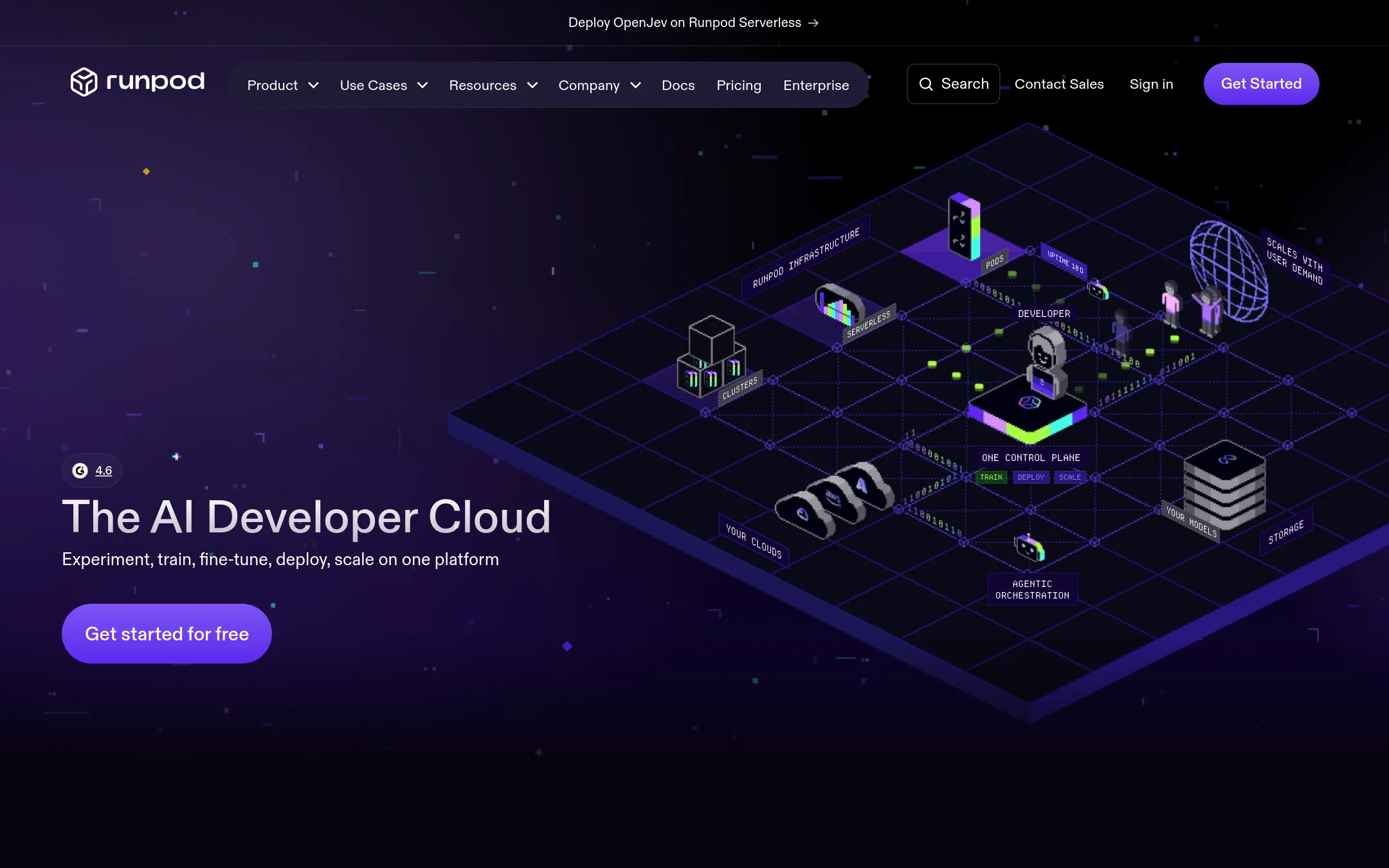
RunPod is a broad AI developer cloud with Pods for persistent GPU instances, Serverless endpoints that scale to zero for inference, and Clusters for multi-GPU training. Choose it over Thunder Compute when you need serverless inference with autoscaling, a wide GPU catalog across 30+ regions, or multi-node clusters, since Thunder Compute's focus is GPU sandboxes for agents and long-lived dev instances.
Where it is strong
- Serverless endpoints scale from zero to many workers and charge nothing while idle
- GPU catalog spans over 30 types across 30+ regions
- Clusters scale to 64 GPUs with shared storage, and reserved clusters are available for large enterprises
Where it falls short
- Pricing varies by cloud tier (Secure versus Community), so costs are harder to predict than a single rate
- Thunder Compute's per-second sandboxes for short isolated agent jobs are not the core product here
- Pricing:
- Pricing is not published as a single rate. The pricing page lists per-GPU-type rates for Pods, Serverless and Clusters, with example Secure Cloud H100 SXM at $3.99/hr and Community Cloud from $2.69/hr, and storage from $0.05/GB/mo.
- Switching from Thunder Compute:
- Moving from Thunder Compute would mean rebuilding your workflow around RunPod's Pods, Serverless handlers or Clusters, and moving any saved disk state into RunPod's storage options.
- LFrom $0.69/hr (A10)
4.Lambda GPU Cloud
Best for: AI labs and ML teams training or serving large models on dedicated multi-GPU clusters
- Pricing
- From $0.69/hr (A10)
- Category
- Other
Lambda runs single-tenant GPU clusters and on-demand instances, with NVIDIA B200, H100, A100 and newer hardware. Teams pick it when they need large dedicated clusters for training foundation models, serving inference at scale, or meeting strict isolation and SOC 2 requirements that Thunder Compute's shared sandboxes do not target.
Where it is strong
- Single-tenant clusters with hardware-level isolation and SOC 2 Type II certification
- Covers a wide range of GPUs, from A10 and A100 up to B200 and GB300 NVL72 systems
- Managed clusters and engineering support for distributed training workloads
Where it falls short
- Per-second sandbox billing for short RL rollouts is not offered, so small bursty jobs fit less well
- Cluster and reserved capacity pricing requires contacting sales for the lowest rates
- Pricing:
- Pricing is published by GPU type, with on-demand instances listed per hour and cluster rates per GPU per hour that drop for longer commitments, for example NVIDIA HGX B200 clusters from $9.86 per GPU per hour on short terms.
- Switching from Thunder Compute:
- Moving from Thunder Compute to Lambda means recreating your environment on Lambda's instances or clusters, since no migration path is described in the supplied facts.
- Market rate, live
5.Vast.ai
Best for: Teams running fault-tolerant batch training that can tolerate interruptions and want the lowest hourly GPU rates
- Pricing
- Market rate, live
- Category
- AI & Machine Learning
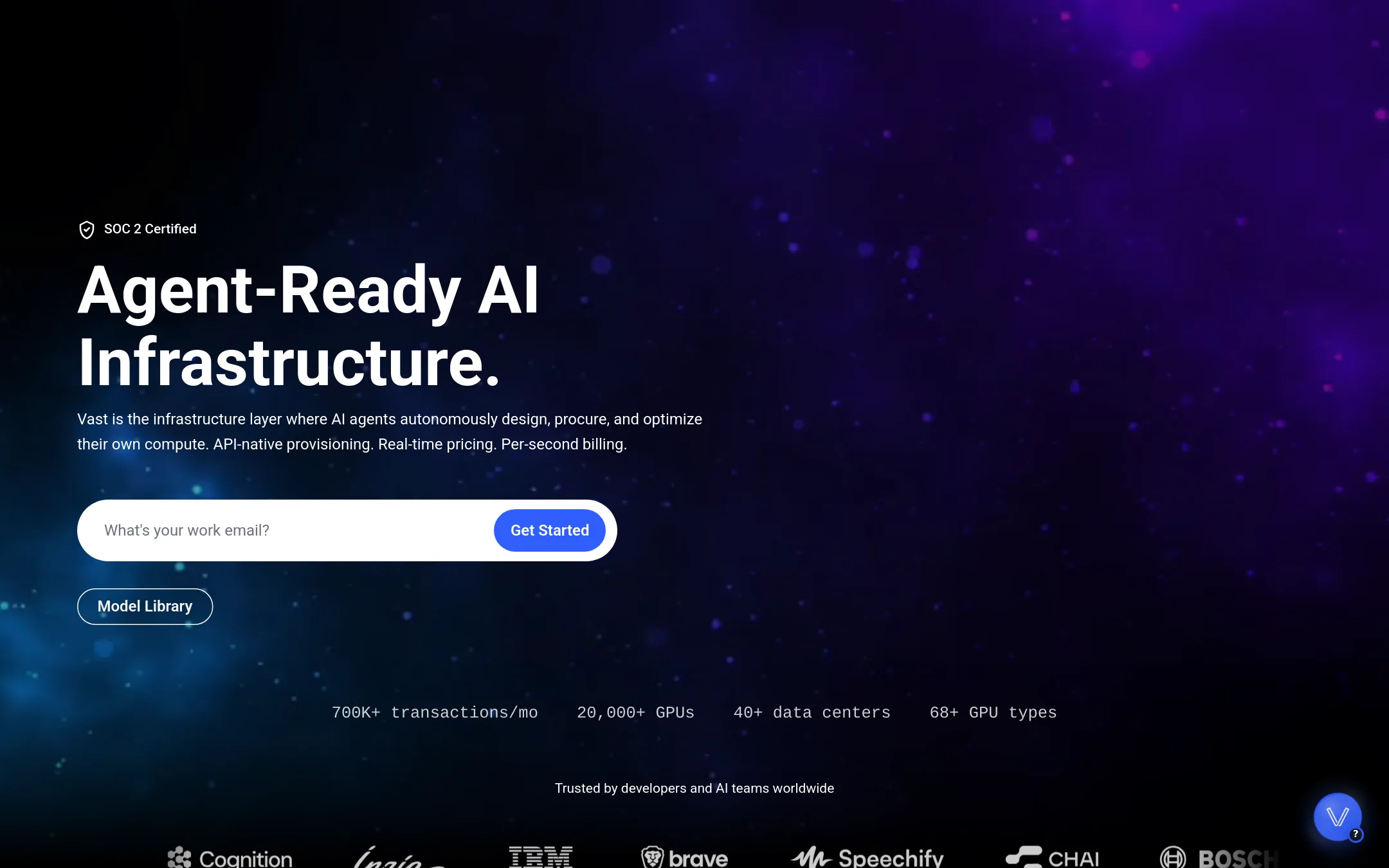
Vast.ai is a GPU marketplace where prices move with supply and demand across more than 40 data centers, and you can provision everything through an API or CLI. Someone would pick it over Thunder Compute when they want the widest range of GPU types, including cheap interruptible capacity for batch training, or when they want multi-node clusters with InfiniBand for large training runs.
Where it is strong
- Over 68 GPU types, from RTX 3060 to B200, so you can match hardware to the job
- Per-second billing with no minimum hours and no rounding up
- Serverless endpoints and multi-node clusters with InfiniBand, not only single instances
Where it falls short
- Interruptible instances can be reclaimed, so they suit only checkpointed, fault-tolerant work
- Its sandbox-style, per-second RL environment offering is not the focus the way it is for Thunder Compute's GPU sandboxes
- Pricing:
- Vast.ai does not publish a single fixed rate. Prices are set by market supply and demand and shown live per GPU, with on-demand, interruptible and reserved tiers, while the page lists no specific numbers in the text provided.
- E$150/mo + usage
6.E2B
Best for: Teams building AI agents that run untrusted code or use tools, and that need a sandbox per session with network and secrets controls

- Pricing
- $150/mo + usage
- Category
- Other
E2B runs an isolated Linux microVM for each AI agent session, with an API for running code, controlling network access, keeping files, holding secrets, and pausing or forking the sandbox. Teams choose it over Thunder Compute when the agent workload is the main concern (coding agents, computer-use agents, evals, RL rollouts) and they need strong isolation and network policy rather than long-lived GPU machines for hands-on development.
Where it is strong
- Each agent session gets its own microVM with a dedicated kernel, booted from a snapshot
- Egress policy and a secrets vault let agents call APIs without reading the keys
- Can run in E2B Cloud, your own AWS, GCP or Azure account, or self-hosted on one node
Where it falls short
- It is built for agent sandboxes, so it does not offer persistent GPU instances for hands-on ML development the way Thunder Compute does
- Enterprise and BYOC options require a custom sales conversation
- Pricing:
- Pricing is billed per second of sandbox runtime, with a free Hobby tier that includes $100 in one-time credits and sessions up to 1 hour, a Pro plan at $150 per month plus usage, and custom Enterprise pricing.
- Switching from Thunder Compute:
- Moving from Thunder Compute means rebuilding the workflow around E2B's sandbox API and SDK rather than SSH-ing into a long-lived GPU machine, and snapshot storage on Thunder Compute does not carry over automatically.
See more comparisons in Other alternatives.
FAQ
Questions about Thunder Compute alternatives
Who is Thunder Compute best suited for?
Thunder Compute suits developers who want persistent GPU instances for hands-on work and short, isolated GPU sandboxes for agents, evals and CI. Its pricing is per minute for instances and per second for sandboxes, with snapshots to keep disks between runs. Teams that need a full inference platform or large dedicated clusters may find the alternatives below a better match.
Which alternative should I choose if I need serverless inference and batch GPU jobs?
Modal is the strongest fit for that case. It bills per second, autoscales from zero to thousands of GPUs, and offers hosted model APIs alongside sandboxes and functions. RunPod is a close second if you need serverless endpoints that charge nothing while idle and a wide catalog of GPU types across more than 30 regions.
Which option works best for AI agents that run untrusted code?
E2B is built for this case. It gives each agent session its own microVM with a dedicated kernel, and it includes egress policy and a secrets vault so agents can call APIs without reading the keys. Daytona is another option, with millisecond sandbox startup and a range of GPU types, though its preemptible GPU capacity can be interrupted.
Which alternative has the lowest hourly GPU cost, and what is the trade-off?
Vast.ai usually offers the lowest rates, because prices move with supply and demand across more than 40 data centers and it lists over 68 GPU types. The trade-off is that interruptible instances can be reclaimed, so they suit only checkpointed, fault-tolerant training. Lambda GPU Cloud is the choice when you need single-tenant clusters with SOC 2 Type II certification, and its lowest cluster rates require contacting sales.
When should I consider Lambda or another provider over Thunder Compute for large training?
Lambda is designed for AI labs and ML teams training or serving large models on dedicated multi-GPU clusters, including B200 and GB300 NVL72 systems. Thunder Compute's listed offering centers on per-minute instances and per-second sandboxes rather than large dedicated clusters. Teams that need strict isolation or managed distributed training should compare Lambda's cluster options against Thunder Compute's pricing directly.
Last updated November 11, 2026.