12 Best Business Intelligence Platforms in 2026
Updated October 15, 2026
The short answer
For most teams, the strongest picks are Microsoft Power BI for organizations already in the Microsoft 365 ecosystem, ThoughtSpot for enterprises needing governed AI-driven analytics with embedding, and Metabase for startups and engineering teams wanting a self-hosted, open-source BI tool. Power BI suits Microsoft-centric organizations, ThoughtSpot fits large enterprises, and Metabase is ideal for cost-conscious, technical teams.
The shortlist, at a glance
Read the comparisons ↓ 42From $1,000/moOmnichannel retail brands and fashion/lifestyle companies that need a single source of truth for merchandising, planning, and AI initiatives.
 LightdashFrom $3000/mo (Pro)Data teams using dbt that want a governed, AI-assisted BI layer without paying per user.
 BluelightCustom quoteServiceTitan operators in the trades who want live budget tracking and morning huddle metrics without building their own dashboards.
 LookerNot publishedEnterprises on Google Cloud that need governed, consistent metrics across self-service BI and embedded analytics.
 Microsoft Power BINot publishedTeams inside Microsoft 365 who want AI-assisted reporting and embedded dashboards in the apps they already use.
 ThoughtSpotFrom $25/user/moEnterprises that need governed, AI-driven analytics across teams and want to embed insights into their own applications.
DomoCustom credit pricingTeams that want a governed data platform with AI agents and automation, not just dashboards, and need to scale usage across unlimited users.
 Qlik SenseNot publishedTeams that need on-prem analytics and want to combine data from several internal systems without moving to the cloud.
 AlteryxFrom $250/user/moEnterprise teams that need governed, repeatable data workflows and AI automation across finance, supply chain, and operations.
 MetabaseFree, usage-based add-Startups and engineering teams that want a self-hosted, open source BI tool with AI-powered querying and embedded dashboards.
 ModeNot publishedData teams that need to run complex ad hoc analysis in SQL, R, or Python while also delivering self-service dashboards to the rest of the company.
 HolisticsNot publishedData teams that want to ship BI like software, with version control and a governed semantic layer for AI-assisted self-service.
About Business Intelligence Platforms
Business intelligence platforms are software tools that connect to your data sources, let you query and visualize data, and share dashboards and reports. They help teams track metrics, spot trends, and make decisions based on facts rather than gut feel.
The products on this list differ in approach, scale, and pricing. Some, like Metabase and Lightdash, are open source and self-hosted, while others like Power BI and Looker are enterprise cloud platforms. Pricing varies from free or usage-based to custom quotes, and some tools are built for specific industries, like Bluelight for ServiceTitan users or 42 for retail.
The 12 best Business Intelligence Platforms, compared
- From $1,000/mo
1.42
Best for: Omnichannel retail brands and fashion/lifestyle companies that need a single source of truth for merchandising, planning, and AI initiatives.
- Pricing
- From $1,000/mo
- Category
- Analytics & Data
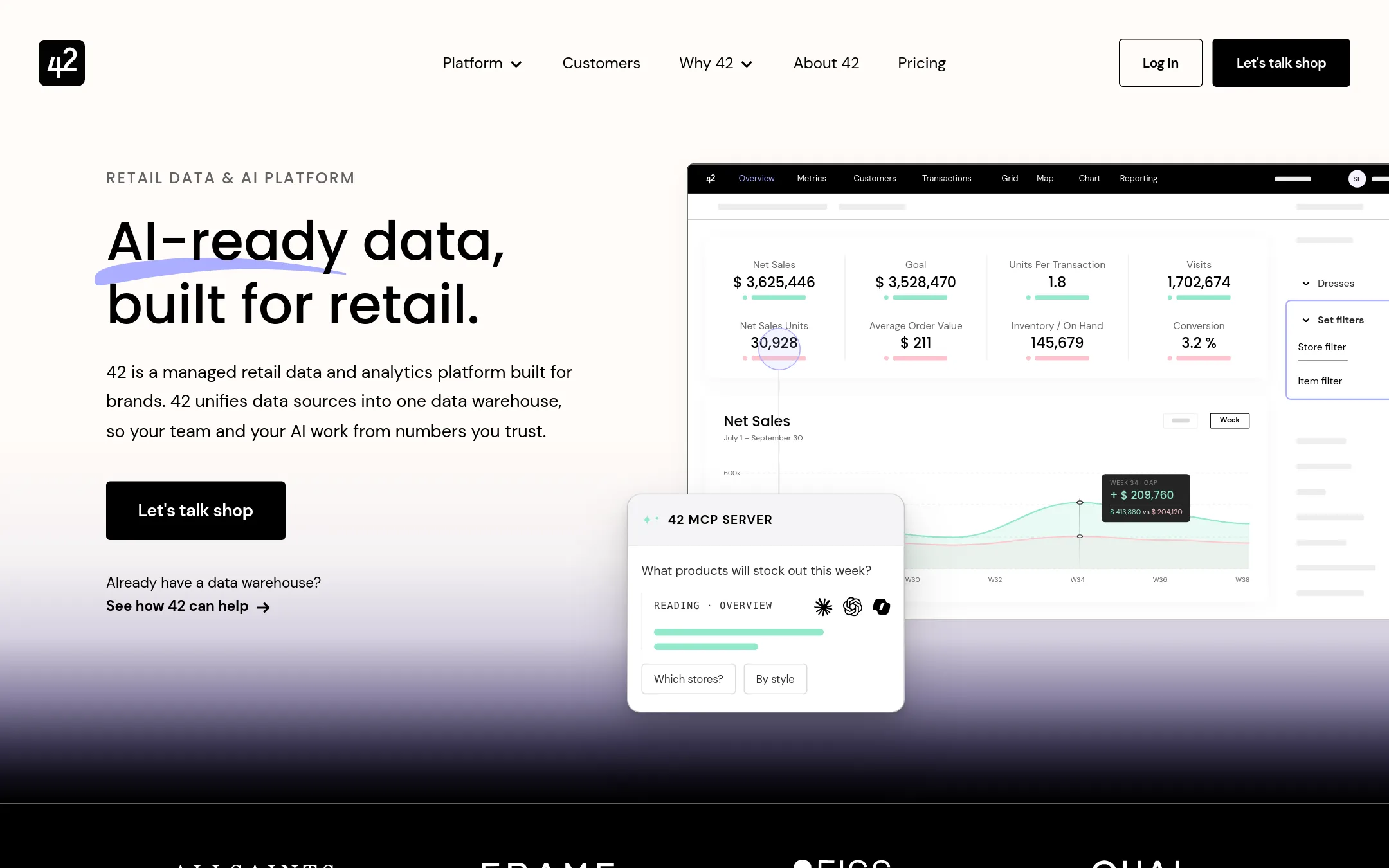
42 is a managed retail data and analytics platform that unifies data from ecommerce, POS, ERP, and marketplaces into one warehouse with a retail semantic layer. It is credible because it comes with 10+ years of retail data engineering and pre-built connections for over 100 brands, so teams get agreed metrics like sell-through without rebuilding logic. The platform also serves data to AI tools via an MCP server, so ChatGPT or Claude read the same numbers as your dashboards.
Where it is strong
- Pre-built retail metrics and definitions for sell-through, markdown, and attribution
- Connects to major retail sources like Shopify, NetSuite, Amazon, and Nordstrom
- Includes managed ETL and data warehouse hosting, so you don't build or maintain pipelines
Where it falls short
- Pricing is not transparent for larger plans, requiring a sales call
- May be overkill for small brands with simple reporting needs
- Pricing:
- Pricing starts at $1,000 per month for Shopify eCommerce with up to 10K orders and 10 users. Larger plans with DTC, wholesale, and unlimited orders require contacting sales.
- From $3000/mo (Pro)
2.Lightdash
Best for: Data teams using dbt that want a governed, AI-assisted BI layer without paying per user.

- Pricing
- From $3000/mo (Pro)
- Category
- Analytics & Data
Lightdash is an open-source BI platform built for teams that already use dbt. It lets you define metrics once in a governed semantic layer and then explore or build dashboards without per-seat pricing. The AI agents can build and refactor dashboards, and the platform supports BI-as-code with version control and CI/CD.
Where it is strong
- Unlimited users on paid plans, no per-seat cost
- Native dbt integration with a governed semantic layer
- BI-as-code with version control, testing, and CI/CD
Where it falls short
- Cloud Pro at $3000/month is a steep entry for small teams
- Self-hosted option requires managing your own infrastructure
- Pricing:
- Open source self-hosted is free. Cloud Pro is $3000 per month with unlimited users. Enterprise is custom quote.
- Custom quote
3.Bluelight
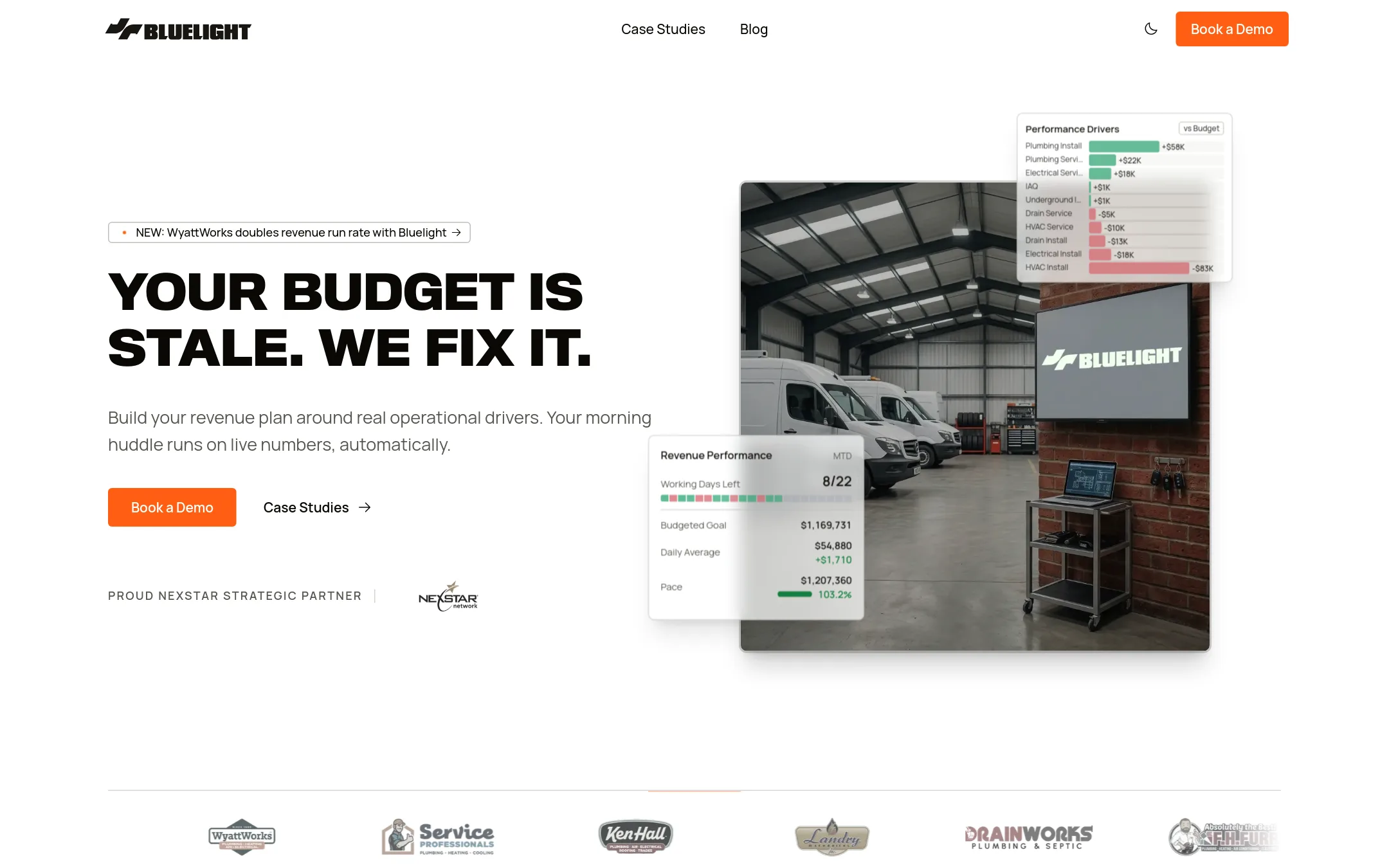
Best for: ServiceTitan operators in the trades who want live budget tracking and morning huddle metrics without building their own dashboards.
- Pricing
- Custom quote
- Category
- Analytics & Data
Bluelight is a revenue planning and live performance tracking tool built specifically for ServiceTitan operators. It connects directly to operational data so morning huddles run on real-time budgeted goals, daily averages, and driver-level variances across plumbing, electrical, HVAC and related services. It is a credible pick because it is a Nexstar Strategic Partner and deployment involves two calls with no upfront setup fee.
Where it is strong
- Live ServiceTitan revenue dashboards
- Driver-level performance vs budget
- No-code custom metric support
Where it falls short
- Pricing is not published, so you must request a quote
- Built only for ServiceTitan, so not for teams using other field service software
- Pricing:
- Pricing is not published on the site. You request a free quote and Bluelight contacts you with tailored pricing.
- Not published
4.Looker
Best for: Enterprises on Google Cloud that need governed, consistent metrics across self-service BI and embedded analytics.
- Pricing
- Not published
- Category
- Analytics & Data
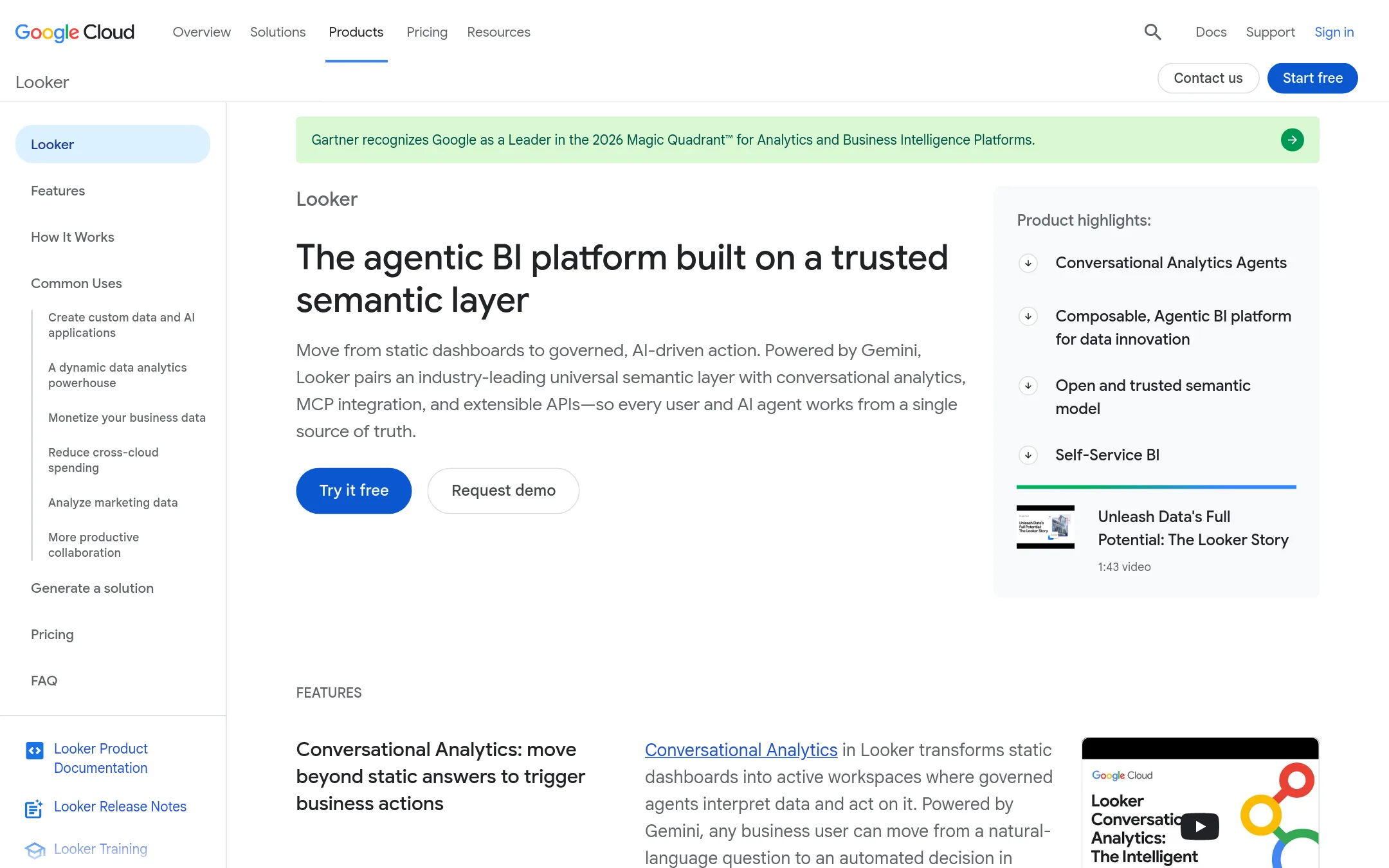
Looker is an enterprise BI platform that uses a LookML semantic layer to keep metrics consistent across dashboards and embedded analytics. It includes Gemini-powered conversational agents for natural language queries and integrates with Google Cloud services like BigQuery and IAM. This makes it a credible choice for teams already on Google Cloud who need governed, AI-assisted analytics.
Where it is strong
- LookML semantic layer ensures consistent metric definitions across all reports.
- Gemini agents allow conversational, natural language data exploration.
- Embedded analytics via APIs and SDKs for custom data experiences.
Where it falls short
- Pricing is not published, so budgeting requires contacting sales.
- Steep learning curve for LookML modeling, not ideal for small teams without data engineering skills.
- Pricing:
- Pricing is not published on the site.
- Not published
5.Microsoft Power BI
Best for: Teams inside Microsoft 365 who want AI-assisted reporting and embedded dashboards in the apps they already use.
- Pricing
- Not published
- Category
- Analytics & Data
Microsoft Power BI is a unified business intelligence platform for self-service analytics and enterprise-scale reporting. It connects data from any source into OneLake, embeds visuals in Microsoft 365 apps like Teams and Excel, and uses Copilot for AI-powered report creation and DAX queries. Its enterprise governance and petabyte scalability make it a credible pick for organizations already on Microsoft infrastructure.
Where it is strong
- Copilot helps create reports and write DAX queries
- Embed visuals directly into Teams, Excel, and other Microsoft 365 apps
- Scales to petabytes with end-to-end governance and compliance
Where it falls short
- No public pricing, so budgeting requires a sales call
- Heavy reliance on Microsoft ecosystem may not suit non-Microsoft shops
- Pricing:
- Pricing is not published on the site.
- From $25/user/mo
6.ThoughtSpot
Best for: Enterprises that need governed, AI-driven analytics across teams and want to embed insights into their own applications.
- Pricing
- From $25/user/mo
- Category
- Analytics & Data
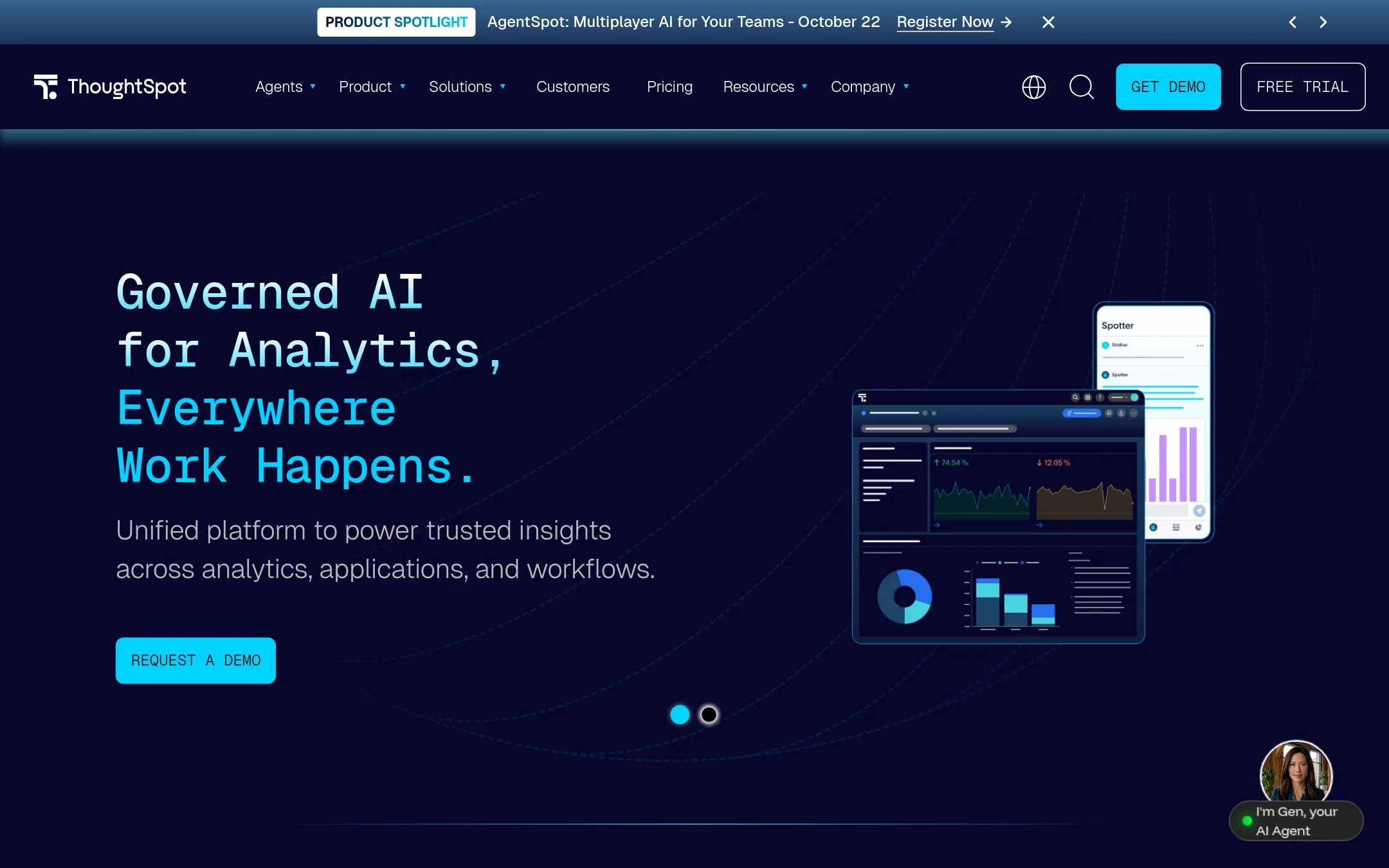
ThoughtSpot is an agentic analytics platform that uses AI agents to answer natural language questions on live data. It includes a governed semantic layer, so answers stay grounded in verified business definitions. It is a credible pick because it is named a 2026 Gartner Leader and supports embedding analytics into other apps with a developer SDK.
Where it is strong
- Natural language search with governed answers
- Spotter AI agents with unlimited LLM tokens on Pro
- Embedded analytics with API and SDK
Where it falls short
- Essentials plan may have limited features
- Enterprise pricing is custom, not published
- Pricing:
- Developer plan starts at $25 per user per month billed annually, Essentials is free, Pro is $50 per user per month billed annually, and Enterprise has custom pricing.
- Custom credit pricing
7.Domo
Best for: Teams that want a governed data platform with AI agents and automation, not just dashboards, and need to scale usage across unlimited users.
- Pricing
- Custom credit pricing
- Category
- Analytics & Data
Domo connects 1,000+ data sources and prepares data with drag-and-drop ETL, then layers on AI agents, conversational AI, and automation. It is credible because it combines BI, low-code apps, embedded analytics, and governance in one platform, and it won six 2025 Technology Innovation Awards. Pricing is credit-based, so you pay for actual usage rather than per user.
Where it is strong
- Unlimited users with no per-user charges
- 1,000+ data connectors and drag-and-drop ETL
- Built-in AI agents, conversational AI, and automation
Where it falls short
- Pricing is custom and credit-based, so costs are not transparent upfront
- May be overkill for small teams that only need basic reporting
- Pricing:
- Domo offers a 30-day free trial with no credit card required, then custom credit-based pricing where you pay for what you use, with volume discounts and support packages available.
- Not published
8.Qlik Sense
Best for: Teams that need on-prem analytics and want to combine data from several internal systems without moving to the cloud.
- Pricing
- Not published
- Category
- Analytics & Data
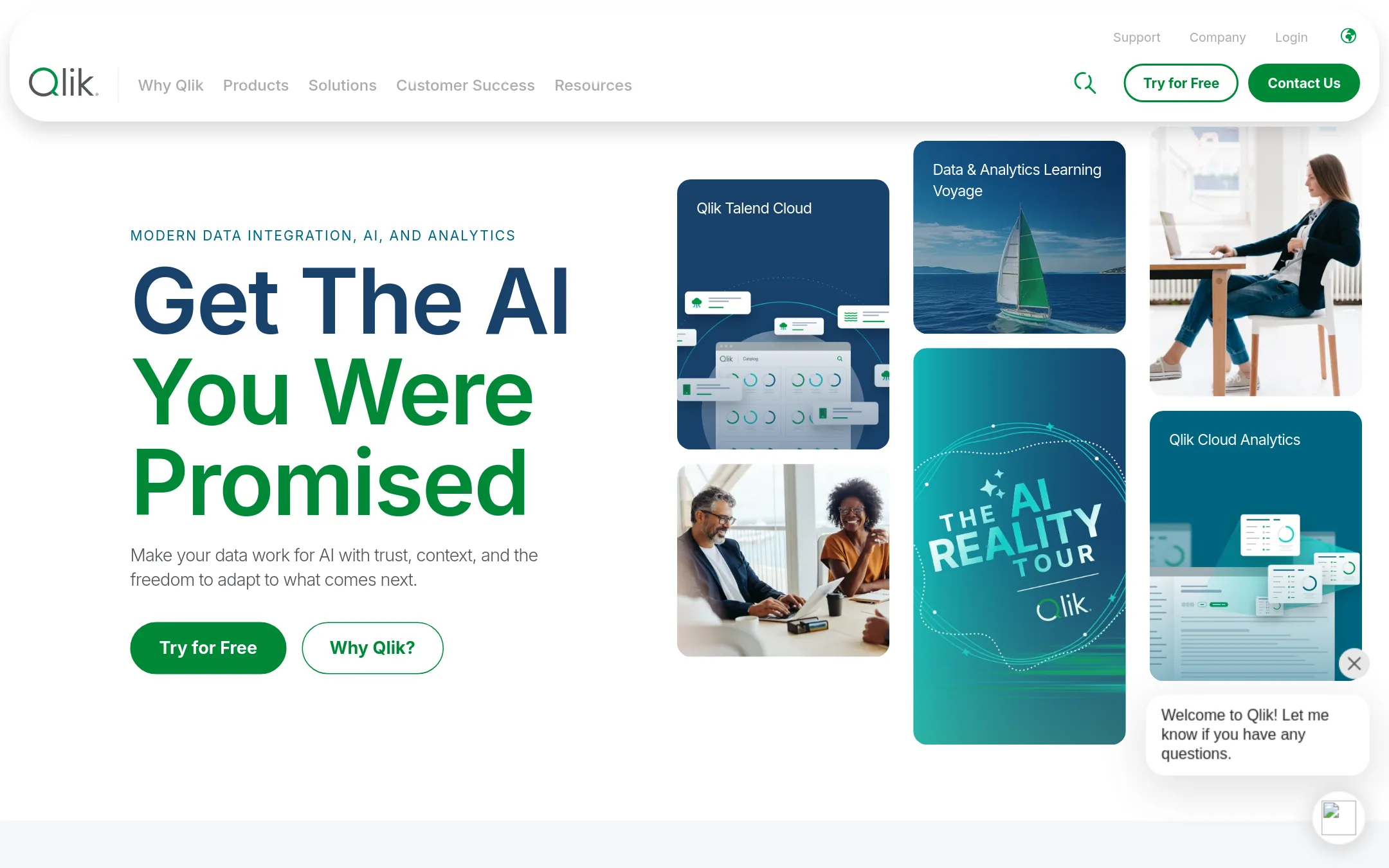
Qlik Sense is an on-prem analytics platform that pulls data from multiple systems into one view. It covers visualizations, dashboards, reporting, and embedded analytics, and now sits inside Qlik's broader data fabric with Talend. That makes it a credible pick for teams that need analytics close to their own infrastructure and want a path into AI-ready data.
Where it is strong
- Runs on-prem, so data stays inside your infrastructure
- Combines data from multiple systems in one analytics view
- Includes reporting and embedded analytics alongside dashboards
Where it falls short
- No cloud deployment option in this product line
- Pricing is not public, so you will need to contact sales
- Pricing:
- Pricing is not published on the site.
- From $250/user/mo
9.Alteryx
Best for: Enterprise teams that need governed, repeatable data workflows and AI automation across finance, supply chain, and operations.
- Pricing
- From $250/user/mo
- Category
- Analytics & Data
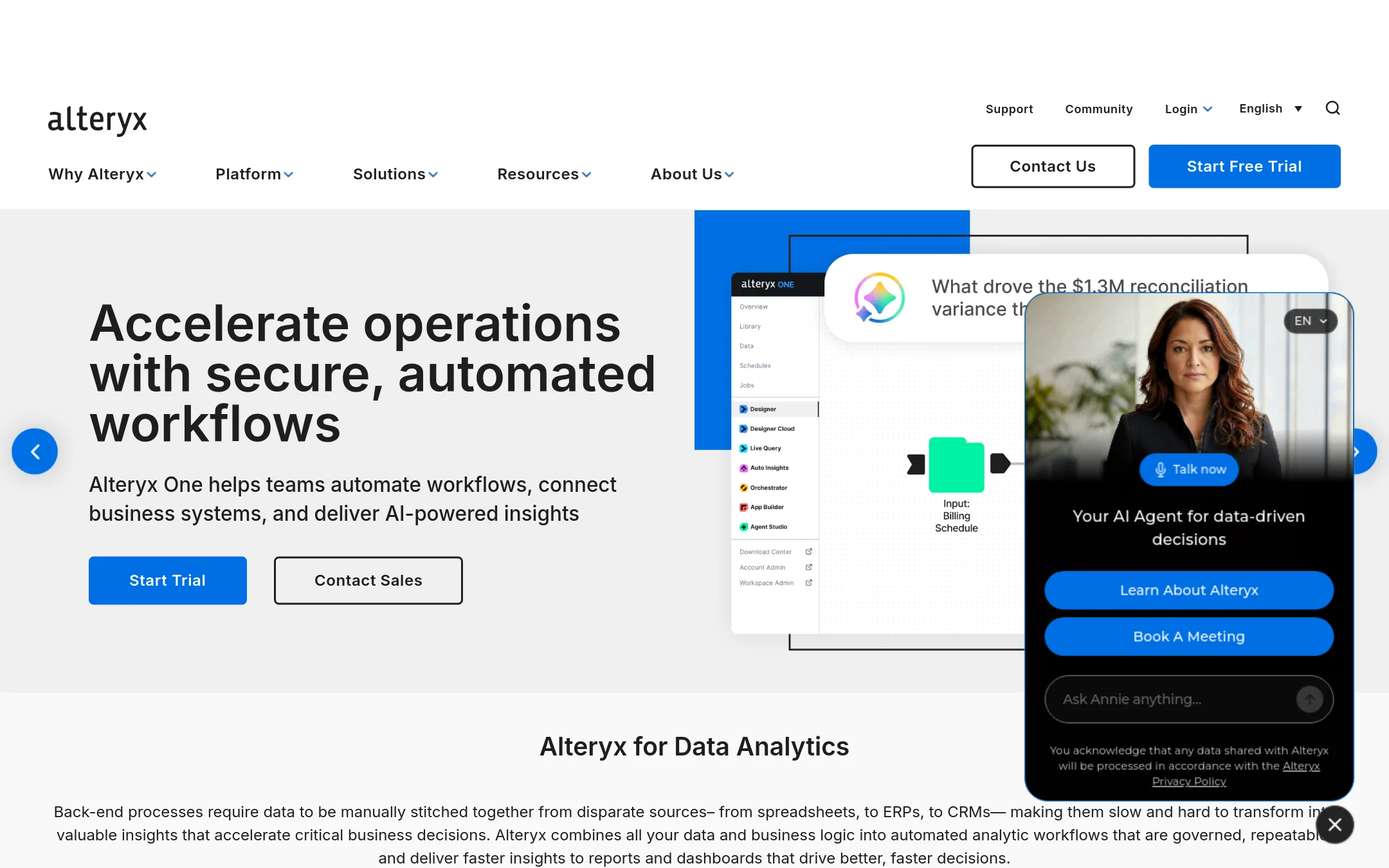
Alteryx One automates data workflows and delivers AI-powered insights. It is credible because it is trusted by 8,000+ global enterprises and rated a leader in multiple 2026 analyst evaluations. The platform reduces AI token consumption by over 90% by cleaning and routing data before it reaches expensive models.
Where it is strong
- No-code visual workflows for data prep and blending
- Push-down processing into Snowflake, Databricks, and Google BigQuery
- VURA framework makes every workflow visible, understandable, repeatable, and auditable
Where it falls short
- Starter Edition is cloud-only and lacks advanced features like geospatial and macros
- Pricing for Professional and Enterprise editions is not published, requiring sales contact
- Pricing:
- Starter Edition is $250 per user per month billed annually. Professional and Enterprise editions require contacting sales for pricing.
- Free, usage-based add-
10.Metabase
Best for: Startups and engineering teams that want a self-hosted, open source BI tool with AI-powered querying and embedded dashboards.
- Pricing
- Free, usage-based add-
- Category
- Analytics & Data
Metabase is an open source business intelligence platform that lets teams query data in plain English with AI, build interactive dashboards, and embed analytics into their own apps. It grounds every answer in a semantic layer of metrics and business logic, so you can inspect the query behind each result. With support for 20+ data sources and self-hosted or cloud deployment, it's a credible pick for startups and engineers who want fast setup and full control.
Where it is strong
- AI querying in plain English on all plans
- Self-host or use cloud, deploy in minutes
- Granular permissions and SSO for security
Where it falls short
- Advanced embedding features only on Pro and Enterprise
- Usage-based pricing for AI and transforms can get complex
- Pricing:
- Open Source plan is free, Starter and Pro plans have usage-based pricing for AI ($3.75 per 1M tokens) and transforms ($0.01 per run after 1,000 included), storage starts at $2 per 1M rows, and Enterprise is custom.
- Not published
11.Mode
Best for: Data teams that need to run complex ad hoc analysis in SQL, R, or Python while also delivering self-service dashboards to the rest of the company.
- Pricing
- Not published
- Category
- Analytics & Data
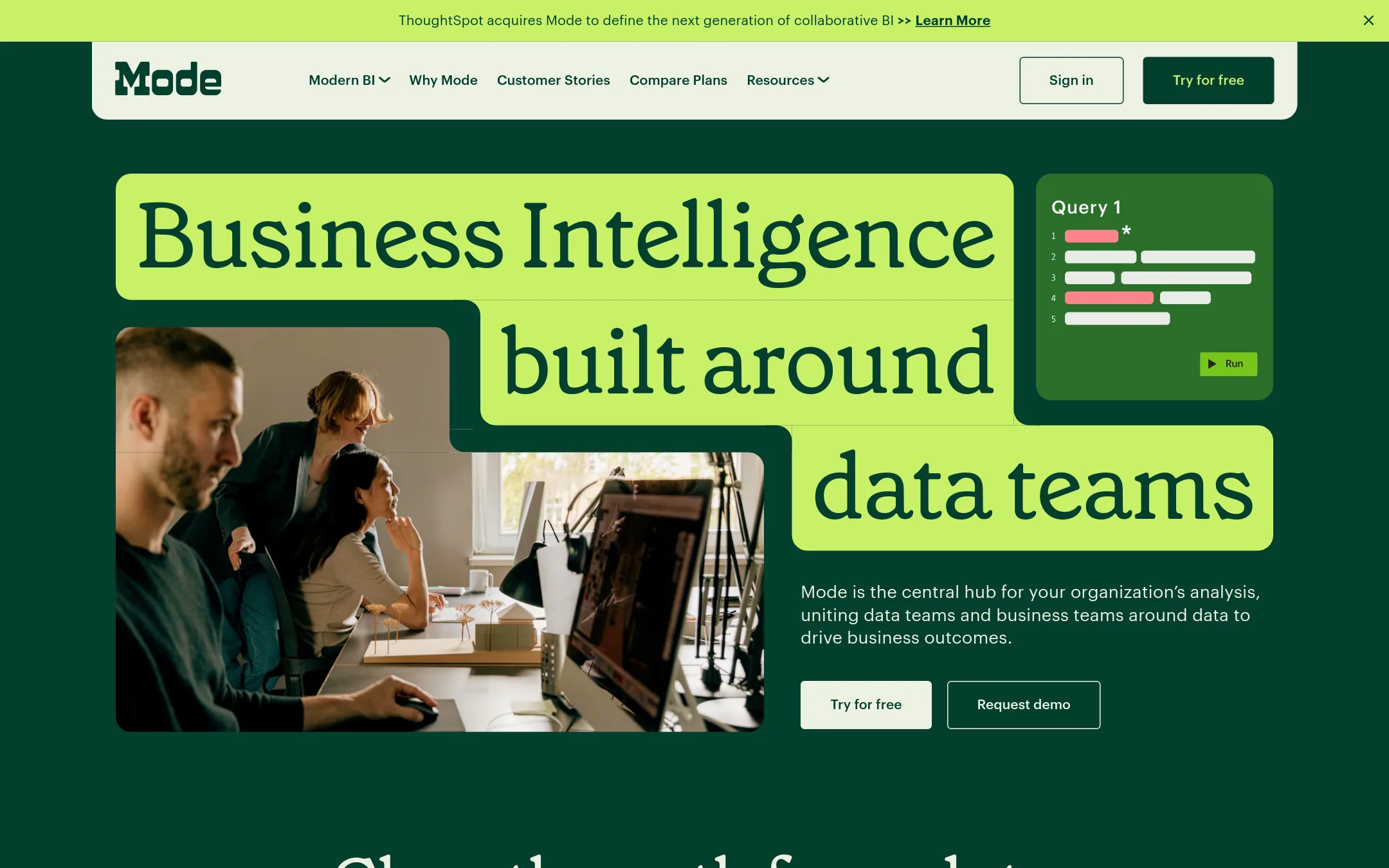
Mode is a collaborative data platform that combines SQL, R, Python, and visual analytics in one place. It is built around data teams, letting them do deep ad hoc analysis while also giving business users simple self-service reporting. The platform includes a SQL editor, integrated notebooks, and governed datasets, making it a credible pick for teams that want both flexibility and control.
Where it is strong
- Combines SQL, R, Python, and visual analytics in one platform.
- Supports both deep ad hoc analysis and self-service reporting.
- Includes governed datasets and AI Assist for faster insights.
Where it falls short
- Pricing is not published, so budgeting requires a sales call.
- May be overkill for teams that only need simple dashboards and no code.
- Pricing:
- Pricing is not published on the site.
- Not published
12.Holistics
Best for: Data teams that want to ship BI like software, with version control and a governed semantic layer for AI-assisted self-service.
- Pricing
- Not published
- Category
- Analytics & Data
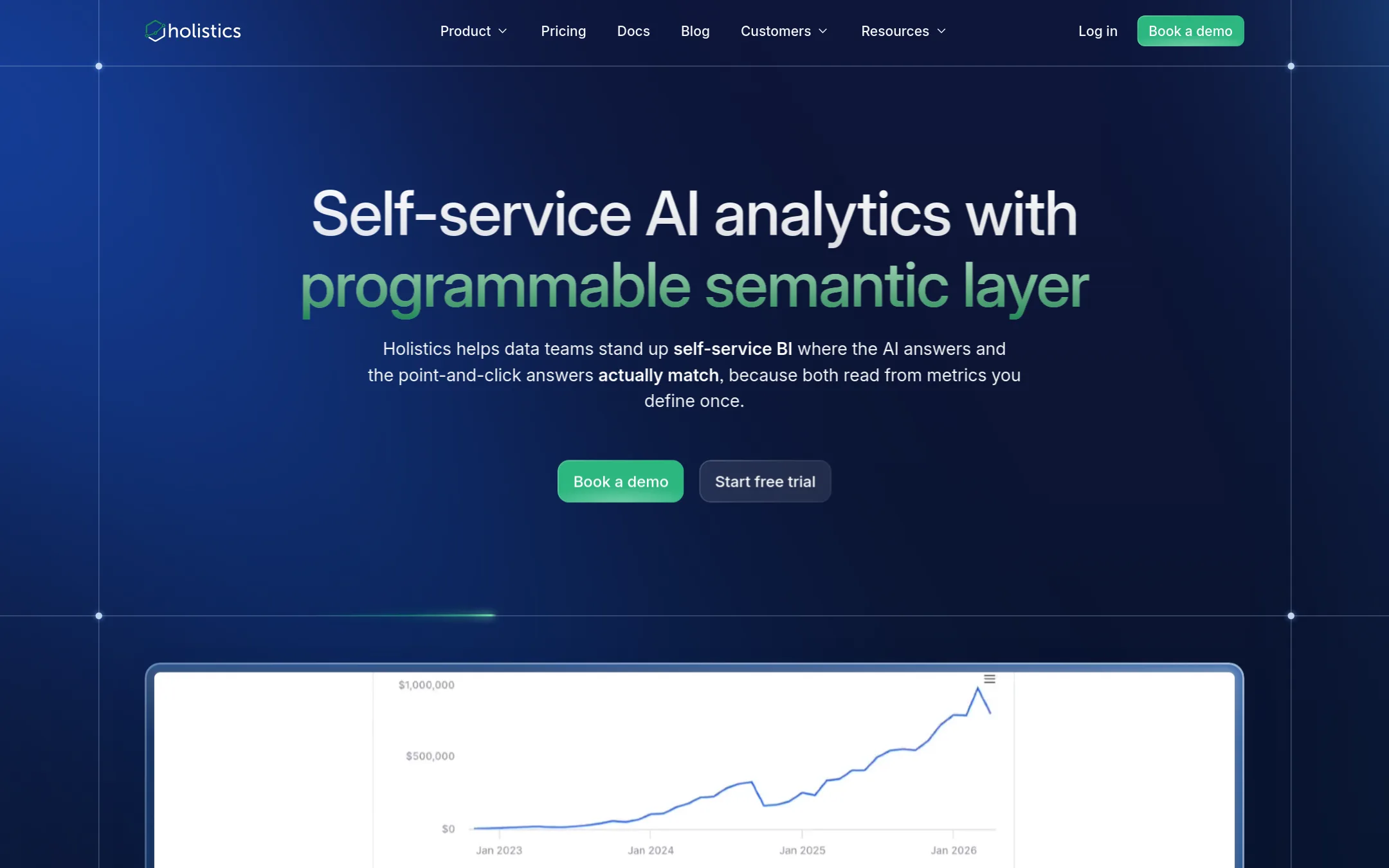
Holistics is an AI analytics platform where data teams define metrics once in a programmable semantic layer, and both AI answers and point-and-click dashboards read from those same definitions. This keeps numbers consistent across every surface. It treats analytics as code, with Git version control and pull-request review on business logic, which makes it credible for teams that want software engineering practices in BI.
Where it is strong
- Define metrics once in code and reuse them across dashboards, AI answers, and embedded analytics.
- AI asks clarifying questions when a request is ambiguous, so answers match your definitions.
- Supports dbt integration and connects to Snowflake, BigQuery, Databricks, and Redshift.
Where it falls short
- Pricing is not listed, so you have to contact sales for a quote.
- Requires a data team to set up and maintain the semantic layer, so it is not for non-technical users.
- Pricing:
- Pricing is not published on the site.
How to choose Business Intelligence Platforms
Pricing structure is a key factor. Some tools like Metabase and ThoughtSpot have transparent per-user or usage-based pricing, while others like Looker, Power BI, and Mode require contacting sales. Open-source options like Metabase and Lightdash offer free tiers but may need self-hosting, and Domo uses credit-based pricing that scales with usage.
Consider who the tool is built for. Some platforms, like Mode and Holistics, are designed for data teams with SQL and code skills, while others like Power BI and ThoughtSpot aim to serve both technical and business users. Bluelight is niche for ServiceTitan operators, and 42 is tailored for retail brands.
Integrations matter. Look for tools that connect to your existing stack. For example, Lightdash and Holistics integrate with dbt, Power BI embeds in Microsoft 365, and 42 has pre-built retail connectors. Domo offers 1,000+ connectors, and Metabase supports 20+ data sources.
Data and compliance requirements can narrow choices. Qlik Sense runs on-prem for data that must stay inside your infrastructure. Enterprise tools like Power BI and Looker emphasize governance and compliance, while open-source options may require you to manage security yourself.
Support and contract terms vary. Some tools like Bluelight and 42 require sales calls for pricing, and enterprise plans often come with custom contracts. Check if the tool offers a free trial, like Domo, or a free open-source version, like Metabase, to test before committing.
FAQ
Questions about Business Intelligence Platforms
What is the difference between open-source and commercial BI platforms?
Open-source platforms like Metabase and Lightdash offer free self-hosted versions, giving you full control and no per-seat costs. Commercial platforms like Power BI and ThoughtSpot provide managed services, support, and advanced features but often require paid subscriptions or custom pricing.
How much does a business intelligence platform cost?
Costs vary widely. Metabase has a free open-source plan, while ThoughtSpot starts at $25 per user per month. Alteryx Starter is $250 per user per month, and Lightdash Cloud Pro is $3000 per month with unlimited users. Many enterprise tools like Looker and Power BI do not publish pricing and require a sales call.
Which BI platform is best for a small startup?
Metabase is a strong choice for startups because it is open source, free to self-host, and supports AI querying. Lightdash is also good if you already use dbt, with a free self-hosted option. Both avoid per-seat costs and give you control over your data.
Can I embed BI dashboards into my own application?
Yes, several platforms support embedding. ThoughtSpot offers an API and SDK for embedded analytics, Metabase has embedding features on Pro and Enterprise plans, and Looker provides embedded analytics via APIs and SDKs. Check each tool's plan to see which tier includes embedding.
Do these platforms support AI-powered analytics?
Many do. Power BI uses Copilot for report creation, ThoughtSpot has Spotter AI agents, and Metabase offers AI querying in plain English. 42 serves data to AI tools via an MCP server, and Holistics uses AI that asks clarifying questions. AI features may be limited to higher-tier plans.
Last updated October 15, 2026.