6 Best Cloud Platforms in 2026
Updated November 6, 2026
The short answer
The three strongest cloud platforms on this list are Heroku, Railway and Northflank. Heroku suits small product teams that want to ship a web app with a git push and no server work. Railway suits startups that want usage-based billing and automatic deploys from a repo. Northflank suits engineering teams that need isolated runtimes for AI agent code and production services on the same platform.
The shortlist, at a glance
Read the comparisons ↓ HerokuFrom $5/dyno/moSmall product teams and startups that want to ship a web app quickly without hiring someone to run servers.
 RailwayFrom $1/mo, usage-baseStartups and small product teams that want to ship from a repo without hand-configuring networking, scaling or preview environments.
 UbicloudFrom $10.47/moStartups and engineering teams paying high AWS bills who want open source infrastructure and less vendor lock-in
 RescaleCustom quoteAerospace, automotive, energy and semiconductor engineering teams that run heavy simulations and need cloud HPC capacity on demand.
 Strong ComputeNot publishedTeams that spend on both GPU compute and LLM APIs and want one view of the AI bill, especially companies with compliance requirements.
 NorthflankFree plan, from $0.016Engineering teams and AI product builders who need to run untrusted or agent-generated code in isolated sandboxes and then ship it to production on the same platform.
About Cloud Platforms
Cloud platforms are services that run your software on hosted infrastructure, so you do not have to buy, configure and maintain servers yourself. Depending on the product, they handle deployment, scaling, databases, networking, storage and compute capacity for web apps, data work or heavy simulations.
The products on this list differ in approach, scale and pricing. Heroku is a managed application platform with flat-rate container tiers. Railway and Ubicloud bill for actual usage, with Ubicloud also positioned as an open source option on bare metal providers. Rescale targets large engineering simulation workloads and prices only by custom quote. Strong Compute focuses on tracking GPU and LLM spend, and Northflank focuses on isolated runtimes for agent-generated and production code.
The 6 best Cloud Platforms, compared
- From $5/dyno/mo
1.Heroku
Best for: Small product teams and startups that want to ship a web app quickly without hiring someone to run servers.
- Pricing
- From $5/dyno/mo
- Category
- Developer Tools
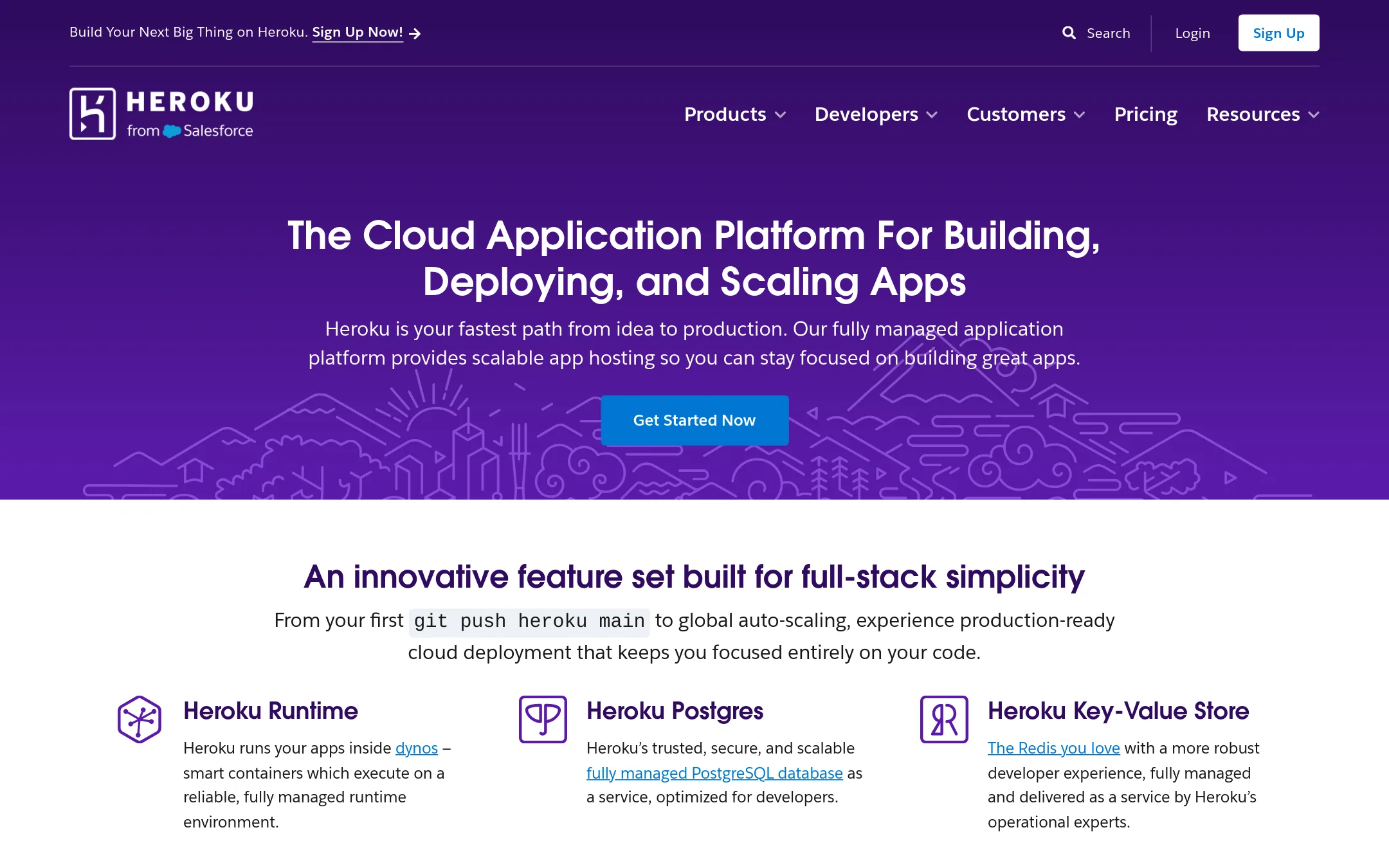
Heroku is a fully managed application platform where you deploy with a git push and it runs your code in dynos, its managed containers. Its managed Postgres and Redis-compatible key-value store mean the database side is handled too, which is a strong reason to pick it over raw infrastructure. Its runtime supports Python, Node.js, Java, Ruby, Go and more, and the site notes 150+ add-ons and 380+ open source buildpacks.
Where it is strong
- Deploy with a single git push, with rollbacks for code and Postgres data
- Managed Postgres and Redis-compatible data services without separate setup
- Broad language support and a large library of add-ons and buildpacks
Where it falls short
- Costs rise quickly as you add dynos and move to Performance or Private tiers
- Dynos sleep after 30 minutes of inactivity on the lowest Eco tier
- Pricing:
- Dynos start at Eco at $5 per month for a 0.5 GB container, Standard-1X is $25 per month, and Performance-M is $250 per month for 2.5 GB, while data services and Heroku AI are priced separately.
- From $1/mo, usage-base
2.Railway
Best for: Startups and small product teams that want to ship from a repo without hand-configuring networking, scaling or preview environments.
- Pricing
- From $1/mo, usage-base
- Category
- Developer Tools
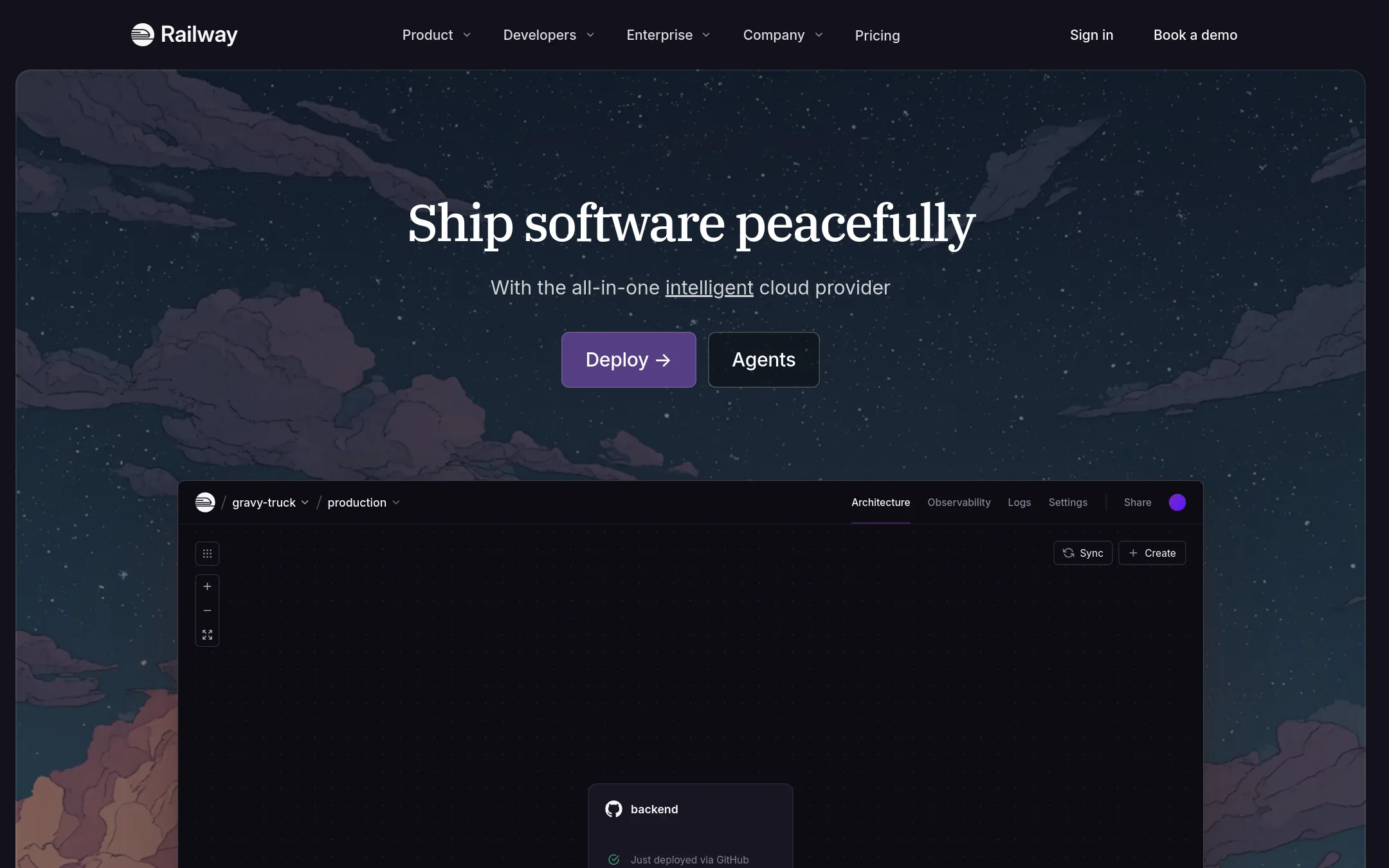
Railway is a cloud platform that deploys web apps, servers and databases from a connected repo with auto-config and instant previews. It bills by the second for CPU, memory and volumes, so you pay for what your app actually uses. Its usage pricing is backed by customer examples that report large bill reductions after moving from Heroku and AWS.
Where it is strong
- Connect a repo and deploy with auto-config and instant PR previews
- Usage billed by the second, so idle capacity is not charged at full size
- Private networking, SSL and logs, metrics and alerts are included from the start
Where it falls short
- Compliance features such as SSO, RBAC and HIPAA BAAs sit on the Enterprise tier at $1,000 and up
- Usage-based bills can be harder to forecast than a flat monthly plan
- Pricing:
- The Hobby plan starts with a 30-day trial with $5 credits, then $1 per month with $5 of monthly usage credits, while Pro includes $20 of monthly usage credits and compute is billed at $0.00000386 per GB per second for memory and $0.00000772 per vCPU per second
- From $10.47/mo
3.Ubicloud
Best for: Startups and engineering teams paying high AWS bills who want open source infrastructure and less vendor lock-in

- Pricing
- From $10.47/mo
- Category
- Other
Ubicloud is an open source cloud platform that runs on bare metal providers such as Hetzner, Leaseweb, or AWS Bare Metal, and you can self-host it or use the managed service. It covers compute, virtual networking, block storage, and managed PostgreSQL with automatic backups and point-in-time restore. Its credibility rests on concrete pricing, such as standard VMs at $41.89 per month against $90 per month on AWS Germany.
Where it is strong
- Standard VMs cost about $41.89 per month versus $90 on AWS Germany
- Managed PostgreSQL includes automatic backups, point-in-time restore, and high availability
- Open source, so you can self-host and move workloads elsewhere
Where it falls short
- Managed PostgreSQL costs $78 per month for 128GB, which adds up as databases grow
- Block storage is non-replicated, so you need your own plan for data durability
- Pricing:
- Pricing is usage-based: burstable VMs start at $10.47 per month, hobby PostgreSQL at $19.54 per month, and GitHub Actions runners at $0.00125 per minute for 8GB standard x64 versus $0.00600 on GitHub.
- Custom quote
4.Rescale
Best for: Aerospace, automotive, energy and semiconductor engineering teams that run heavy simulations and need cloud HPC capacity on demand.

- Pricing
- Custom quote
- Category
- Developer Tools
Rescale is a cloud HPC platform for engineering teams, running simulation and modeling workloads on elastic cloud infrastructure with pre-configured applications so teams skip setup work. It also offers AI Physics, which turns existing simulation results into surrogate models that predict in milliseconds. Its customer base includes Honda, which the site announced as a multi-year expansion of their partnership.
Where it is strong
- Pre-installed catalog of over 1,250 engineering and open source software packages
- Budget controls and spending analytics at organization, project and user levels
- Compliance options including SOC 2 Type II, ISO 27001, HIPAA and FedRAMP Moderate authorization
Where it falls short
- Pricing is only available through a custom quote, so small teams cannot check costs up front
- Built for engineering simulation workloads, so it is a poor fit for general web or application hosting
- Pricing:
- Pricing is not published on the site.
- Not published
5.Strong Compute
Best for: Teams that spend on both GPU compute and LLM APIs and want one view of the AI bill, especially companies with compliance requirements.

- Pricing
- Not published
- Category
- AI & Machine Learning
Strong Compute puts GPU cloud costs and LLM token spend from one dashboard, so finance and engineering read the same numbers. It connects to 15+ cloud providers and to OpenAI, Anthropic, xAI, Together AI, and Fireworks AI, and you add read-only API keys to see spend by provider, model, and team. The site lists SOC 2, ISO 27001, HIPAA, and GDPR compliance, which matters if you plan to connect production keys.
Where it is strong
- Shows GPU and LLM token spend in a single dashboard
- Connects to 15+ cloud providers and five named LLM providers
- Lists SOC 2, ISO 27001, HIPAA, and GDPR compliance
Where it falls short
- Gemini and other providers are listed as coming soon, not yet supported
- Pricing terms beyond the free trial are not published, so you need to ask sales for the cost
- Pricing:
- Pricing is not published on the site.
- Free plan, from $0.016
6.Northflank
Best for: Engineering teams and AI product builders who need to run untrusted or agent-generated code in isolated sandboxes and then ship it to production on the same platform.
- Pricing
- Free plan, from $0.016
- Category
- Developer Tools
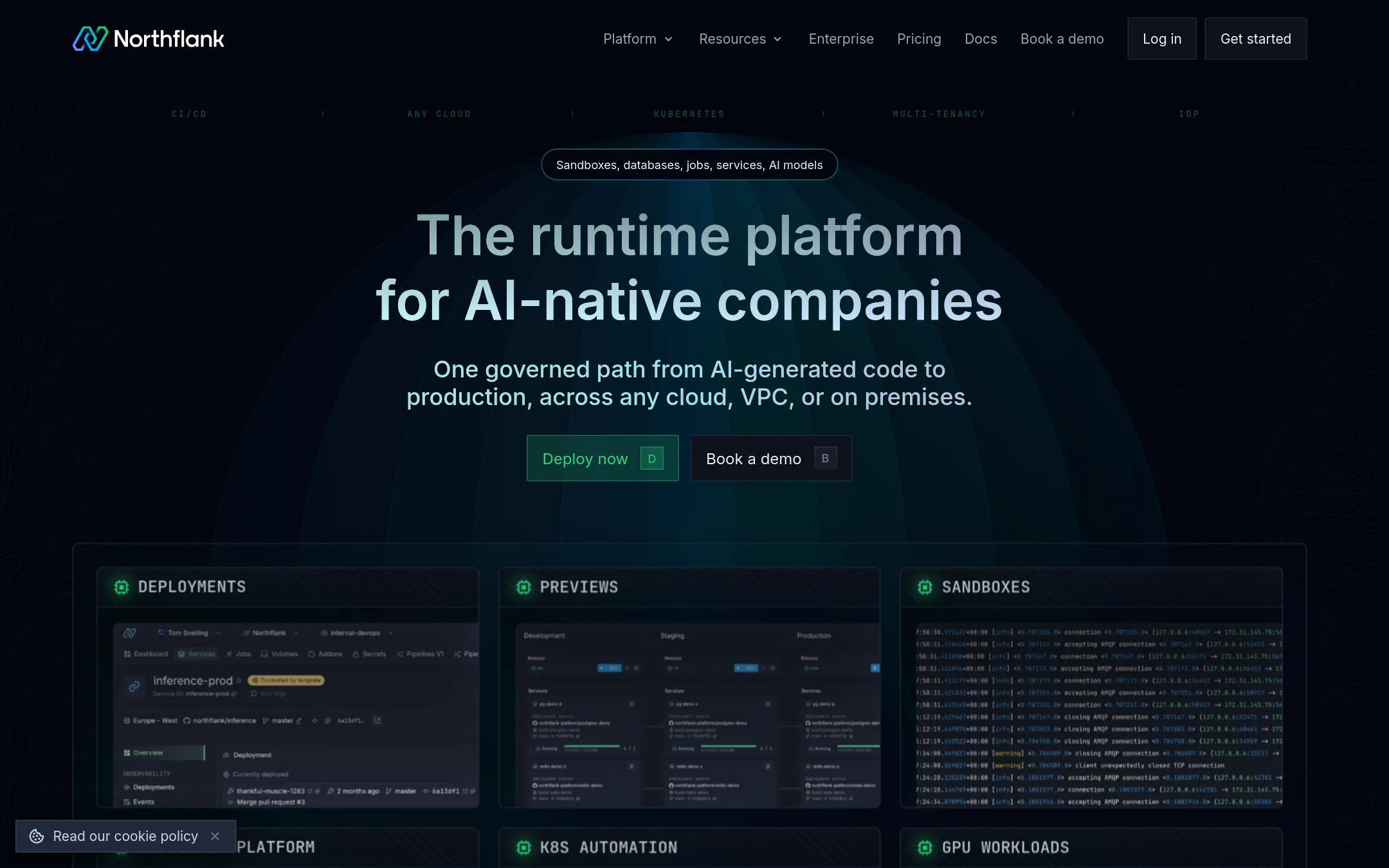
Northflank is a runtime platform for running AI agents, their generated code, and production workloads. Every workload runs in its own microVM, isolated by default, and it can run on Northflank Cloud or inside your own VPC on AWS, Google Cloud, Azure, Oracle or bare metal. For a cloud platform pick, the concrete draw is that the same workflow covers a coding agent sandbox, a PR preview, and a live production service.
Where it is strong
- Each workload runs in its own microVM, isolated by default
- Runs on Northflank Cloud or in your own VPC with the same workflow
- Billed to the second with no seat fees, and GPUs available on demand
Where it falls short
- Enterprise features like SAML, SCIM, audit logs and a 99.99% SLA sit behind custom enterprise pricing
- Built around containerized workloads, so it is less of a fit if you are not already packaging apps as containers
- Pricing:
- The free Sandbox plan includes 2 services, 2 jobs and 1 database with up to $20/mo of resources, and pay-as-you-go compute starts at $0.01667 per vCPU hour, with usage billed to the second and no seat fees.
How to choose Cloud Platforms
Start with pricing structure. Heroku charges fixed monthly amounts per container tier, which makes costs easier to predict but rises quickly as you scale up. Railway and Ubicloud bill for usage, which can lower idle costs but makes monthly bills harder to forecast.
Check who the platform is built for. Heroku and Railway suit small teams shipping web apps, while Rescale is built for aerospace, automotive, energy and semiconductor simulation work and is a poor fit for general hosting. Match the product to the kind of workload you actually run.
Look at the integrations you need. Heroku offers over 150 add-ons and broad language support, Strong Compute connects to 15+ cloud providers and five named LLM providers, and Northflank runs on several major clouds or your own VPC. Confirm the services you depend on are supported before committing.
Review data and compliance requirements. Strong Compute and Rescale list certifications such as SOC 2, ISO 27001 and HIPAA, while Railway keeps SSO, RBAC and HIPAA BAAs on its Enterprise tier. If you handle regulated data, check where each certification applies and at which plan.
Finally, read support and contract terms. Northflank's 99.99% SLA and SAML sit behind custom enterprise pricing, and several products do not publish pricing beyond trials. Ask for written terms and a clear cost estimate before you sign.
FAQ
Questions about Cloud Platforms
What is a cloud platform?
A cloud platform is a hosted service that runs your applications and data on infrastructure you do not manage yourself. Products on this list handle deployment, scaling, databases and compute capacity for different types of work. The right choice depends on whether you are hosting a web app, running data pipelines or running large simulations.
Which cloud platform is best for a small startup shipping a web app?
Heroku is aimed at small product teams that want to deploy with a single git push and skip server management. It includes managed Postgres and a broad range of language runtimes. Railway is another option for startups that want usage-based billing and instant previews from a connected repo.
How do pricing models differ across these platforms?
Heroku uses fixed monthly prices per container tier, starting at $5 per month for the Eco tier. Railway and Ubicloud bill for compute by usage, Railway by the second for CPU and memory. Rescale and Strong Compute do not publish pricing and require a custom quote.
Can I run these platforms on my own infrastructure?
Northflank can run inside your own VPC on AWS, Google Cloud, Azure, Oracle or bare metal. Ubicloud is open source and can be self-hosted, and it runs on bare metal providers such as Hetzner, Leaseweb or AWS Bare Metal. Heroku and Railway are managed services that run on their own infrastructure.
Do these cloud platforms meet compliance standards?
Several products list compliance certifications, including Rescale with SOC 2 Type II, ISO 27001, HIPAA and FedRAMP Moderate, and Strong Compute with SOC 2, ISO 27001, HIPAA and GDPR. Railway offers HIPAA BAAs and SSO only on its Enterprise tier. Check the certifications directly on each product's site for your specific requirements.
Last updated November 6, 2026.