6 Best GPU Cloud Platforms in 2026
Updated November 8, 2026
The short answer
The three strongest GPU cloud platforms on this list are CoreWeave, Vast.ai and Thunder Compute. CoreWeave suits AI labs and enterprise teams training or serving large models that need high-end GPU clusters and managed Kubernetes. Vast.ai suits developers who want the lowest rental cost and can tolerate variable availability, especially for batch and fault-tolerant jobs. Thunder Compute suits ML and RL teams running many short GPU jobs who want per-second billing and scale-to-zero sandboxes.
The shortlist, at a glance
Read the comparisons ↓ CoreWeaveCustom quoteAI labs and enterprise teams training or serving large models who need high-end GPU clusters and managed Kubernetes.
 Vast.aiFrom $5 creditDevelopers and AI teams that want the lowest possible GPU rental cost and can handle variable availability, especially for batch training and fault-tolerant jobs.
 ShadeformCustom quoteAI teams training or deploying models that need burst GPU capacity across several clouds and regions without managing separate vendor accounts.
 Thunder ComputeFrom $0.35/hrML teams and RL researchers running many short GPU jobs or evals who want per-second billing and scale-to-zero sandboxes.
 LilacNot publishedAI enterprises running thousands of GPU nodes that want to operate their own neocloud and need reliable delivery to customers.
 Cumulus LabsNot publishedTeams running several AI workloads on GPUs who want to cut idle capacity and pick their own deployment model.
About GPU Cloud Platforms
GPU cloud platforms rent graphics processing units on demand so teams can train, fine-tune, and serve machine learning models without buying hardware. They handle provisioning, scaling, storage, and networking around that compute, and some add orchestration and deployment tools on top.
The products on this list differ in approach, scale, and pricing model. CoreWeave targets large AI clusters with committed-use discounts, while Vast.ai runs a live marketplace where prices move with supply and demand. Shadeform aggregates capacity from more than 30 providers through one console, and Thunder Compute bills by the second for short jobs. Lilac and Cumulus Labs focus on operating the GPU infrastructure itself rather than just renting it.
The 6 best GPU Cloud Platforms, compared
- Custom quote
1.CoreWeave
Best for: AI labs and enterprise teams training or serving large models who need high-end GPU clusters and managed Kubernetes.
- Pricing
- Custom quote
- Category
- AI & Machine Learning
CoreWeave is an AI-native cloud built for large GPU workloads, offering NVIDIA Blackwell, Hopper and Ada Lovelace GPUs along with managed Kubernetes and AI object storage. It is a credible pick because the site cites SemiAnalysis' Platinum ClusterMAX rating three times and says nine of the ten leading foundation model providers use it.
Where it is strong
- Offers NVIDIA GB300 and GB200 NVL72, HGX B200 and H200 GPUs, plus a range of older options
- Includes managed Kubernetes and AI object storage with zero egress, per its listing
- Committed-use discounts of up to 60% off on-demand prices
Where it falls short
- Pricing is spread across many SKUs and networking, storage and egress lines, so cost is hard to estimate without talking to sales
- Its focus on large-scale AI infrastructure may be more than a small team running modest workloads needs
- Pricing:
- Pricing is not published as a single figure. The site lists per-GPU and per-instance rates on its pricing page, offers committed-use discounts of up to 60% off on-demand prices, and asks you to contact sales for inference platform pricing.
- From $5 credit
2.Vast.ai
Best for: Developers and AI teams that want the lowest possible GPU rental cost and can handle variable availability, especially for batch training and fault-tolerant jobs.
- Pricing
- From $5 credit
- Category
- AI & Machine Learning
Vast.ai rents GPUs from a marketplace where prices move with supply and demand across more than 20,000 GPUs in 40+ data centers. Developers can search, filter, and launch instances from the CLI, Python SDK, or API in seconds, with per-second billing and no contracts.
Where it is strong
- Real-time, programmatically queryable GPU prices across 68+ GPU types
- Per-second billing with no long-term contract required to start
- Deploy via CLI, Python SDK, or API, so scripts and agents can provision compute
Where it falls short
- Interruptible instances can be reclaimed, so they suit fault-tolerant work only
- Marketplace supply varies by GPU model and region, so availability is not guaranteed on demand
- Pricing:
- Pricing is set by live supply and demand with three tiers (on-demand, interruptible, and reserved on 1, 3, or 6 month terms), billed per second with a $5 minimum to start, but no specific per-GPU rates are published in the page text.
- Custom quote
3.Shadeform
Best for: AI teams training or deploying models that need burst GPU capacity across several clouds and regions without managing separate vendor accounts.
- Pricing
- Custom quote
- Category
- AI & Machine Learning
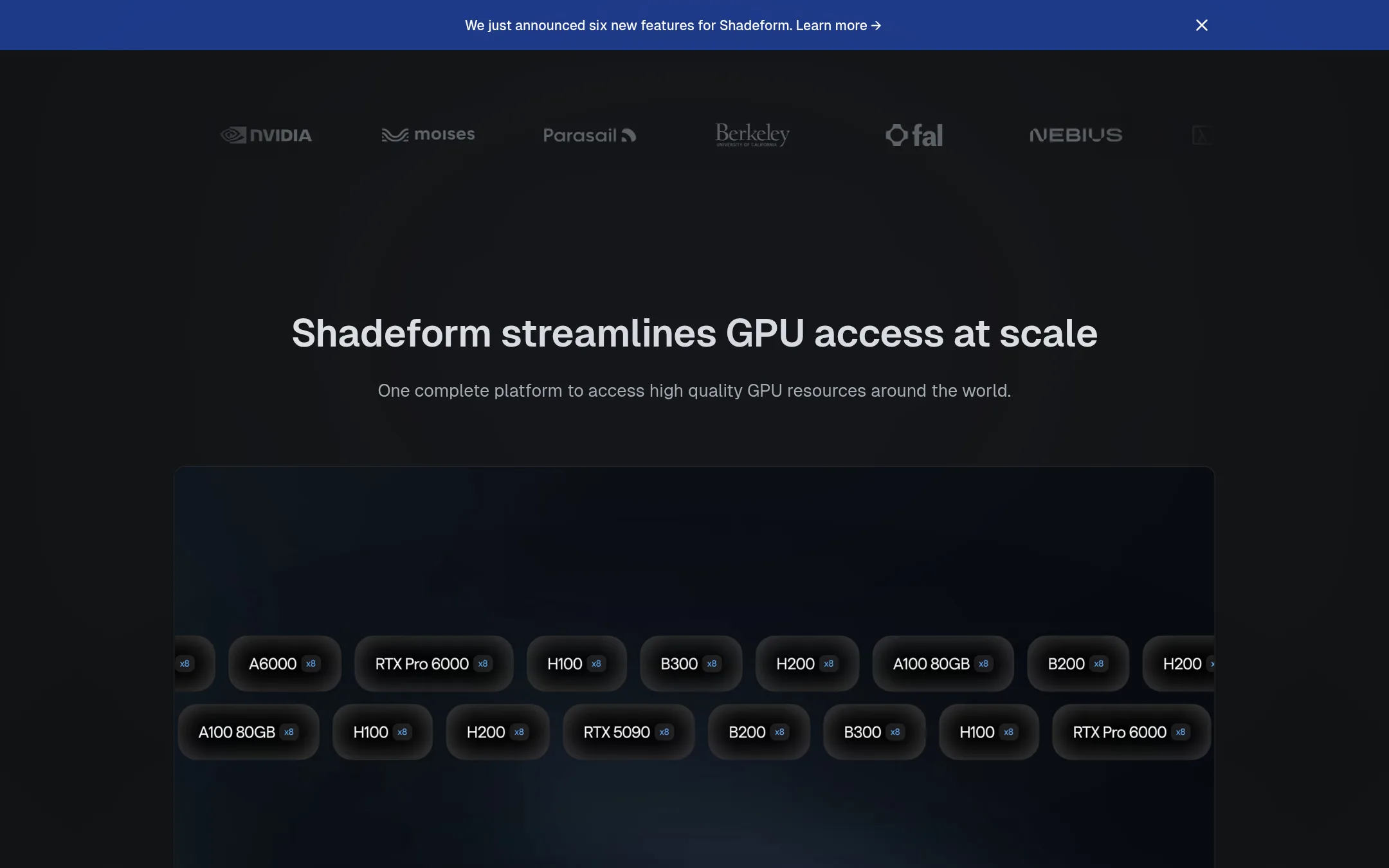
Shadeform is a marketplace that lets you rent GPU compute from more than 30 cloud providers through one console. It covers over 100 regions across North America, Europe, Asia and Australia, with centralized billing and support. That spread makes it a credible option when you need hard-to-find capacity fast.
Where it is strong
- One console covers 30+ GPU clouds
- Access to more than 100 regions worldwide
- Centralized billing and support across providers
Where it falls short
- Reserved compute requires a minimum 12-month term
- No public pricing, so budgeting depends on getting quotes
- Pricing:
- Pricing is not published on the site. Reserved compute is quoted on request with a minimum 12-month term.
- From $0.35/hr
4.Thunder Compute
Best for: ML teams and RL researchers running many short GPU jobs or evals who want per-second billing and scale-to-zero sandboxes.
- Pricing
- From $0.35/hr
- Category
- Other
Thunder Compute rents GPU instances for long-running developer work and GPU sandboxes for short isolated jobs like RL rollouts, evals, and CI. Its pitch is low cost from reduced idle time across its infrastructure, and it lists A100 at $1.09/hr and H100 at $3.20/hr with no egress fees.
Where it is strong
- Sandboxes bill per second and scale to zero, so idle time costs nothing.
- No data egress fees, and snapshots let you save disks between runs.
- Listed H100 price of $3.20/hr sits below several larger clouds on the same page.
Where it falls short
- Stock varies by configuration, and a launch can fail if a GPU type is sold out.
- Reserved and volume rates require a sales quote, so committed-use pricing is not published.
- Pricing:
- A100 80GB instances list at $1.09/hr and H100 SXM at $3.20/hr, billed per minute while running, with snapshot storage at $0.05/GB/mo and no egress fees.
- Not published
5.Lilac
Best for: AI enterprises running thousands of GPU nodes that want to operate their own neocloud and need reliable delivery to customers.
- Pricing
- Not published
- Category
- AI & Machine Learning
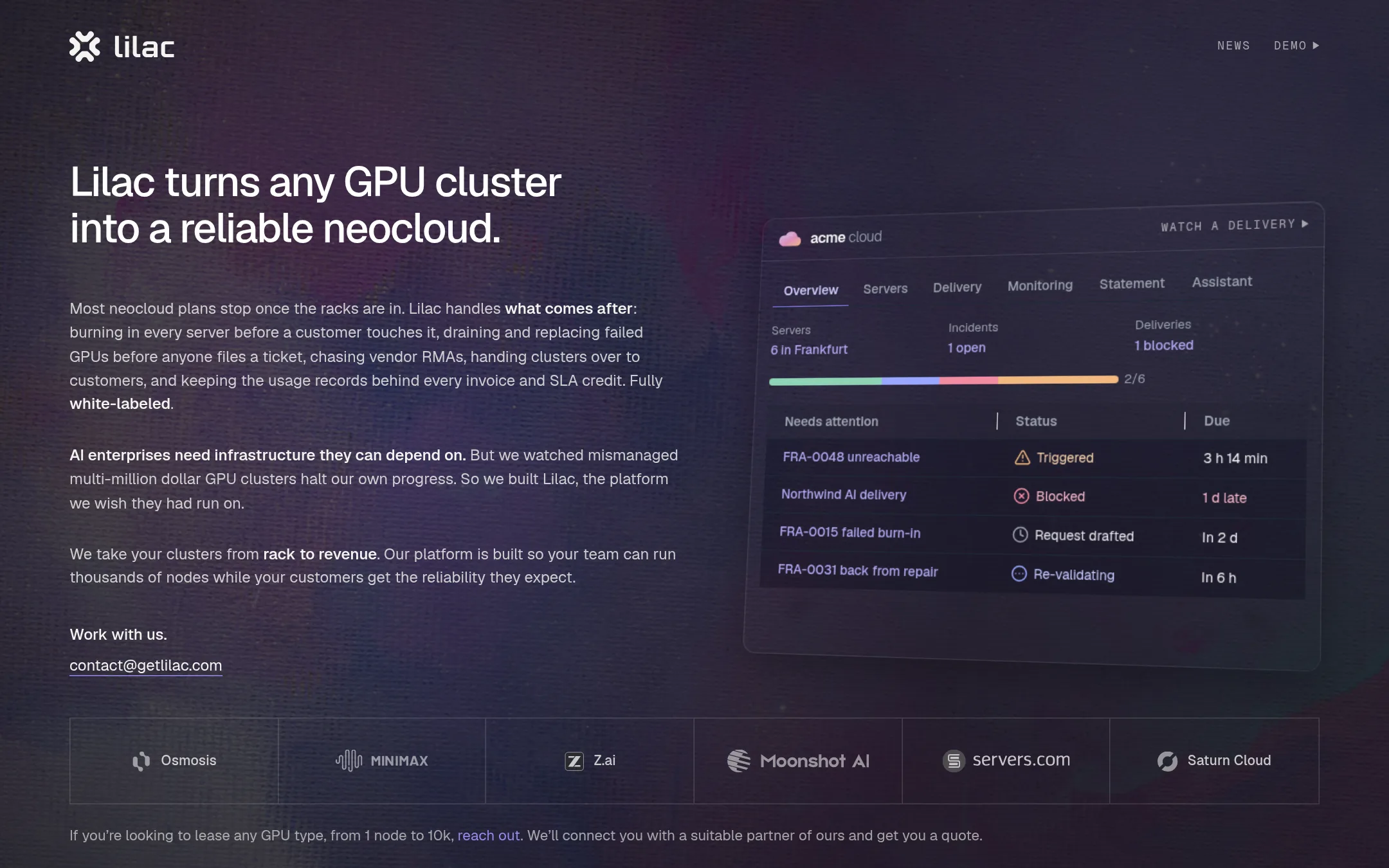
Lilac is white-label GPU operations software that runs the work after racks go in: burning in every server before a customer uses it, draining and replacing failed GPUs, chasing vendor RMAs, and handing clusters to customers. It also keeps the usage records behind invoices and SLA credits. Its credibility rests on the operating loop it describes, from burn-in through hand-off and metering, rather than on the hardware itself.
Where it is strong
- Burns in every server before a customer touches it
- Replaces failed GPUs and chases vendor RMAs without waiting for tickets
- Meters usage to one record behind invoices and SLA credits
Where it falls short
- Pricing is not listed, so cost has to be discussed directly with the company
- Built for operators running large clusters, so it is a poor fit for teams renting a few GPUs
- Pricing:
- Pricing is not published on the site.
- Not published
6.Cumulus Labs
Best for: Teams running several AI workloads on GPUs who want to cut idle capacity and pick their own deployment model.
- Pricing
- Not published
- Category
- AI & Machine Learning
Cumulus Labs runs GPU orchestration, model inference, and agent deployment in one stack. Paladin predicts resource needs and packs jobs into spare GPU capacity, and it moves running work as demand changes. That scheduling layer is the concrete reason to look at it among gpu cloud platforms.
Where it is strong
- Paladin packs jobs into spare GPU capacity and moves running work as demand changes
- Ion serves text, vision, and audio models through an API or on dedicated GPUs
- Each part can be adopted on its own, or the full stack can be connected
Where it falls short
- Pricing is not listed, so cost has to be checked with the vendor
- The site does not say which regions or hardware types are available
- Pricing:
- Pricing is not published on the site.
How to choose GPU Cloud Platforms
Start with pricing structure. Some platforms publish per-GPU rates, such as Thunder Compute's listed A100 and H100 prices, while others, including CoreWeave and Shadeform, rely on quotes or committed-use terms. Compare the total cost, including storage and egress, rather than the headline hourly rate.
Check who the platform is built for. Large-scale training clusters, short evaluation jobs, and burst capacity across several clouds each call for different products. A marketplace with variable supply suits fault-tolerant work, while reserved capacity suits steady workloads.
Consider integrations and how you will provision compute. Vast.ai offers a CLI, Python SDK, and API so scripts and agents can launch instances, and CoreWeave includes managed Kubernetes. Match the interface to how your team already deploys software.
Look at data handling and contract terms. Thunder Compute lists no egress fees, and CoreWeave advertises zero egress on its AI object storage. Shadeform requires a minimum 12-month term for reserved compute, so confirm the commitment before signing.
Finally, weigh support and operational depth. Lilac and Cumulus Labs address running and scheduling GPU fleets, which matters more for operators than for teams renting a handful of instances. Pricing for several products is not published, so ask vendors for specifics on support levels and service terms.
FAQ
Questions about GPU Cloud Platforms
What is a GPU cloud platform?
A GPU cloud platform rents graphics processing units over the internet so you can run machine learning training, fine-tuning, or inference without owning the hardware. Providers handle the servers, networking, and storage around that compute. Some also include orchestration or deployment tools.
How do GPU cloud platforms usually charge?
Pricing models vary across the list. Thunder Compute bills per minute while instances run, and Vast.ai bills per second with three tiers including interruptible and reserved options. CoreWeave offers committed-use discounts of up to 60% off on-demand prices, while Shadeform and Lilac do not publish prices.
Which platform is cheapest for GPU compute?
Vast.ai is built around low cost, since its marketplace prices move with live supply and demand across more than 20,000 GPUs. Its interruptible instances can be reclaimed, so they suit fault-tolerant work. Thunder Compute also lists low hourly rates, including $3.20 per hour for an H100 SXM, with no egress fees.
Can I use interruptible GPUs for production workloads?
Interruptible instances on Vast.ai can be reclaimed, so they fit fault-tolerant work such as batch training with checkpoints. For steady production serving, reserved capacity or a platform with dedicated clusters, such as CoreWeave, is the safer choice. Check the terms before relying on any tier.
Do these platforms charge for data transfer out?
Some do not. Thunder Compute states it has no egress fees, and CoreWeave says its AI object storage has zero egress. Confirm how storage and transfer are billed on any platform before you commit, since networking and egress lines can add significant cost.
Last updated November 8, 2026.