6 Best Health Data Platforms in 2026
Updated November 8, 2026
The short answer
The strongest health data platforms on this list are Validic, 1upHealth and Health Gorilla. Validic suits health systems and health plans running remote care programs that need device data in their EHR. 1upHealth suits health plans that must meet CMS interoperability rules. Health Gorilla suits EHR vendors, payers and digital health companies that need complete patient records and TEFCA or California DxF compliance.
The shortlist, at a glance
Read the comparisons ↓ ValidicNot publishedHealth systems and health plans that run remote care programs and need device data flowing into their EHR without building and maintaining each device integration themselves.
 1upHealthNot publishedHealth plans, from small regional payers to national Medicare, Medicaid and commercial plans, that need to meet CMS interoperability rules and exchange member data.
Health GorillaNot publishedEHR vendors, payers, and digital health companies that need complete patient records and TEFCA or California DxF compliance without building interoperability in-house.
MedPiper Technologies, IncNot publishedIndian life and health insurers and healthcare operators that need diagnostics-linked underwriting and DPDP-ready data flows
 Particle HealthNot publishedHealthcare innovators, payers, and developers who need external patient records inside their own product for value-based or specialty care
 Human APINot publishedLife insurance carriers that want underwriters to pull EHRs and make risk decisions faster at scale
About Health Data Platforms
Health data platforms collect, standardize and move health information between devices, electronic health records, payers and apps. They give organizations a way to access patient data without building and maintaining each connection themselves.
The products on this list differ mainly in who they serve and how they are built. Validic focuses on device data and remote patient monitoring for health systems. 1upHealth is built around payer compliance and member data exchange. Health Gorilla operates a national records network with federal and state designations. Particle Health and Human API focus on retrieving records through a single API or for specific underwriting work. None of the entries publish pricing, so cost comparisons require a sales conversation.
The 6 best Health Data Platforms, compared
- Not published
1.Validic
Best for: Health systems and health plans that run remote care programs and need device data flowing into their EHR without building and maintaining each device integration themselves.
- Pricing
- Not published
- Category
- Healthcare
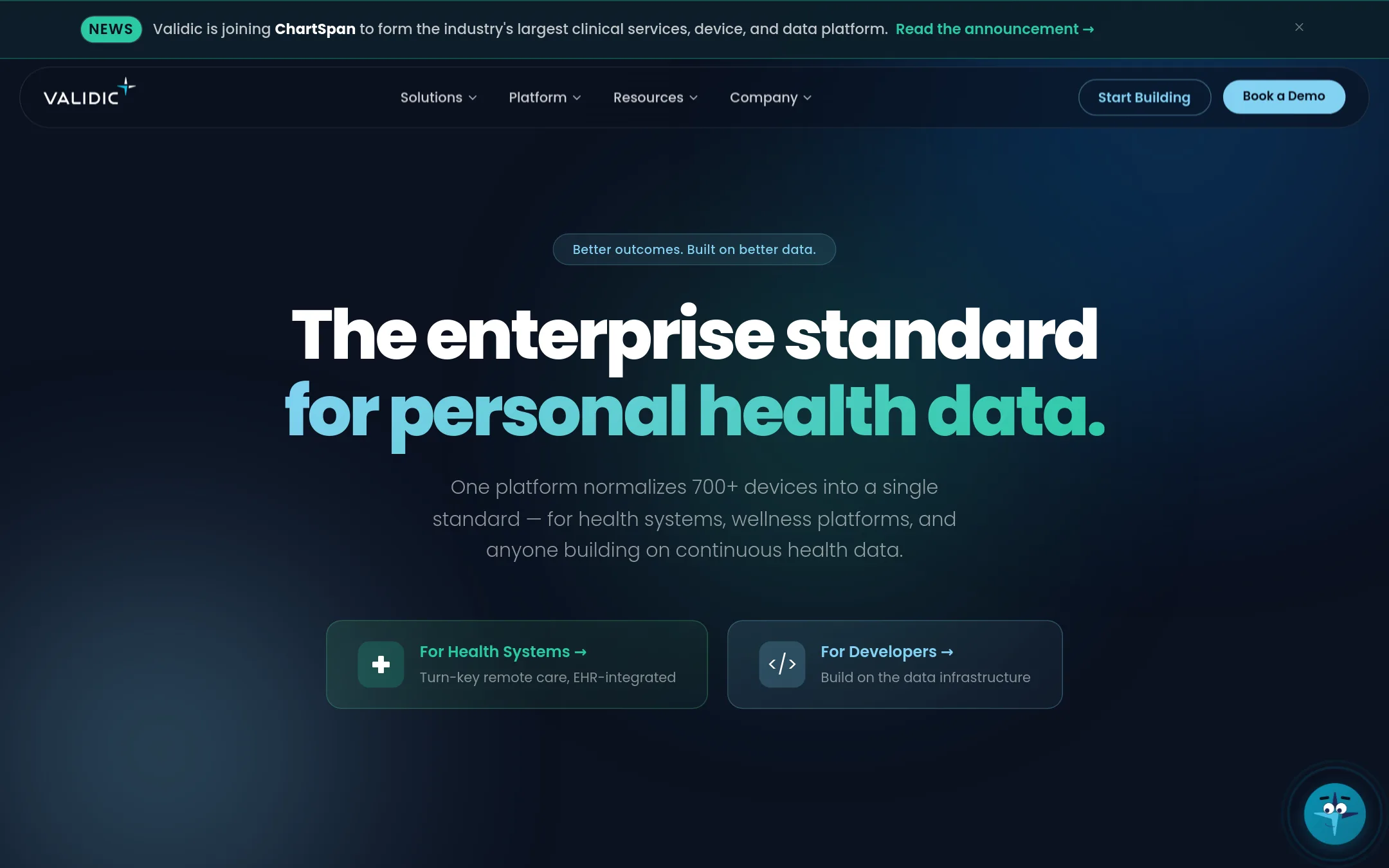
Validic normalizes data from more than 700 health devices into one standard, so a health system or app team does not need a separate integration for each device. It also runs managed remote patient monitoring that writes directly into Epic, Cerner and other EHRs, which sets it apart from pure data pipes.
Where it is strong
- One normalization layer covers 700+ devices, so teams avoid redundant integrations across departments.
- Direct EHR write-back to Epic and Cerner supports clinical workflows, not just data collection.
- Developers get a REST API, streaming, and iOS and Android SDKs to build on the same infrastructure.
Where it falls short
- Pricing is not disclosed, so a buyer has to request a quote before comparing costs.
- The managed remote care offering targets organizations running care programs, so small wellness startups may only need the data layer and sh
- Pricing:
- Pricing is not published on the site.
- Not published
2.1upHealth
Best for: Health plans, from small regional payers to national Medicare, Medicaid and commercial plans, that need to meet CMS interoperability rules and exchange member data.
- Pricing
- Not published
- Category
- Healthcare
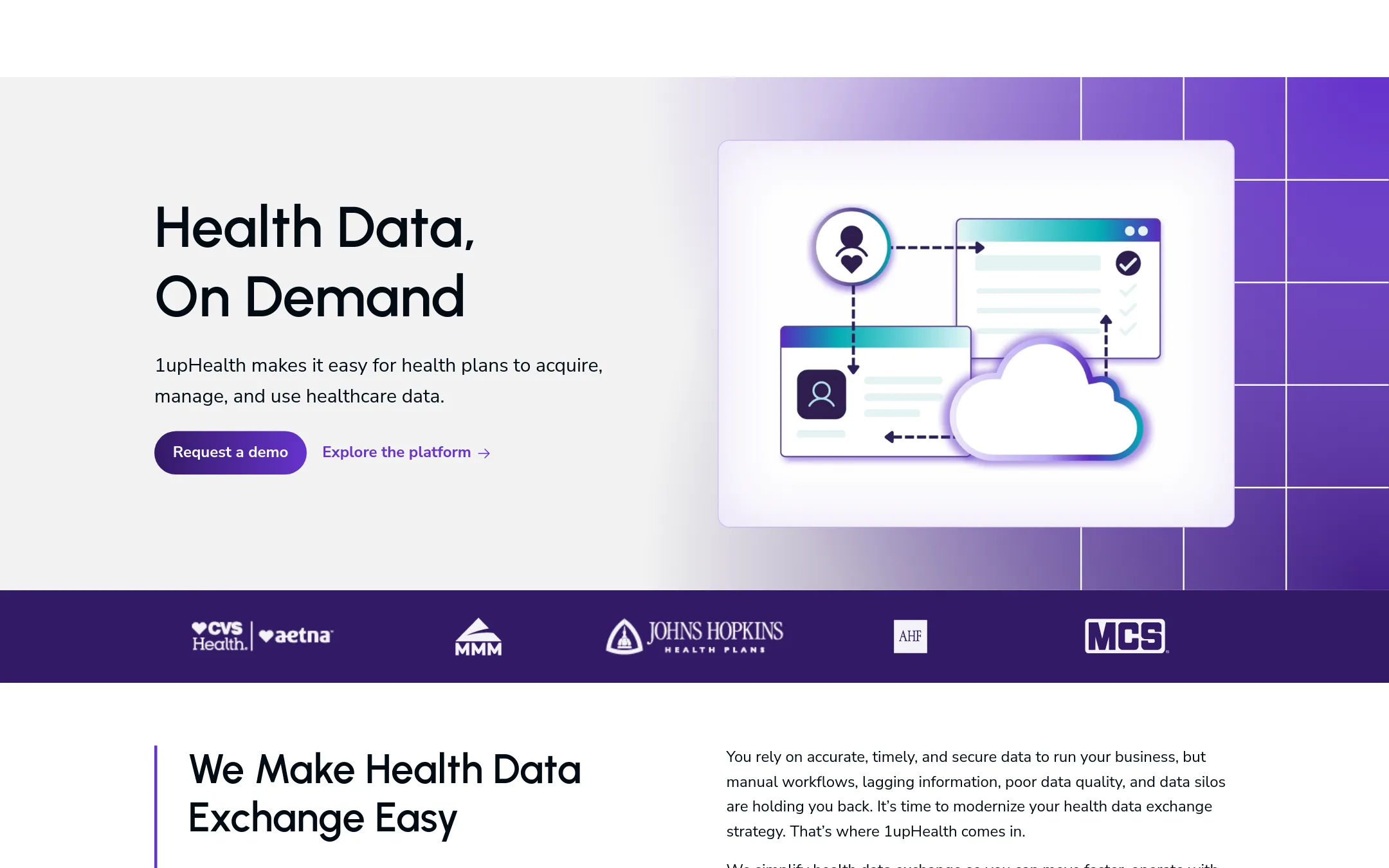
1upHealth is an interoperability platform that health plans use to exchange clinical and claims data, built on a FHIR-first lakehouse architecture. It covers CMS-0057-F and CMS-9115-F compliance and includes modules like Electronic Prior Authorization and Payer-to-Payer Data Exchange. Its credibility rests on its focus on payers, with a network of payers, providers and third-party apps.
Where it is strong
- Built around FHIR APIs and CMS-0057-F and CMS-9115-F compliance for payers.
- Modules can run on their own or together, so plans can start with one workflow such as prior authorization.
- Includes a dedicated partner team with regulatory guidance and 24/7 support.
Where it falls short
- Aimed at health plans, so providers and digital health startups outside payer work are not the core customer.
- No public price list, so budgeting requires a sales conversation.
- Pricing:
- Pricing is not published on the site.
- Not published
3.Health Gorilla
Best for: EHR vendors, payers, and digital health companies that need complete patient records and TEFCA or California DxF compliance without building interoperability in-house.
- Pricing
- Not published
- Category
- Healthcare
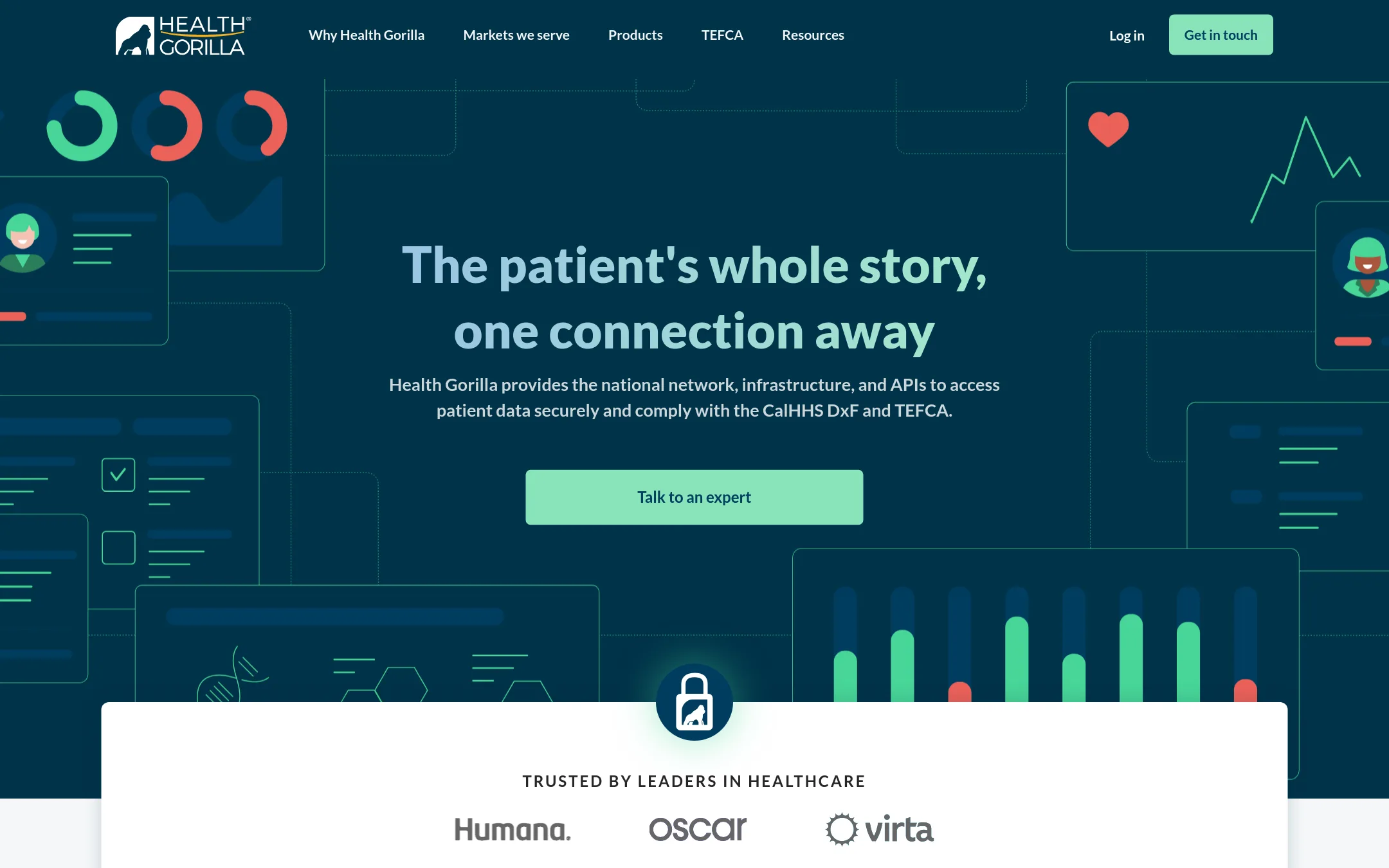
Health Gorilla runs a national health data network and APIs that pull together a patient's records from many sources into one trustworthy chart. It is the first company to hold both federal QHIN and California QHIO designations, which means it can take part in TEFCA and the California Data Exchange Framework. Its pipeline matches patients, de-duplicates records, and keeps a trace of where each fact came from.
Where it is strong
- Dual-designated as a QHIN and QHIO, the only company the site describes that holds both
- Covers EHR, lab, SDOH, ADT, and pharmacy data, with lab ordering from 120+ vendors
- Traces every fact to its source and logs every access
Where it falls short
- Built for health organizations and data buyers, so it is not a fit for small teams wanting a self-serve tool
- No public pricing, so you need a sales conversation to compare costs
- Pricing:
- Pricing is not published on the site.
- Not published
4.MedPiper Technologies, Inc
Best for: Indian life and health insurers and healthcare operators that need diagnostics-linked underwriting and DPDP-ready data flows
- Pricing
- Not published
- Category
- Healthcare
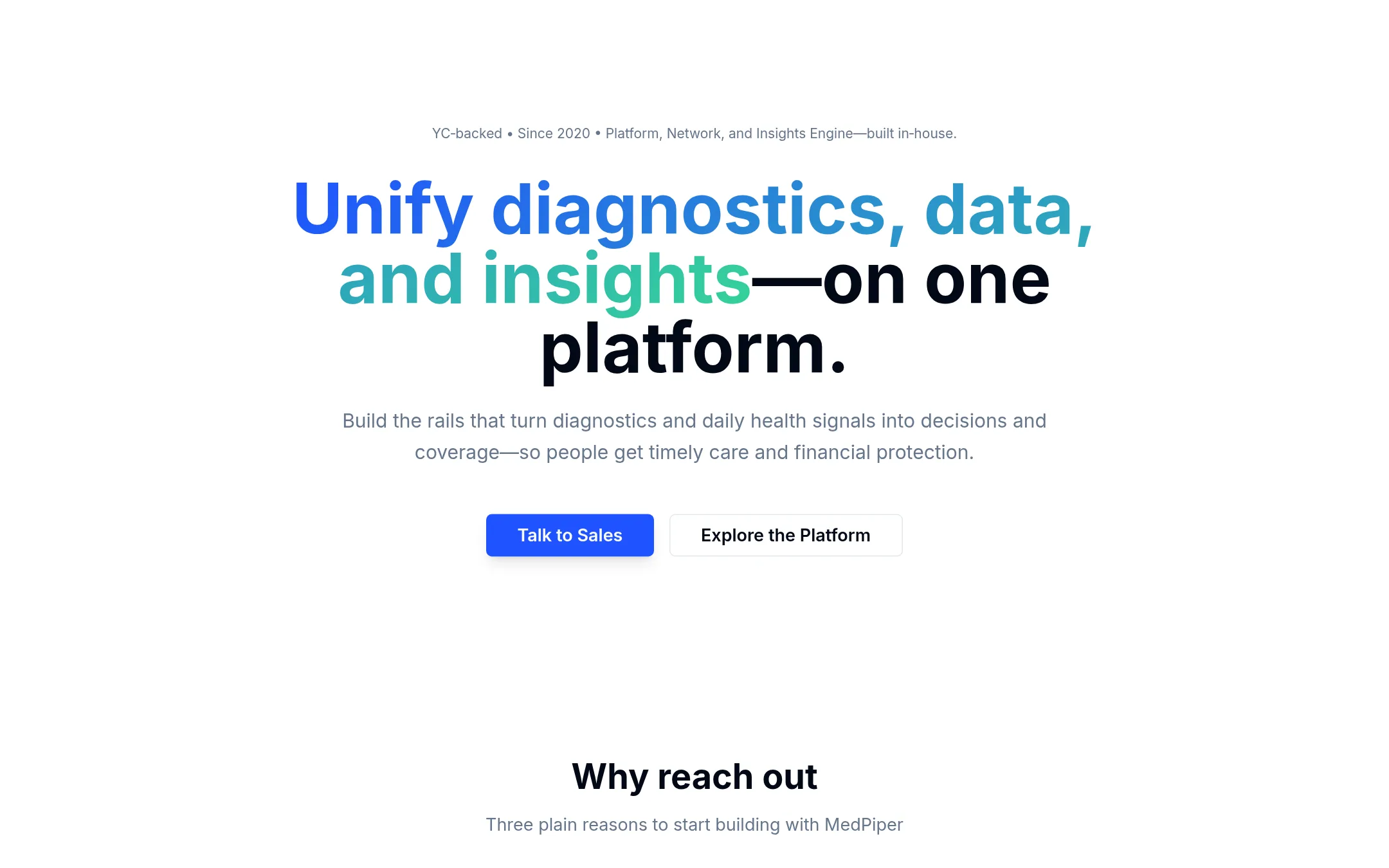
MedPiper unifies diagnostics and daily health signals from wearables into decision intelligence for insurers and healthcare teams. Its Network pillar gives distributed lab access with booking, reports and reconciliation, which is rare in this category. The company cites a regional life insurer that cut underwriting turnaround time by 38%, though that figure comes from a single customer quote.
Where it is strong
- Prebuilt connectors and workflows to go live in weeks
- Built for India, with DPDP-ready data flows and vernacular UX
- Combines diagnostics network, decision analytics and micro-cover rails in one stack
Where it falls short
- Pricing is not published, so budgeting needs a sales conversation
- The 38% underwriting gain comes from one unnamed customer quote, so verify results in your own pilot
- Pricing:
- Pricing is not published on the site.
- Not published
5.Particle Health
Best for: Healthcare innovators, payers, and developers who need external patient records inside their own product for value-based or specialty care
- Pricing
- Not published
- Category
- Healthcare
Particle Health is an API platform that delivers patient medical records from more than 160,000 health systems, practices, and clinics through one integration, returning FHIR R4 or C-CDA data. It is credible because it is built around live record access, with over 320 million patient records queryable in a single call and pre-curated datasets and ADT feeds for teams that need data fast.
Where it is strong
- One API covers records from over 160,000 health systems, practices, and clinics
- Returns FHIR R4 or C-CDA data, so it fits standard interoperability workflows
- Offers ADT feeds and pharmacy fill data for care coordination use cases
Where it falls short
- No public pricing, so budgeting requires a sales conversation
- Built for developers and health organizations, so it is a poor fit for teams without integration capacity
- Pricing:
- Pricing is not published on the site.
- Not published
6.Human API
Best for: Life insurance carriers that want underwriters to pull EHRs and make risk decisions faster at scale
- Pricing
- Not published
- Category
- Healthcare
LexisNexis Health Intelligence pulls electronic health records for life insurance underwriting, drawing on more than 30,000 U.S. data sources that cover over 270 million lives. Its Clinical History Report is up to 30% shorter than a standard EHR while keeping the clinical details underwriters need. The company says EHR hit rates can reach 76% by combining HIPAA-authorized and consumer-mediated networks.
Where it is strong
- Connects to over 30,000 U.S. data sources covering more than 270 million lives
- Clinical History Report is up to 30% shorter while keeping key underwriting information
- Automatically orders an attending physician statement when no EHR is available
Where it falls short
- Built specifically for life insurance underwriting, so it is a poor fit for general health data projects
- Pricing is not published, so cost must be confirmed through a sales conversation
- Pricing:
- Pricing is not published on the site.
How to choose Health Data Platforms
Start with pricing structure. None of the listed products publish prices, so ask each vendor how fees are set and whether they are based on volume, modules or patients before comparing quotes.
Check who the product is built for. Validic, 1upHealth, Health Gorilla, Particle Health, MedPiper and Human API each target specific buyers such as health systems, health plans, EHR vendors, developers or insurers. A product built for one of these groups may be a poor fit for a small team or a different kind of organization.
Look closely at integrations. Validic supports more than 700 devices and direct write-back to Epic and Cerner. Particle Health offers one API across more than 160,000 sources. Confirm that the systems your organization already uses are supported before you commit.
Review data handling and compliance. Health Gorilla traces each fact to its source and logs every access, and 1upHealth supports CMS-0057-F and CMS-9115-F. MedPiper cites DPDP-ready data flows for India. Ask each vendor for documentation on consent, auditing and the rules that apply in your market.
Consider support and contract terms. 1upHealth includes a dedicated partner team and 24/7 support. Ask what support, implementation help and service levels are included before signing.
FAQ
Questions about Health Data Platforms
What is a health data platform?
A health data platform collects and standardizes health information from sources such as devices, electronic health records, payers and labs. It then delivers that data to the organization or app that needs it. Products on this list range from device data normalization to national records networks.
Which health data platform is best for health plans?
1upHealth is built for health plans, from small regional payers to national Medicare, Medicaid and commercial plans. It is designed to help them meet CMS interoperability rules and exchange member data. Human API serves a different buyer, life insurance carriers.
Do these platforms publish pricing?
None of the listed platforms publish pricing on their sites. Buyers need to request a quote or hold a sales conversation to compare costs. Ask each vendor how fees are structured before committing.
Can small startups use these platforms?
Most of these platforms are built for health systems, payers, EHR vendors or developers with integration capacity. Validic's managed remote care offering targets organizations running care programs, and Particle Health is a poor fit for teams without integration resources. Small teams should check whether a product offers a self-serve option before choosing it.
What should I check for compliance?
Check which regulations and networks each platform supports, such as CMS-0057-F, CMS-9115-F, TEFCA or California's Data Exchange Framework. Health Gorilla reports holding both federal QHIN and California QHIO designations. Ask vendors for documentation on consent, data tracing and access logging.
Last updated November 8, 2026.