6 Best Time Series Databases in 2026
Updated November 8, 2026
The short answer
For time series databases, QuestDB suits capital markets and industrial teams that need real-time SQL over high-volume trade or sensor data, and TimescaleDB suits engineering teams that already run PostgreSQL and want to keep SQL while handling machine data. VictoriaMetrics suits platform and infrastructure teams running Prometheus at a scale where it struggles, because it stays compatible with existing queries.
The shortlist, at a glance
Read the comparisons ↓ QuestDBOpen source, Ent. quotCapital markets and industrial teams that ingest high volumes of sensor or trade data and need real-time SQL over both live and historical records.
 TimescaleDBFrom $30/mo + storageEngineering teams running factories, energy grids, fleets or other sensor and machine-data workloads that already use Postgres and want to keep SQL.
 VictoriaMetricsNot publishedPlatform and infrastructure teams running Prometheus at a scale where it struggles, who want to keep their current queries and tooling.
 InfluxDataFree core, custom planEngineering teams in aerospace, energy, manufacturing, or infrastructure monitoring that ingest high-rate sensor or telemetry data and need real-time analytics.
TDengineFrom $5,000/yr (self)Industrial operators and manufacturers that collect large volumes of sensor data from OPC, MQTT, or Kafka sources and want a historian replacement.
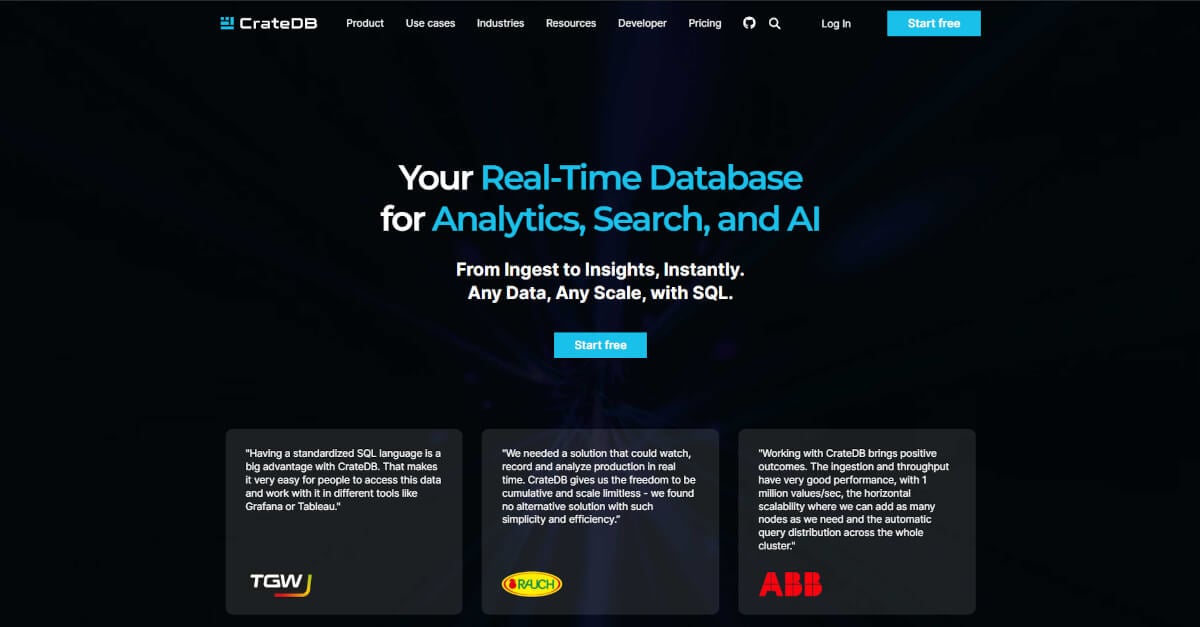 CrateDBFree plan, from $0.073Industrial, IoT and telemetry teams that ingest high-volume sensor or event data and need SQL analytics on it without a separate search or ETL layer.
About Time Series Databases
A time series database stores data that is indexed by time, such as sensor readings, market trades, metrics and logs. It is built to take in large volumes of timestamped events, keep them efficiently, and run queries over time windows such as averages, rollups and trends.
The products on this list differ in approach, scale and pricing model. QuestDB and CrateDB are open source engines built around SQL and high ingest rates, with QuestDB focused on low-latency finance and industrial data. TimescaleDB extends PostgreSQL, so teams keep their existing SQL and tools. VictoriaMetrics is a drop-in replacement for Prometheus, and TDengine and InfluxDB target industrial and telemetry data. Pricing ranges from free self-hosted editions to per-core and per-hour cloud plans, with several enterprise tiers priced by quote.
The 6 best Time Series Databases, compared
- Open source, Ent. quot
1.QuestDB
Best for: Capital markets and industrial teams that ingest high volumes of sensor or trade data and need real-time SQL over both live and historical records.
- Pricing
- Open source, Ent. quot
- Category
- Analytics & Data
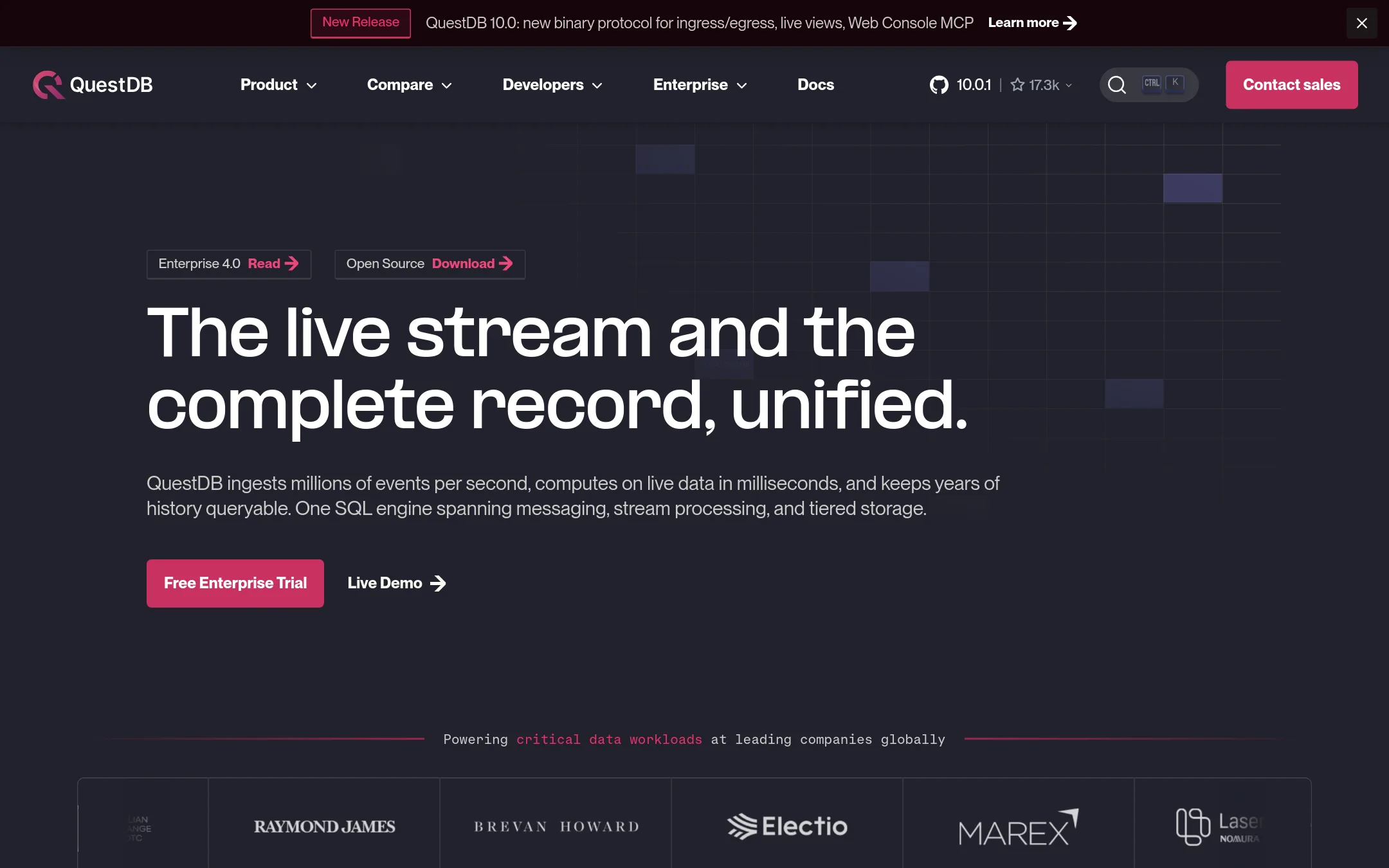
QuestDB is an open source time series database built for workloads where latency matters, such as market data and sensor feeds. It ingests ordered and out-of-order events, runs time-series SQL like ASOF JOIN and SAMPLE BY on live data, and tiers older data to Apache Parquet on object storage. Its credibility rests on production users like B3, One Trading and Airbus, and on open source benchmark results against InfluxDB and TimescaleDB.
Where it is strong
- Apache 2.0 license with open formats like Parquet and Iceberg, so data is not locked in
- Standard SQL with time-series functions such as ASOF JOIN and SAMPLE BY
- Tiered storage moves older data to object storage while keeping it queryable in one engine
Where it falls short
- Enterprise pricing is not published, so budgeting needs a sales conversation
- Teams without high ingest volumes or latency needs may find simpler time series tools easier to run
- Pricing:
- The open source edition is Apache 2.0 licensed, and Enterprise pricing is not published on the site.
- From $30/mo + storage
2.TimescaleDB
Best for: Engineering teams running factories, energy grids, fleets or other sensor and machine-data workloads that already use Postgres and want to keep SQL.
- Pricing
- From $30/mo + storage
- Category
- Analytics & Data
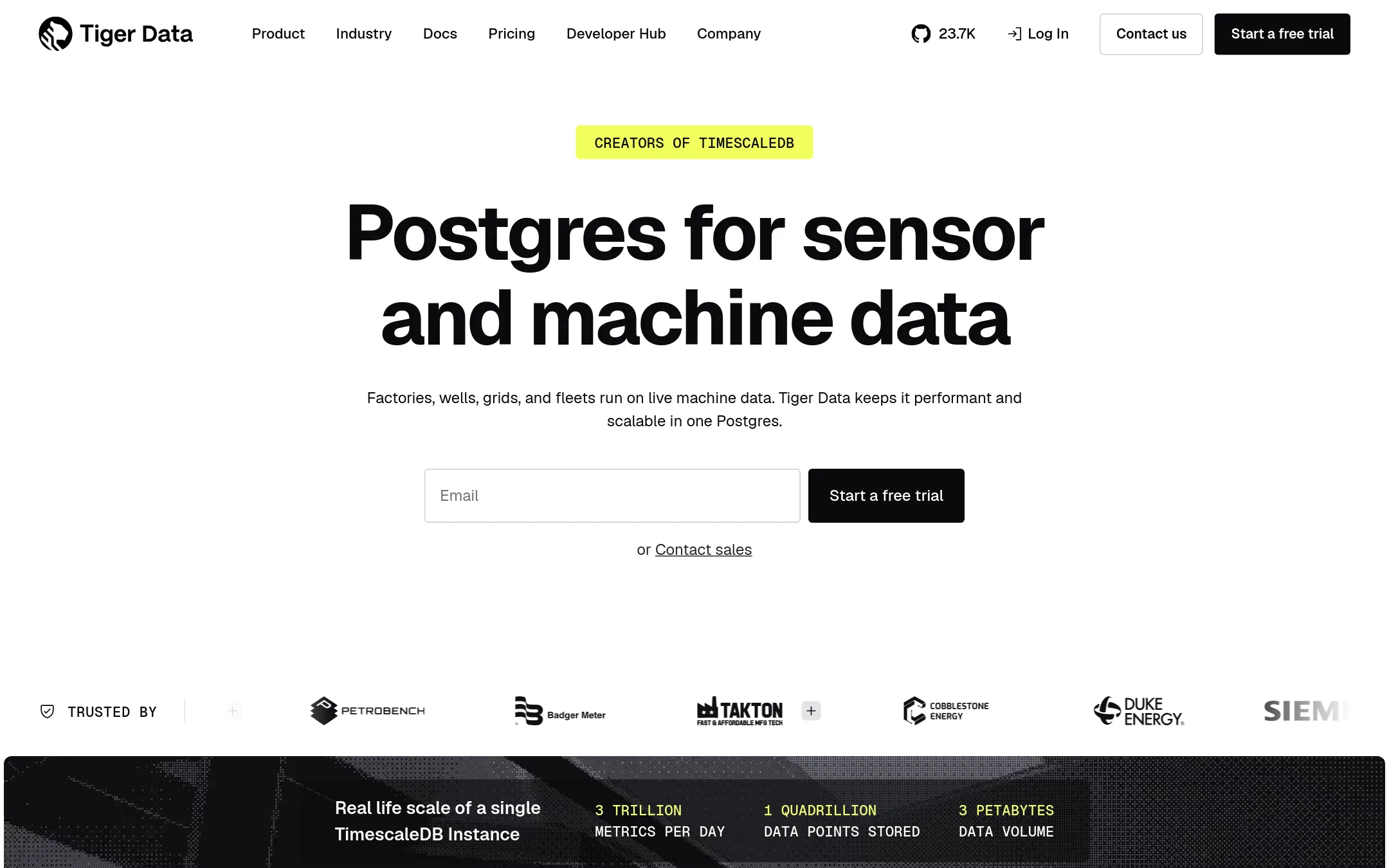
TimescaleDB is a PostgreSQL extension and cloud platform built for time-series data, with automatic time and key-based partitioning and a hybrid row-columnar engine that uses row storage for writes and columnar compression for analytics. Its strongest credibility point is the scale the site cites: 3 trillion metrics per day and 3 petabytes of data on a single instance. It also offers over 200 SQL functions for time-based analytics, so teams can keep working in standard Postgres.
Where it is strong
- Keeps full Postgres compatibility, so SQL, APIs and existing tooling carry over.
- Tiered storage moves colder data to low-cost object storage, which lowers long-term costs.
- Lakehouse integration ingests from Kafka and S3 and replicates to Iceberg.
Where it falls short
- Scale-tier features like read replicas, SAML SSO and HIPAA sit behind higher plans or Enterprise quotes.
- Storage pricing assumes around 5x compression, so savings depend on your data and actual compression ratios.
- Pricing:
- Compute starts at $30 per month and storage at $0.177 per GB-month on the Performance plan, while the Scale plan starts at $36 per month with storage at $0.212 per GB-month, and Enterprise pricing is by quote.
- Not published
3.VictoriaMetrics
Best for: Platform and infrastructure teams running Prometheus at a scale where it struggles, who want to keep their current queries and tooling.
- Pricing
- Not published
- Category
- Analytics & Data
VictoriaMetrics is a time series database that works as a drop-in replacement for Prometheus, so existing queries and setups carry over. It is built to handle very large volumes, with one customer reporting a 10x lower AWS bill after a proof-of-concept trial. It is open source, with enterprise and managed cloud options.
Where it is strong
- Drop-in compatible with Prometheus, so existing queries and code need no changes
- Open source core with a free self-hosted option
- Covers metrics, logs and traces, with Kubernetes and OpenTelemetry support
Where it falls short
- Pricing for enterprise and cloud plans is not published, so budgeting requires a sales conversation
- Self-hosting at scale still means someone on the team has to run and tune it, unless you choose the managed cloud
- Pricing:
- Pricing is not published on the site.
- Free core, custom plan
4.InfluxData
Best for: Engineering teams in aerospace, energy, manufacturing, or infrastructure monitoring that ingest high-rate sensor or telemetry data and need real-time analytics.
- Pricing
- Free core, custom plan
- Category
- Analytics & Data
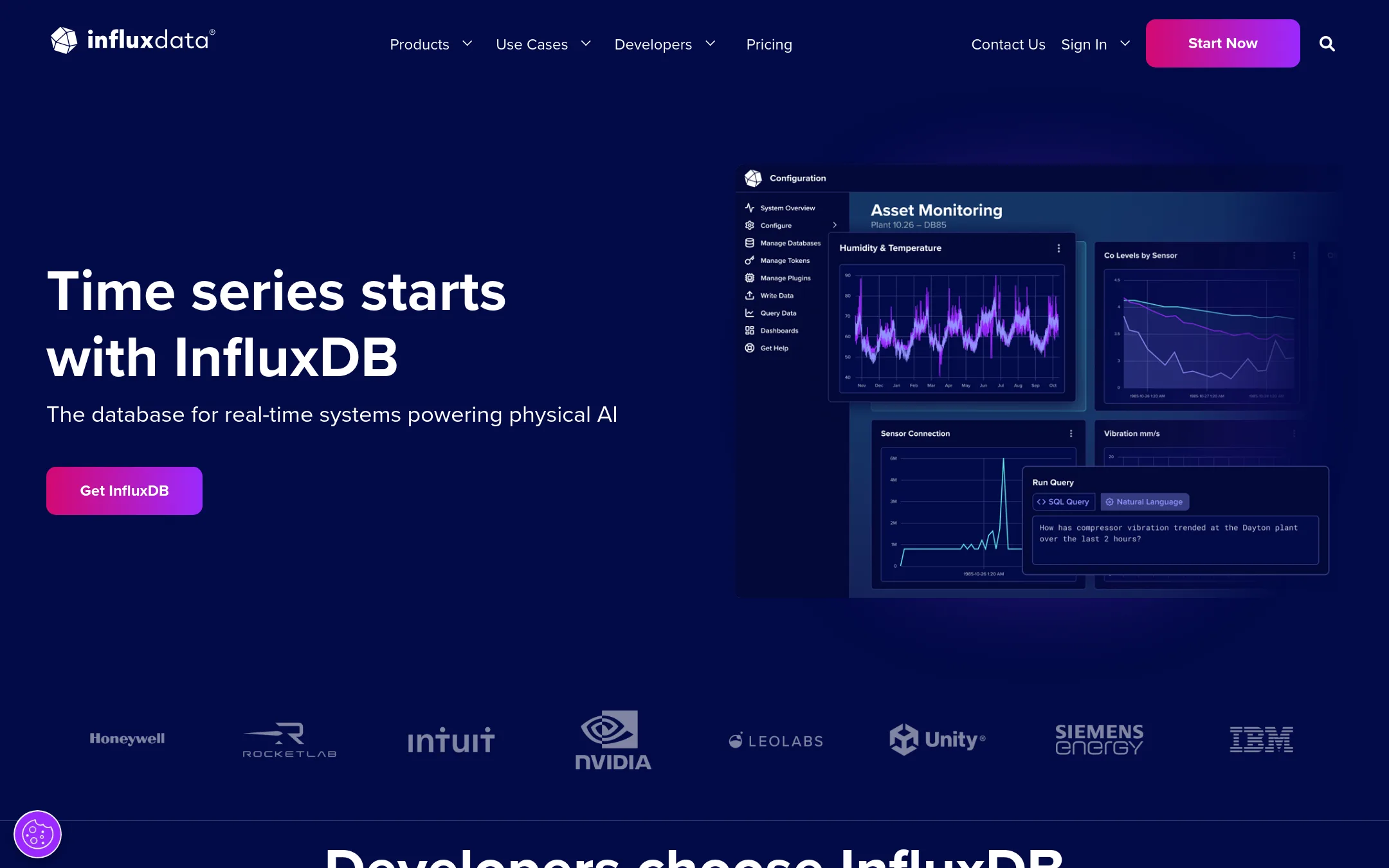
InfluxDB is built for continuous, high-resolution time series data from telemetry and edge devices, and it ingests millions of data points per second. The company reports over 1 billion downloads of InfluxDB and more than 5 billion downloads of its Telegraf collection agent, which gives it a large user base to draw on. It runs on-prem, at the edge, or in the cloud.
Where it is strong
- Ingests millions of data points per second on high-resolution data.
- Automatically moves cold data into lakes, warehouses, and AI pipelines.
- Deploys on-prem, at the edge, or in the cloud with one engine.
Where it falls short
- Enterprise and dedicated cloud tiers use custom pricing, so budgeting takes a sales conversation.
- The free core edition is community supported and lacks high availability and enterprise security.
- Pricing:
- InfluxDB 3 Core is free and self-managed, Cloud Serverless is pay-as-you-go with $250 of free credit, and Enterprise, Cloud Dedicated, and Telegraf Enterprise use custom pricing, with Telegraf Enterprise plans starting at $18,000 per year.
- From $5,000/yr (self)
5.TDengine
Best for: Industrial operators and manufacturers that collect large volumes of sensor data from OPC, MQTT, or Kafka sources and want a historian replacement.
- Pricing
- From $5,000/yr (self)
- Category
- Analytics & Data
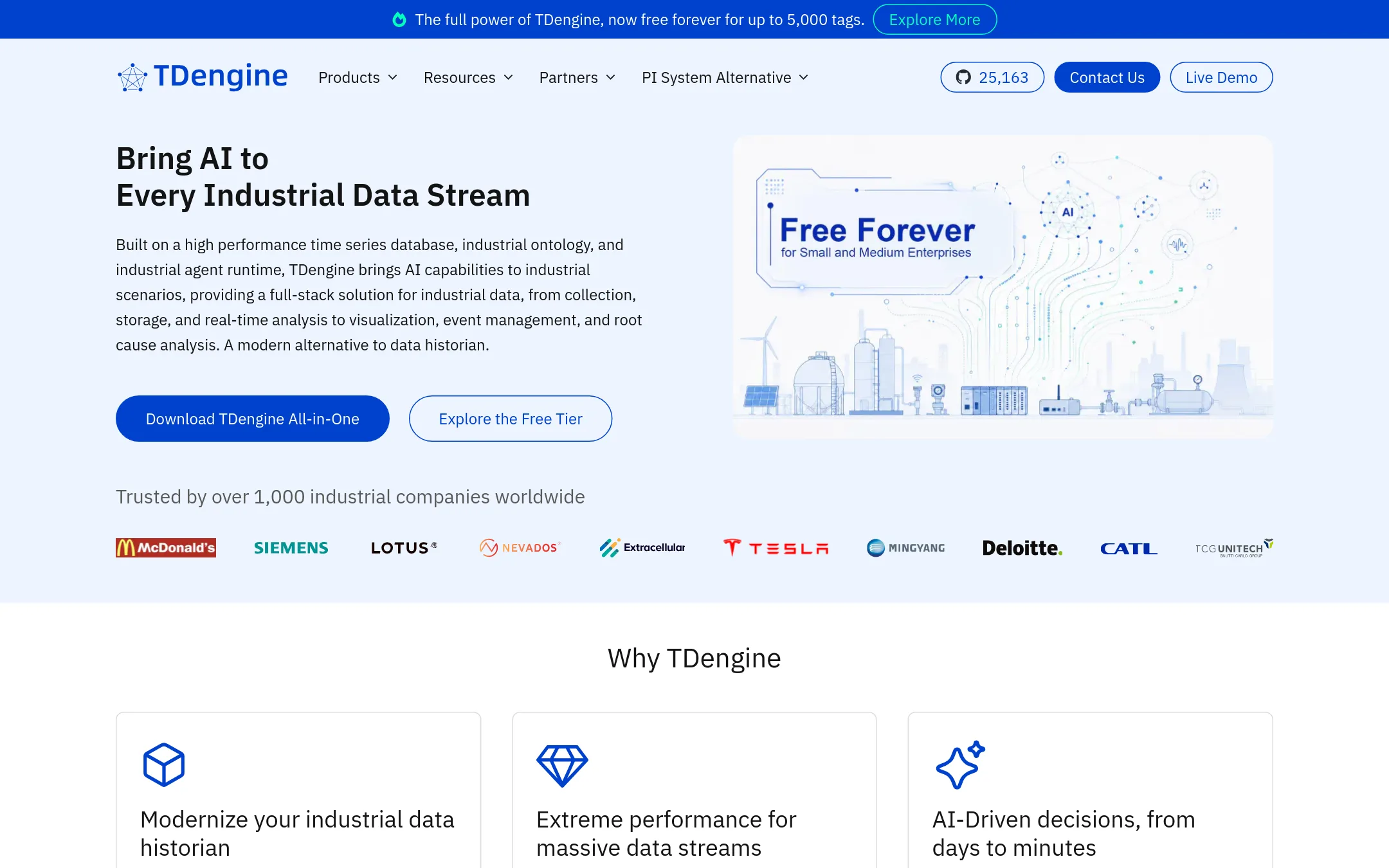
TDengine is a time-series database built for industrial sensor data, with ingestion, storage, and query engines designed for high-volume, high-cardinality streams. Its open-source core, TDengine TSDB-OSS, includes clustering and has about 24,000 GitHub stars. The platform also covers asset hierarchy modeling, stream processing, and AI-based anomaly detection and forecasting.
Where it is strong
- Built-in connectors for OPC, MQTT, Kafka, and PI System require no code.
- Storage engine claims more than 10 times the write and query speed of general-purpose databases, with up to 90% lower storage costs.
- Open-source core with clustering, plus deployment options at the edge, on premises, or in public and private cloud.
Where it falls short
- Dashboards, asset model UI, and alerting are not in the TSDB tier and require the higher-priced All-in-One product.
- Pricing is per core, and annual licenses for larger deployments climb quickly, so it is a weaker fit for small teams with little data.
- Pricing:
- Self-hosted TDengine TSDB-Enterprise starts at $5,000 per year for 1 core, and managed cloud plans start at $600 per month for 4 GB memory.
- Free plan, from $0.073
6.CrateDB
Best for: Industrial, IoT and telemetry teams that ingest high-volume sensor or event data and need SQL analytics on it without a separate search or ETL layer.
- Pricing
- Free plan, from $0.073
- Category
- Analytics & Data
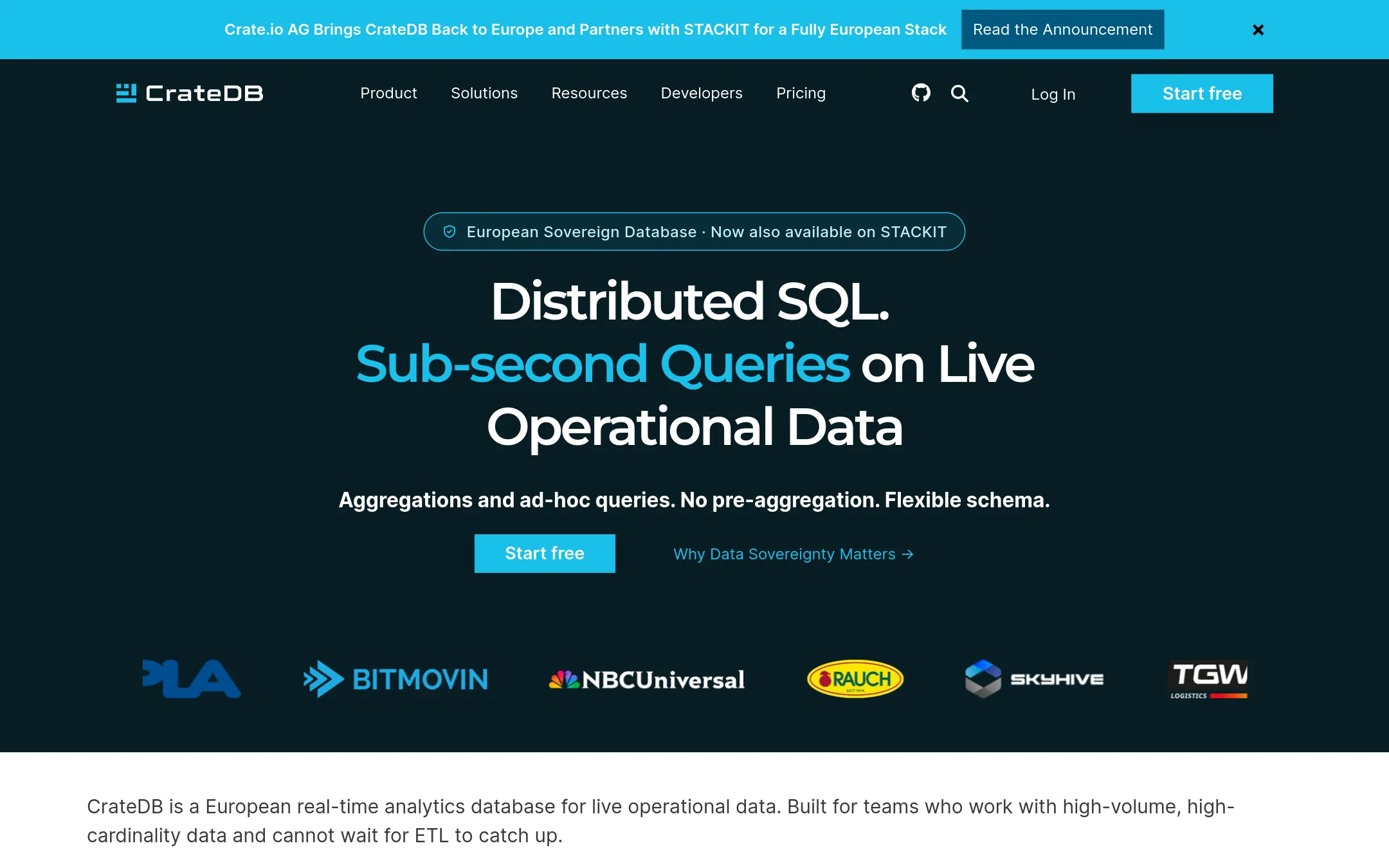
CrateDB is an Apache 2.0 licensed database that runs time-series aggregations, full-text search, geospatial joins and vector similarity in one SQL query over live data. It ingests millions of events per second from sensors and log streams without pre-aggregation. One customer reports 1 million values ingested per second, which gives a concrete sense of its throughput.
Where it is strong
- Standard SQL with PostgreSQL wire protocol, so existing clients and tools like Grafana and Tableau connect without rewriting
- Handles time-series, JSON, full-text, vector and geospatial data in one engine
- Apache 2.0 license and deployable on-prem, at the edge or in any cloud, which limits lock-in
Where it falls short
- Dedicated cloud pricing has several tiers, and premium support, custom backups and dedicated master nodes sit behind a contact-us step rathe
- Teams that only need simple relational queries on modest data may find a standard PostgreSQL setup less work to run
- Pricing:
- CrateDB Cloud has a free plan with 2 vCPUs, 2 GB RAM and 8 GB storage, shared single-node plans from $0.073 per hour, and dedicated environments from $0.246 per hour including basic support.
How to choose Time Series Databases
Start with pricing structure. Some products publish per-hour, per-GB or per-core rates, while others, including QuestDB Enterprise, VictoriaMetrics and InfluxDB Enterprise, do not publish enterprise pricing. Compare the real cost of your expected data volume, and remember that storage estimates depend on your compression ratio.
Check who the product is built for. TimescaleDB fits teams already invested in PostgreSQL, VictoriaMetrics fits teams running Prometheus, and TDengine fits industrial operators replacing a historian. Choosing a tool that matches your existing stack usually reduces the work of adoption.
Look at integrations. TDengine includes connectors for OPC, MQTT, Kafka and PI System, while CrateDB works with tools like Grafana and Tableau through the PostgreSQL wire protocol. TimescaleDB ingests from Kafka and S3 and replicates to Iceberg. Confirm that your sources and dashboards connect before you commit.
Consider data and compliance needs. Open formats such as Parquet and Iceberg reduce lock-in, and Apache 2.0 licensing makes self-hosting possible. Some compliance features, such as HIPAA and SAML SSO, sit behind higher plans, so check which tier includes what you need.
Finally, review support and contract terms. Free editions are often community supported and may lack high availability or enterprise security. Where pricing is by quote, ask what support, backup and uptime commitments are included before signing.
FAQ
Questions about Time Series Databases
What is a time series database used for?
It stores timestamped data such as sensor readings, metrics, logs and market trades, and runs queries over time windows. Teams use it for monitoring, industrial telemetry and financial data, where ingest speed and time-based analysis matter.
Can I keep using SQL with a time series database?
Yes, several options support it. QuestDB and CrateDB offer standard SQL, and TimescaleDB keeps full PostgreSQL compatibility, so existing queries and tools carry over.
Which option is free to start with?
Several have free paths. QuestDB's open source edition is Apache 2.0 licensed, VictoriaMetrics has a free self-hosted option, InfluxDB 3 Core is free and self-managed, and CrateDB Cloud has a free plan with limited resources.
How does pricing usually work for these products?
Pricing varies by product. TimescaleDB charges per compute and per GB of storage, TDengine charges per core for self-hosted licenses, and CrateDB Cloud charges per hour. Enterprise tiers for several products are priced by quote.
How should I choose between them?
Match the tool to your existing stack and data type. Teams on PostgreSQL may prefer TimescaleDB, teams on Prometheus may prefer VictoriaMetrics, and industrial operators with OPC or MQTT sources may prefer TDengine. Test your expected data volume before committing.
Last updated November 8, 2026.