10 Best AI Monitoring Tools in 2026
Updated November 8, 2026
The short answer
The strongest AI monitoring tools on this list are Dynatrace, Traceloop and Metoro. Dynatrace suits engineering and operations teams at mid-size to large companies that want one observability platform covering apps, infrastructure and AI workloads. Traceloop suits engineering teams shipping LLM apps who need to catch quality drops before users do, and it offers a free tier. Metoro suits platform and DevOps teams running Kubernetes who want alert investigation and deploy verification without instrumenting each service.
The shortlist, at a glance
Read the comparisons ↓ EvertuneCustom quoteMid-market brands and advertisers that want to track AI visibility and act on it with content and ChatGPT ad campaigns.
 DynatraceFrom $29/host/moEngineering and operations teams at mid-size to large companies running multi-cloud or Kubernetes estates who want one observability platform covering apps, infrastructure and AI workloads.
 AdenFrom $20/mo (credits)Operations and engineering teams that run autonomous agents on business workflows and need audit trails and isolated compute.
 TraceloopFree to 50k spans/moEngineering teams shipping LLM apps who need to catch quality drops before users do, including teams that want to run evaluations on every pull request.
MetoroFree plan, $0.20/GB ovPlatform and DevOps teams running Kubernetes clusters who want alert investigation and deploy verification without instrumenting each service.
 RaindropNot publishedTeams shipping AI agents to production who need to find silent failures and check changes before they merge.
 SensoFree trial, then custoBrand and marketing teams that want to track and correct how ChatGPT and other AI tools describe their company
 SentrialNot publishedStartups running production AI agents or support bots that need to catch silent regressions before users report them.
 OximyFrom $10/device/moCompanies with a Windows, Mac or Linux fleet that need to control what staff and coding agents send to AI tools, such as IT and security teams at mid-sized firms.
 ModaNot publishedTeams running AI agents in production that need to find silent failures and test fixes against real failed conversations.
About AI Monitoring Tools
AI monitoring tools track how AI systems behave in use. They record model prompts, responses, latency, costs, tool calls and failures, so teams can see when quality drops, when an agent goes wrong, or how a brand is described by AI assistants. Some of these tools also investigate incidents or check changes before they ship.
The products on this list differ in approach, scale and pricing. Some focus on LLM quality and evaluation, such as Traceloop and Moda. Others cover full infrastructure and application observability, such as Dynatrace and Metoro. A few track brand visibility inside AI answers, as Evertune and Senso do, and some govern what staff send to AI tools, as Oximy does. Pricing ranges from free tiers to usage-based and per-device plans, with several vendors publishing no price at all.
The 10 best AI Monitoring Tools, compared
- Custom quote
1.Evertune
Best for: Mid-market brands and advertisers that want to track AI visibility and act on it with content and ChatGPT ad campaigns.
- Pricing
- Custom quote
- Category
- Marketing & Sales
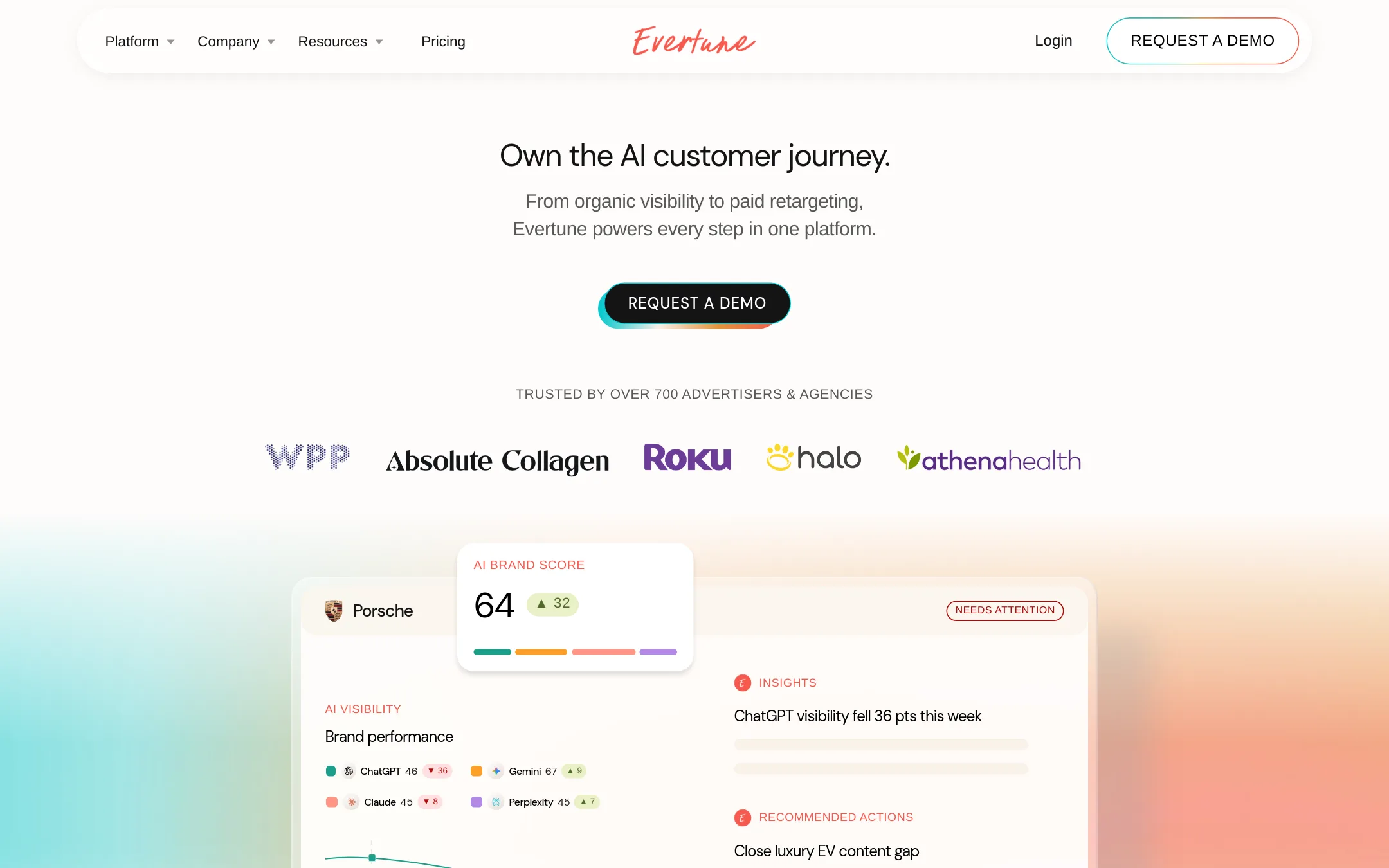
Evertune tracks how AI models like ChatGPT, Gemini, Claude and Perplexity describe a brand, sampling each prompt up to 100 times per model. Its prompt tracking is grounded in EverPanel, a proprietary panel of over 150 million real user prompts, which is a concrete basis for choosing what to measure.
Where it is strong
- Samples each prompt up to 100 times per model, with a stated margin of error of plus or minus 2 points
- Builds tracking prompts from a panel of over 150 million real user prompts
- Connects visibility data to content creation, site audits and ChatGPT ad campaigns in one platform
Where it falls short
- Pricing is not published on the site, so you need a demo to learn the cost
- The product spans tracking, content and advertising, so a team that only wants monitoring may pay for features it does not use
- Pricing:
- The Pro plan covers 100,000 prompts tracked across 11 AI models, with an Enterprise plan on custom quotes, and the site does not list a specific dollar price.
- From $29/host/mo
2.Dynatrace
Best for: Engineering and operations teams at mid-size to large companies running multi-cloud or Kubernetes estates who want one observability platform covering apps, infrastructure and AI workloads.
- Pricing
- From $29/host/mo
- Category
- Analytics & Data
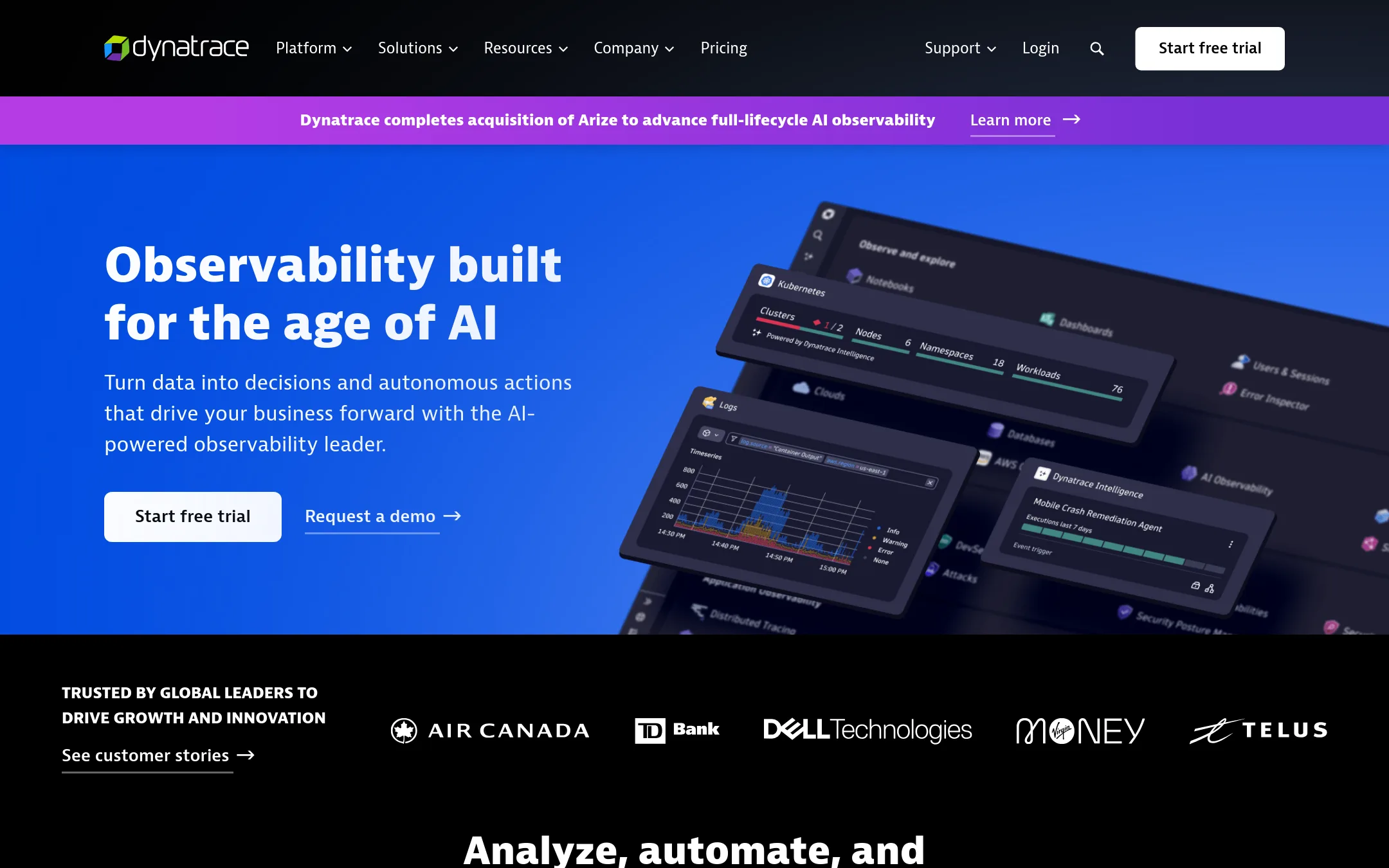
Dynatrace puts application performance monitoring, infrastructure visibility, log analytics, security and digital experience monitoring on one platform. Its deterministic AI engine runs causal root cause analysis and anomaly detection, which matters when you need a clear answer about what broke rather than a list of correlated alerts. The Grail data lakehouse lets teams query telemetry in context across all of those signals.
Where it is strong
- Causal root cause analysis that points to the failing component instead of raising many separate alerts
- Covers AI and LLM workloads, APM, infrastructure, logs and application security in one product
- Native OpenTelemetry support lets teams ingest telemetry from many sources without locking into one agent
Where it falls short
- Usage-based pricing across hosts, pods, containers, logs and retention is hard to forecast without a sizing exercise
- Full-featured setup suits larger engineering organizations better than small teams with a handful of services
- Pricing:
- Pricing is published as usage-based rates against an annual platform commitment, with Infrastructure Monitoring at $29 per host per month, Full-Stack Monitoring at $58 per 8 GiB host per month, and Log Analytics ingest at $0.20 per GiB.
- From $20/mo (credits)
3.Aden
Best for: Operations and engineering teams that run autonomous agents on business workflows and need audit trails and isolated compute.
- Pricing
- From $20/mo (credits)
- Category
- AI & Machine Learning
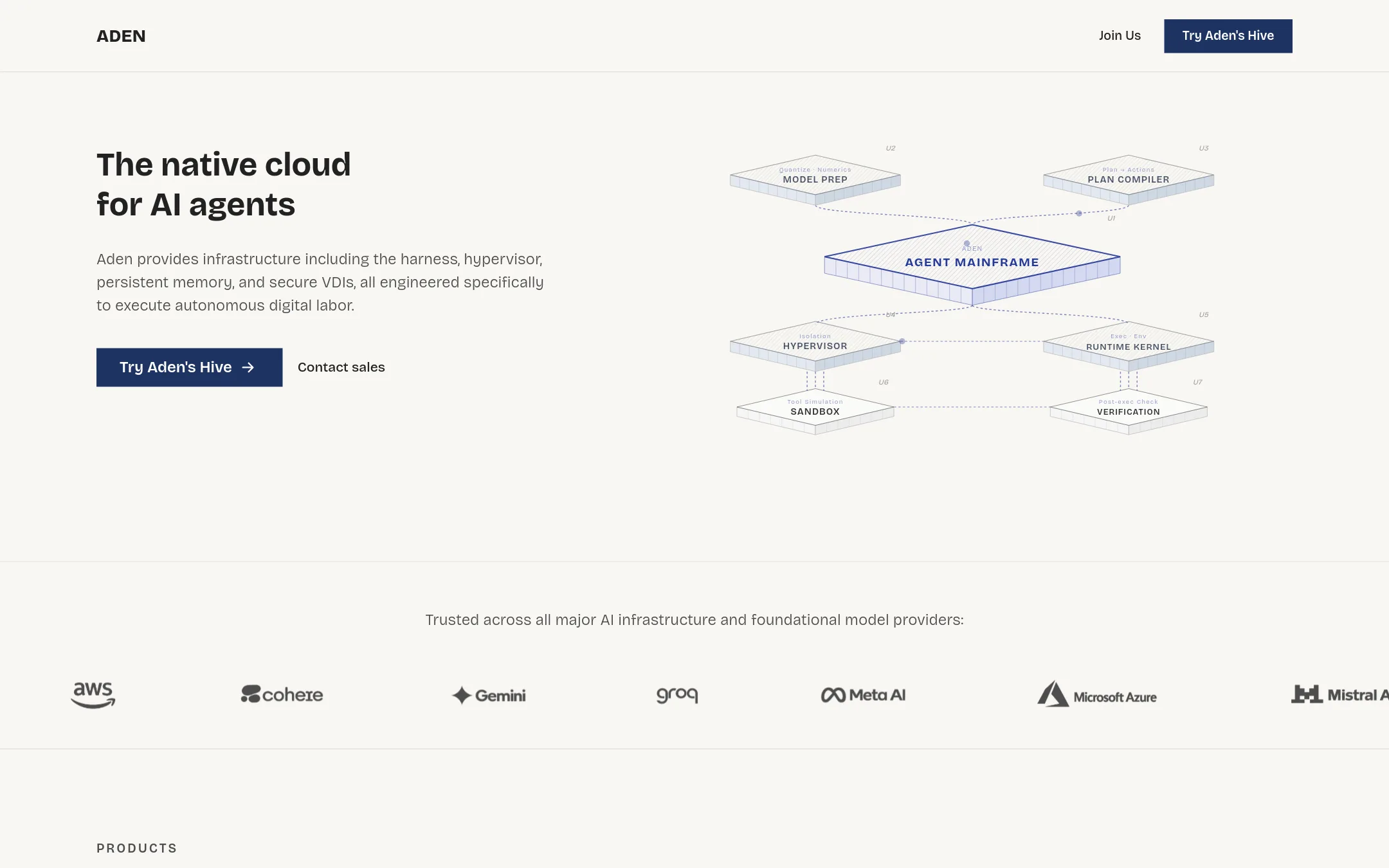
Aden is infrastructure built specifically for running AI agents, with a hypervisor, persistent memory, and secure VDIs in one stack. Its Hive product offers deterministic execution with full observability and audit trails, which matters if you need to see what an agent did and why. Dedicated GPU clusters with guaranteed SLAs and no shared tenancy set it apart from general-purpose clouds.
Where it is strong
- Deterministic execution with observability and audit trails in Hive
- Dedicated GPU clusters with guaranteed SLAs and no shared tenancy
- Free prototyping tier at 20 credits per day with no credit card needed
Where it falls short
- Built for agent workloads, so it is a poor fit for teams that only need basic monitoring of existing models
- Credit-based pricing makes monthly costs harder to predict until you measure your usage
- Pricing:
- Pricing starts at $20 per month for 500 credits on live workflows, rising to $200 per month for 20,000 credits, with a free prototyping tier of 20 credits per day shared among users and custom volume plans.
- Free to 50k spans/mo
4.Traceloop
Best for: Engineering teams shipping LLM apps who need to catch quality drops before users do, including teams that want to run evaluations on every pull request.
- Pricing
- Free to 50k spans/mo
- Category
- AI & Machine Learning
Traceloop gives live visibility into LLM prompts, responses, and latency after a single line of code. It runs built-in checks for faithfulness, relevance, and safety on real data, and can train custom evaluators on annotated examples. It is built on OpenTelemetry and ships an open-source SDK, OpenLLMetry, so teams are not locked in.
Where it is strong
- Setup is one line of code, with no tests to write before you see data.
- Supports 20+ providers, including OpenAI, Anthropic, Gemini, Bedrock and Ollama, plus vector DBs like Pinecone and Chroma.
- Built on OpenTelemetry with the Apache-2.0 OpenLLMetry SDK, so you can send data to other observability platforms.
Where it falls short
- Free tier caps at 50,000 spans a month, so high-volume apps will need a paid plan, and paid pricing is not published on the site.
- Compliance claims such as SOC 2 and HIPAA are stated on the site, but teams with strict audit needs should verify them directly.
- Pricing:
- Free for up to 50,000 spans per month with no seat limit, and on-prem or air-gapped deployment is offered.
- Free plan, $0.20/GB ov
5.Metoro
Best for: Platform and DevOps teams running Kubernetes clusters who want alert investigation and deploy verification without instrumenting each service.
- Pricing
- Free plan, $0.20/GB ov
- Category
- Developer Tools
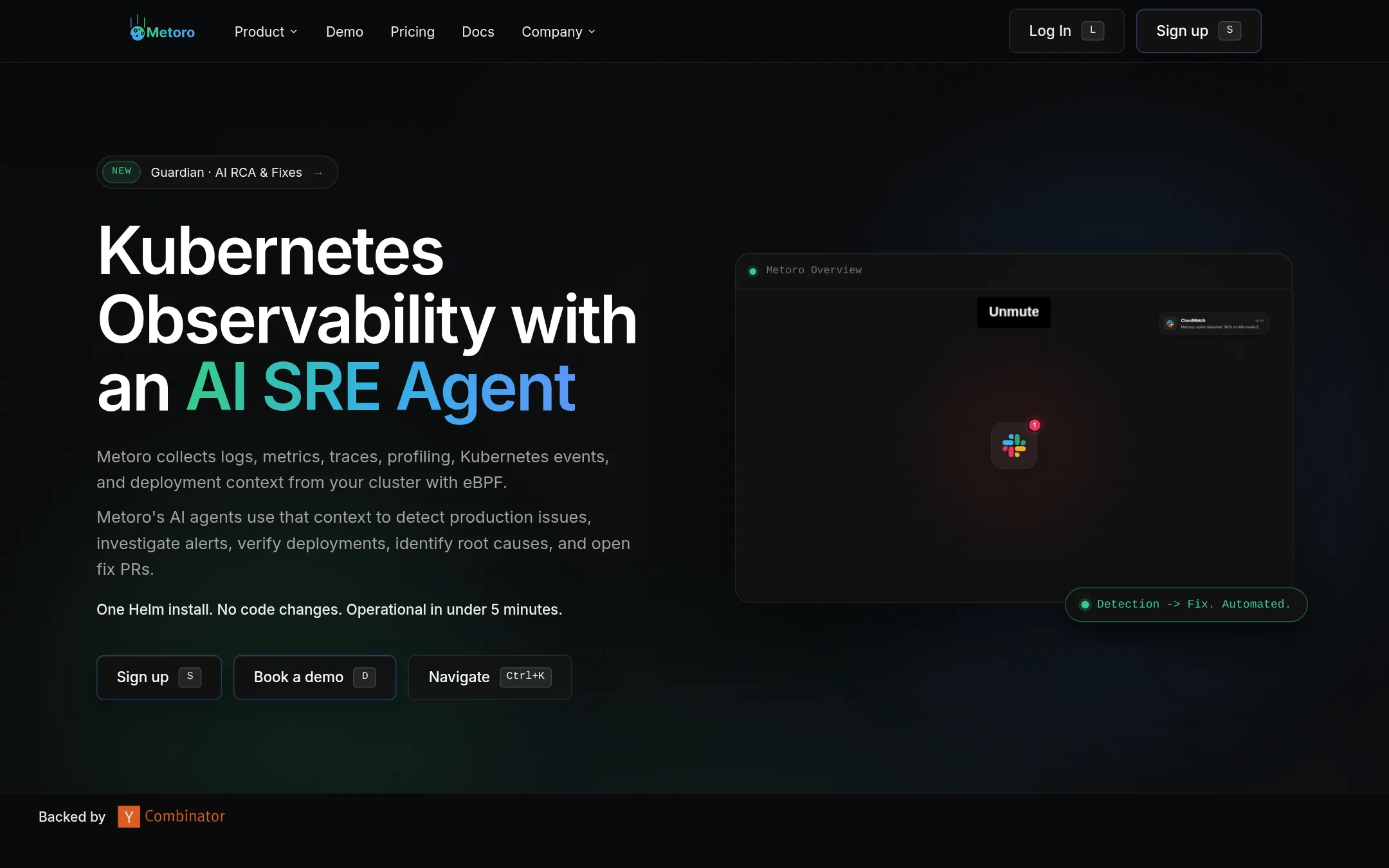
Metoro is an AI SRE agent built for Kubernetes teams. It collects logs, metrics, traces, profiling, events and deployment context with eBPF, so there is nothing to instrument in application code. The agents investigate alerts, verify deploys and can open fix PRs, and every signal arrives tied to the workload and rollout that produced it.
Where it is strong
- Installs as one Helm chart with no code changes or SDKs, and runs on EKS, GKE, AKS, OpenShift or bare metal.
- Correlates logs, traces, events and deploy metadata with Kubernetes identity, so the AI agent has context to work from.
- Verifies each deployment and investigates alerts automatically, returning root cause and next steps.
Where it falls short
- It is built for Kubernetes, so it does not cover VMs or serverless workloads outside a cluster.
- Usage beyond 100GB per node on Scale adds per-GB charges, which can grow with high log volume.
- Pricing:
- Hobby is free for 1 cluster, 1 user and 2 nodes, and the Scale plan is billed per node with $0.20/GB on usage over 100GB per node, while Enterprise pricing is custom.
- Not published
6.Raindrop
Best for: Teams shipping AI agents to production who need to find silent failures and check changes before they merge.
- Pricing
- Not published
- Category
- AI & Machine Learning
Raindrop traces every message and tool call in an agent run, so you can see where a run went wrong. It also groups recurring failures across runs into one issue with the original traces as evidence. Its simulation step shows results on pull requests before merge, which sets it apart from tools that only log production behavior.
Where it is strong
- Traces show each message and tool call, so you can find the exact step where a run failed
- Recurring failures get grouped into one issue with the original traces attached
- Simulation results appear on pull requests, so regressions can be caught before merge
Where it falls short
- Pricing is not published, so you will need to contact the company to learn the cost
- The listing does not describe integrations or supported frameworks, so check fit with your stack before committing
- Pricing:
- Pricing is not published on the site.
- Free trial, then custo
7.Senso
Best for: Brand and marketing teams that want to track and correct how ChatGPT and other AI tools describe their company
- Pricing
- Free trial, then custo
- Category
- AI & Machine Learning
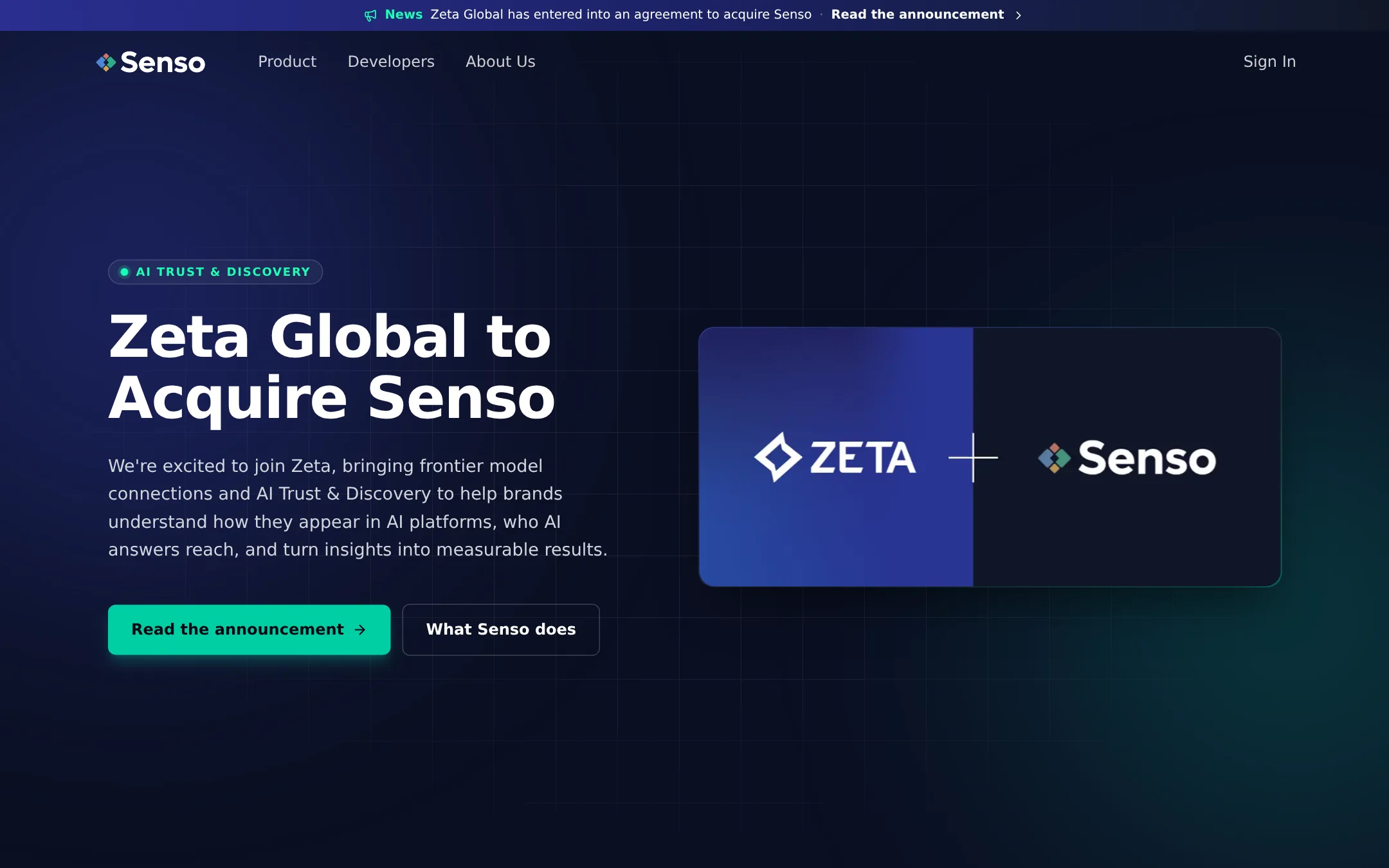
Senso ingests a company's ground truth, checks AI answers against it, and publishes verified sources that AI agents can read and cite. It shows which source an AI cited and whether that source was yours. The Zeta Global acquisition is a concrete sign the company is backed by an established marketing platform.
Where it is strong
- Shows which source an AI cited and whether it was your own
- Publishes verified sources that agents can read and cite
- Free trial available on the Brand plan to test baseline metrics
Where it falls short
- The free Brand plan tracks only one AI model, ChatGPT
- Partner plans with all AI models and advanced features require custom pricing with no published numbers
- Pricing:
- The Brand plan has a free trial limited in time, covering one AI model (ChatGPT), and Partner plans use custom pricing.
- Not published
8.Sentrial
Best for: Startups running production AI agents or support bots that need to catch silent regressions before users report them.
- Pricing
- Not published
- Category
- AI & Machine Learning
Sentrial records every agent run, including messages, tool calls, responses, timing and estimated token costs, so teams can see what their agent actually did. It also flags issues like user frustration, ungrounded answers and wrongful refusals, and can alert the team when a tool starts timing out, such as a billing lookup failing across 45 sessions in ten minutes.
Where it is strong
- Shows the tool calls and responses behind each failure, so you can see the evidence
- Compares changes on the same saved cases before you ship a prompt or code change
- Tiers scale by trace volume, with a free Developer plan to test it first
Where it falls short
- Pricing for the paid tiers is not published, so you need to ask for a quote to compare costs
- The free Developer tier keeps data for only 7 days, and automated issue grouping and advanced evaluations start at the Startup plan
- Pricing:
- Pricing is not published on the site, though the site lists plans by monthly trace volume: Developer at 10,000 traces per month, Startup at 1,000,000 traces per month, and Enterprise with unlimited traces.
- From $10/device/mo
9.Oximy
Best for: Companies with a Windows, Mac or Linux fleet that need to control what staff and coding agents send to AI tools, such as IT and security teams at mid-sized firms.
- Pricing
- From $10/device/mo
- Category
- AI & Machine Learning
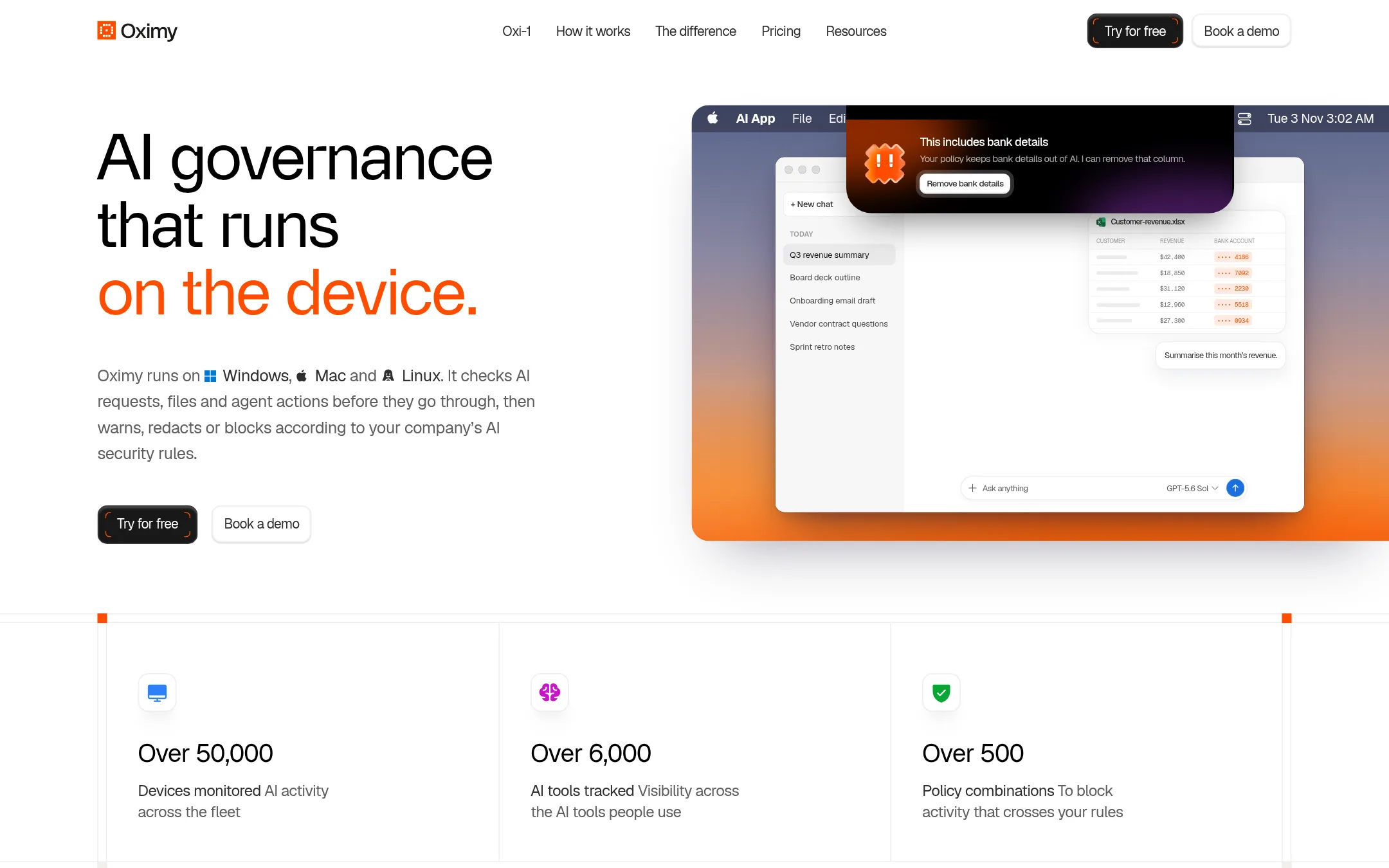
Oximy is an on-device AI governance tool that checks AI requests, files and agent actions before they leave the machine, then warns, redacts or blocks them under rules you write in plain language. Its own model, Oxi-1, reads prompts, files, images and screenshots locally, and it reports visibility across more than 6,000 AI tools on over 50,000 devices.
Where it is strong
- Checks run on the device, and Oximy receives only what was caught, not what was typed.
- Policies are written in plain language and can allow, warn, redact, ask for review or block.
- Covers coding agents, blocking actions like sending credentials or changing production configs.
Where it falls short
- Supported platforms are Windows 10 and 11, Apple silicon Macs on macOS 13 or later, and Linux, so Intel Macs and other systems are not cover
- Per-device pricing adds up across large fleets, and the 50+ tier, which includes SSO, SCIM and MDM deployment, requires a custom quote.
- Pricing:
- Self-serve pricing is $10 per device per month or $100 per device per year for 1 to 50 devices, with custom pricing for 50 or more devices and a free 3-day trial on one device with no card needed.
- Not published
10.Moda
Best for: Teams running AI agents in production that need to find silent failures and test fixes against real failed conversations.
- Pricing
- Not published
- Category
- AI & Machine Learning
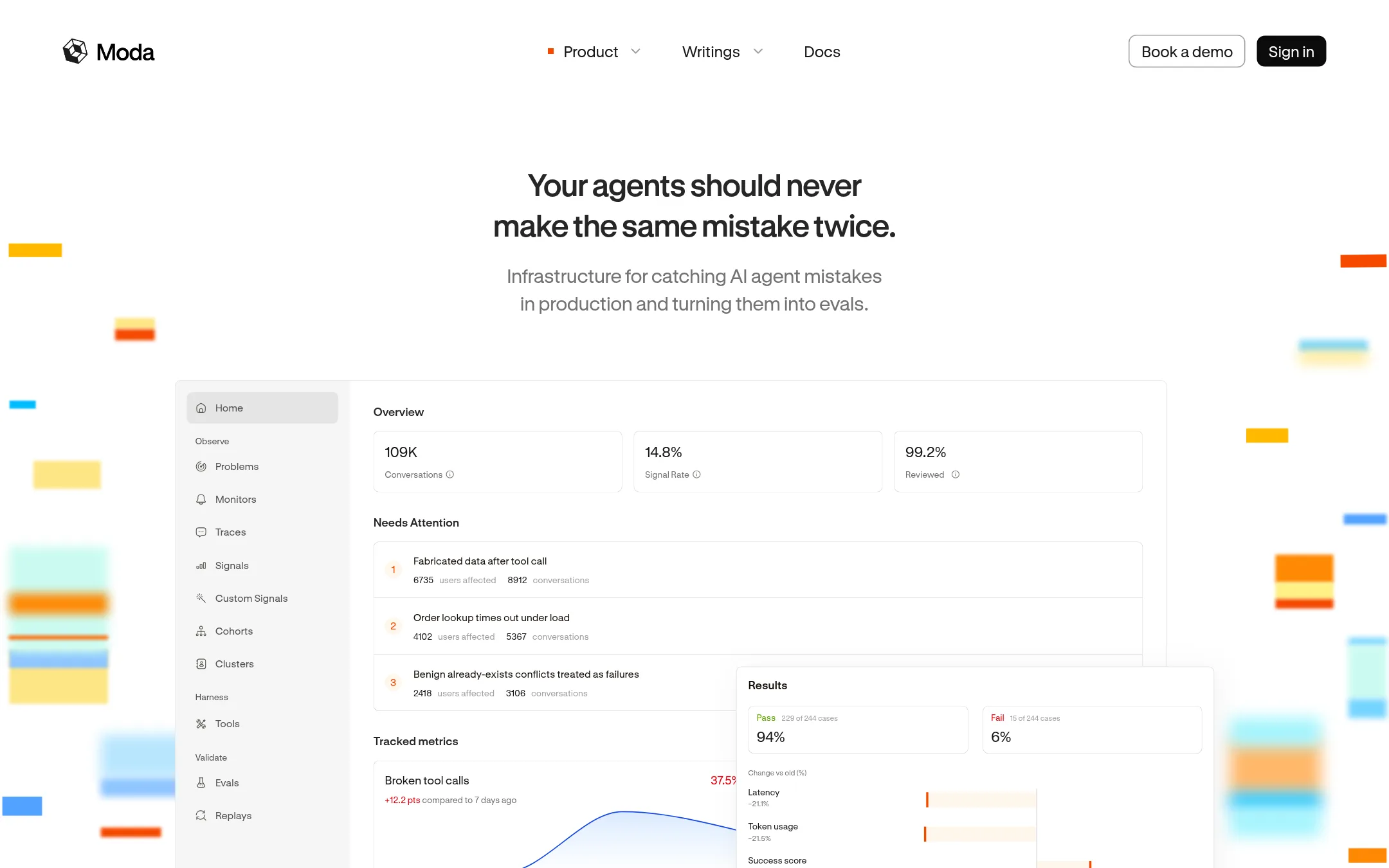
Moda reads every production trace from AI agents and catches failures that never throw an error, such as hallucinated order numbers or frustrated users. It groups these failures into problems ranked by how many users they hit, and each problem links back to the traces behind it. Its replay feature runs a prompt, model, or tool change against the exact traces that failed, so you can see pass rate, latency, and token changes before shipping.
Where it is strong
- Catches silent failures like fabricated data that throw no errors
- Ranks problems by number of users affected, so you know what to fix first
- Replays changes against the exact failed traces and shows pass rate, latency, and tokens
Where it falls short
- Pricing is not published, so you need to contact the team to learn the cost
- Its focus is production monitoring and evals, so teams looking only for basic tracing may find it more than they need
- Pricing:
- Pricing is not published on the site.
How to choose AI Monitoring Tools
Start with pricing structure. Some tools charge per host, per device, per trace, per credit or per GB of logs, and these costs can grow quickly with volume. Dynatrace and Metoro both bill on usage, so a sizing exercise helps before you commit. Several vendors on this list do not publish prices, so expect to request a quote.
Next, check who the product is built for. Dynatrace and Metoro target engineering and platform teams running large estates, while Traceloop and Sentrial fit smaller teams shipping LLM or agent apps. Oximy fits IT and security teams managing device fleets. A tool that fits one role well may be heavier or narrower than you need.
Look at integrations and platform support. Traceloop and Dynatrace both build on OpenTelemetry, which can reduce lock-in. Metoro runs on major Kubernetes services, but it does not cover VMs or serverless workloads outside a cluster. Oximy supports Windows, Linux and Apple silicon Macs on recent macOS, so Intel Macs are not covered.
Review data handling and compliance. Oximy keeps checks on the device and sends only what it catches. Traceloop lists SOC 2 and HIPAA claims and offers on-prem or air-gapped deployment, though teams with strict audit needs should verify these directly. Ask each vendor where your prompts and traces are stored.
Finally, review support and contract terms. Free tiers and trials let you test a product before buying, such as Traceloop's free tier, Aden's prototyping tier and Oximy's three-day trial. Check retention limits too, since Sentrial's free Developer tier keeps data for only seven days.
FAQ
Questions about AI Monitoring Tools
What is an AI monitoring tool?
An AI monitoring tool records how AI systems behave in use, including prompts, responses, latency, costs, tool calls and failures. Some also flag quality problems or investigate incidents. Tools on this list range from LLM tracing and evaluation to infrastructure observability and brand visibility tracking.
Which AI monitoring tool has a free option?
Traceloop offers a free tier for up to 50,000 spans per month with no seat limit. Metoro has a Hobby plan free for one cluster, one user and two nodes. Sentrial offers a free Developer plan, though its data retention is limited to seven days.
How is AI monitoring priced?
Pricing varies widely across the list. Dynatrace bills by host, memory and log ingest against an annual commitment. Aden uses monthly credits, Oximy charges per device, and Sentrial and others tier by trace volume. Several vendors, including Moda and Raindrop, do not publish prices.
Can AI monitoring tools track how AI assistants describe my brand?
Yes. Evertune tracks how models such as ChatGPT, Gemini, Claude and Perplexity describe a brand, sampling each prompt up to 100 times per model. Senso shows which source an AI cited and whether it was your own, though its free plan covers only ChatGPT.
Do these tools work with Kubernetes and OpenTelemetry?
Metoro is built for Kubernetes and installs as a Helm chart that runs on EKS, GKE, AKS, OpenShift or bare metal. Traceloop and Dynatrace both support OpenTelemetry, with Dynatrace offering native OpenTelemetry ingestion. Check each product's supported platforms before choosing.
Last updated November 8, 2026.