11 Best AI Security Platforms in 2026
Updated November 8, 2026
The short answer
The three strongest AI security platforms on this list are Cyble, PromptArmor and Unbound. Cyble suits security teams that want threat intelligence and external exposure monitoring in one platform, especially enterprises and government bodies. PromptArmor suits vendor security and third-party risk teams that review many AI vendors. Unbound suits engineering-heavy companies whose developers use AI coding agents and whose security teams need policy control over terminal and MCP access.
The shortlist, at a glance
Read the comparisons ↓ CybleNot publishedSecurity teams that want threat intelligence and external exposure monitoring in one platform, especially enterprises and government bodies.
 CinderNot publishedConsumer platforms and AI product teams that have content policies to enforce and need agents plus human review at high volume.
Adri AIFree plan, from $100SAP development teams and consultants planning an S/4HANA migration or handling custom ABAP, RAP, or CAP work.
 PromptArmorFree trial, EnterpriseVendor security and third-party risk teams that need to review many AI vendors and keep up with changes after onboarding.
 UnboundFrom $28/user/moEngineering-heavy companies whose developers use AI coding agents and whose security team needs visibility and policy control over terminal and MCP access.
 winfuncFrom $500 one-timeEngineering and security teams that want exploitability proof and reviewable fixes instead of unverified scanner alerts.
 Gecko SecurityFrom $100/mo, free triEngineering and security teams that ship code weekly and want fewer repeat vulnerabilities, not just faster ticket closure.
 GolfNot publishedSecurity and compliance teams at mid-size or larger companies that need to govern AI agents and MCP servers they did not set up themselves.
 TinfoilCustom quoteLegal, healthcare, and consumer AI teams that handle sensitive data and need verifiable privacy instead of vendor promises.
 MindFortFrom $499/moEngineering teams shipping often that want continuous penetration testing on live applications instead of an annual pentest report
CotoolNot publishedSecurity teams that want AI agents to handle detection and response and that want to read and edit the detection logic themselves.
About AI Security Platforms
AI security platforms are tools that protect AI systems, the data they touch, and the AI agents and models a company uses. Some watch for external threats and exposed assets. Others check third-party AI vendors for risk, filter content before it reaches users, control what coding agents can run, or test live applications for exploitable flaws.
The products on this list differ mainly in approach and scope. Some focus on threat intelligence and external monitoring, such as Cyble. Others focus on governing AI agents and MCP connections inside a company, such as Golf and Unbound. Several target engineering teams that want verified fixes, including winfunc, Gecko Security and MindFort. Pricing models vary as well. Some publish plans with fixed monthly prices, some use credits, and many keep pricing behind a sales conversation.
The 11 best AI Security Platforms, compared
- Not published
1.Cyble
Best for: Security teams that want threat intelligence and external exposure monitoring in one platform, especially enterprises and government bodies.
- Pricing
- Not published
- Category
- Security & Privacy
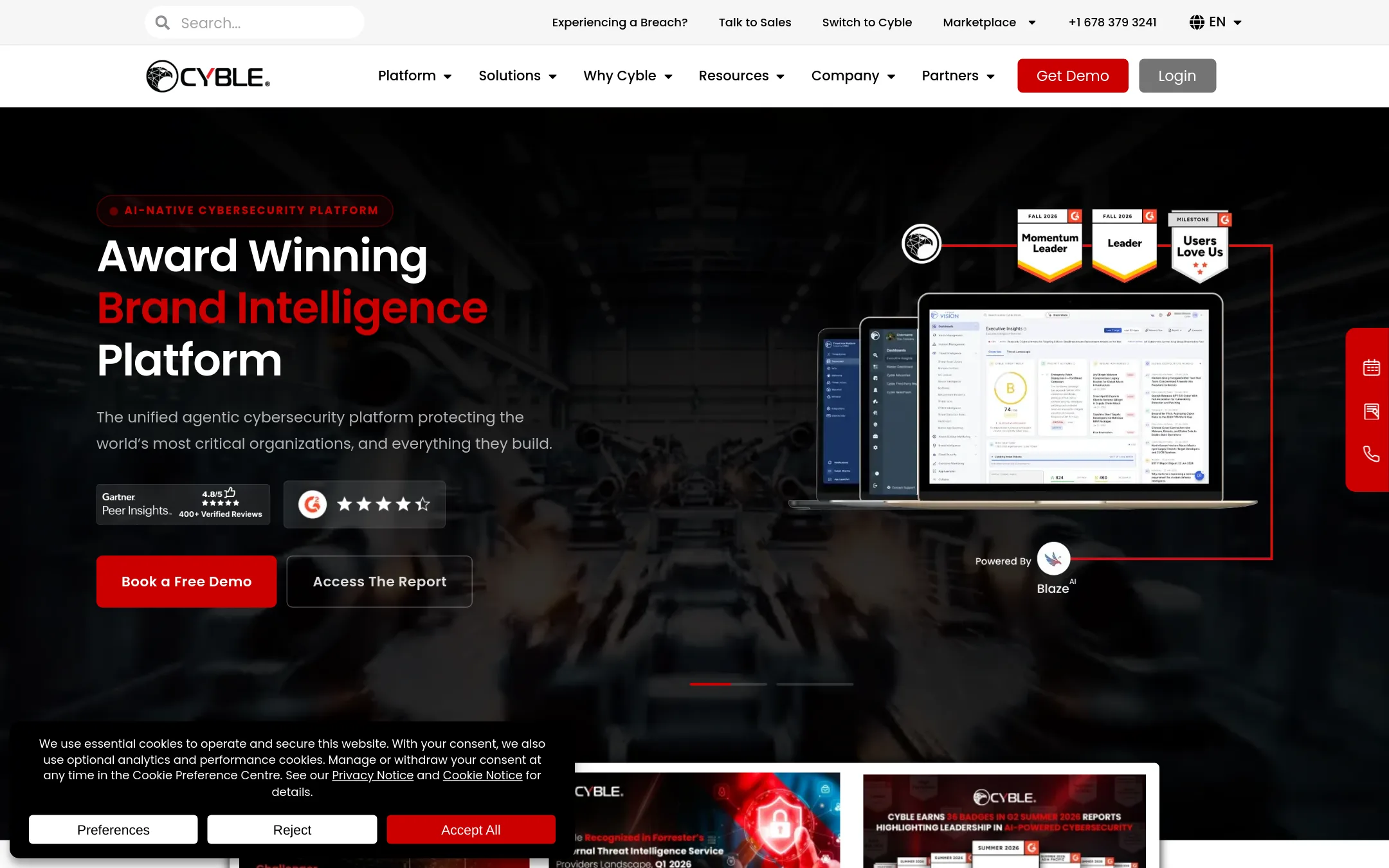
Cyble is an AI-native threat intelligence company that watches dark web, open and deep web sources and the customer's attack surface, then flags which threats are aimed at them. Its Vision product covers dark web monitoring, attack surface management and brand protection, while Titan adds agent-based endpoint security. Its Gartner Magic Quadrant challenger listing for cyberthreat intelligence is one reason it appears on this list.
Where it is strong
- Covers dark web, deep web and surface web sources in one feed.
- Bundles attack surface monitoring, brand protection and endpoint security under one vendor.
- Customer reviews cite early spotting of external exposures and data leaks.
Where it falls short
- Pricing is not published, so budgeting requires a sales conversation.
- Autonomous response features run under human-in-the-loop policy guards, so teams still need staff to approve actions.
- Pricing:
- Pricing is not published on the site.
- Not published
2.Cinder
Best for: Consumer platforms and AI product teams that have content policies to enforce and need agents plus human review at high volume.
- Pricing
- Not published
- Category
- AI & Machine Learning
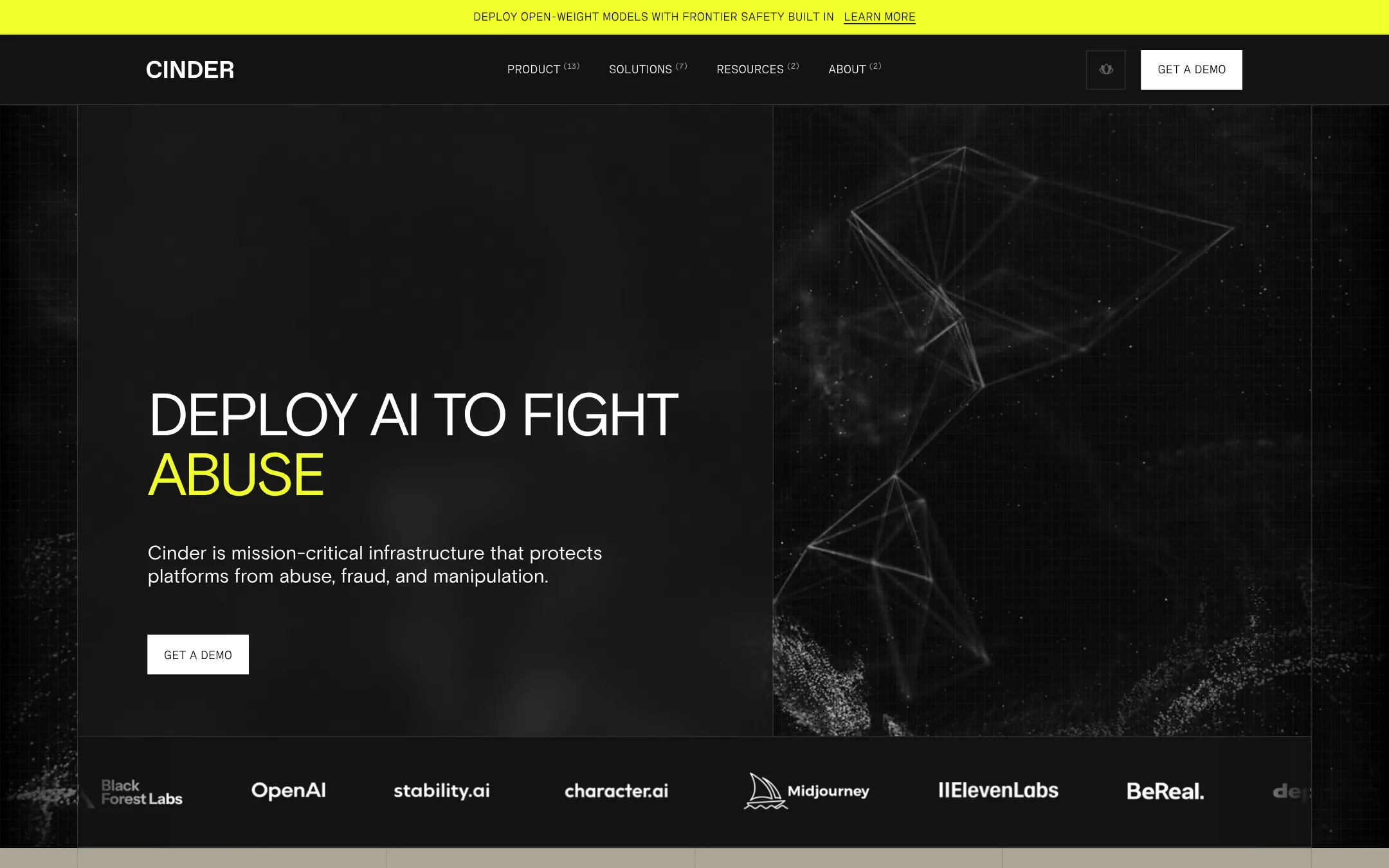
Cinder is a trust and safety platform that turns your policies into AI agents that screen prompts, model outputs, and multimodal content before risky interactions reach users. It also keeps every decision logged with stored reasoning, so audits and benchmarking are built in. The site names Synthesia as a customer that chose Cinder for moderation accuracy.
Where it is strong
- Agents are trained on your own policies and learn from reviewer decisions over time.
- Every decision and its reasoning is logged, which helps with audits and compliance paperwork.
- Connects to tools such as StopNCII, IWF, and Salesforce, and offers SOC2, GDPR, and HIPAA compliance.
Where it falls short
- Pricing is not published, so you will need to talk to sales to learn the cost.
- Integration needs engineering work for the API and webhooks, so it is less suited to very small teams without developers.
- Pricing:
- Pricing is not published on the site.
- Free plan, from $100
3.Adri AI
Best for: SAP development teams and consultants planning an S/4HANA migration or handling custom ABAP, RAP, or CAP work.
- Pricing
- Free plan, from $100
- Category
- Security & Privacy
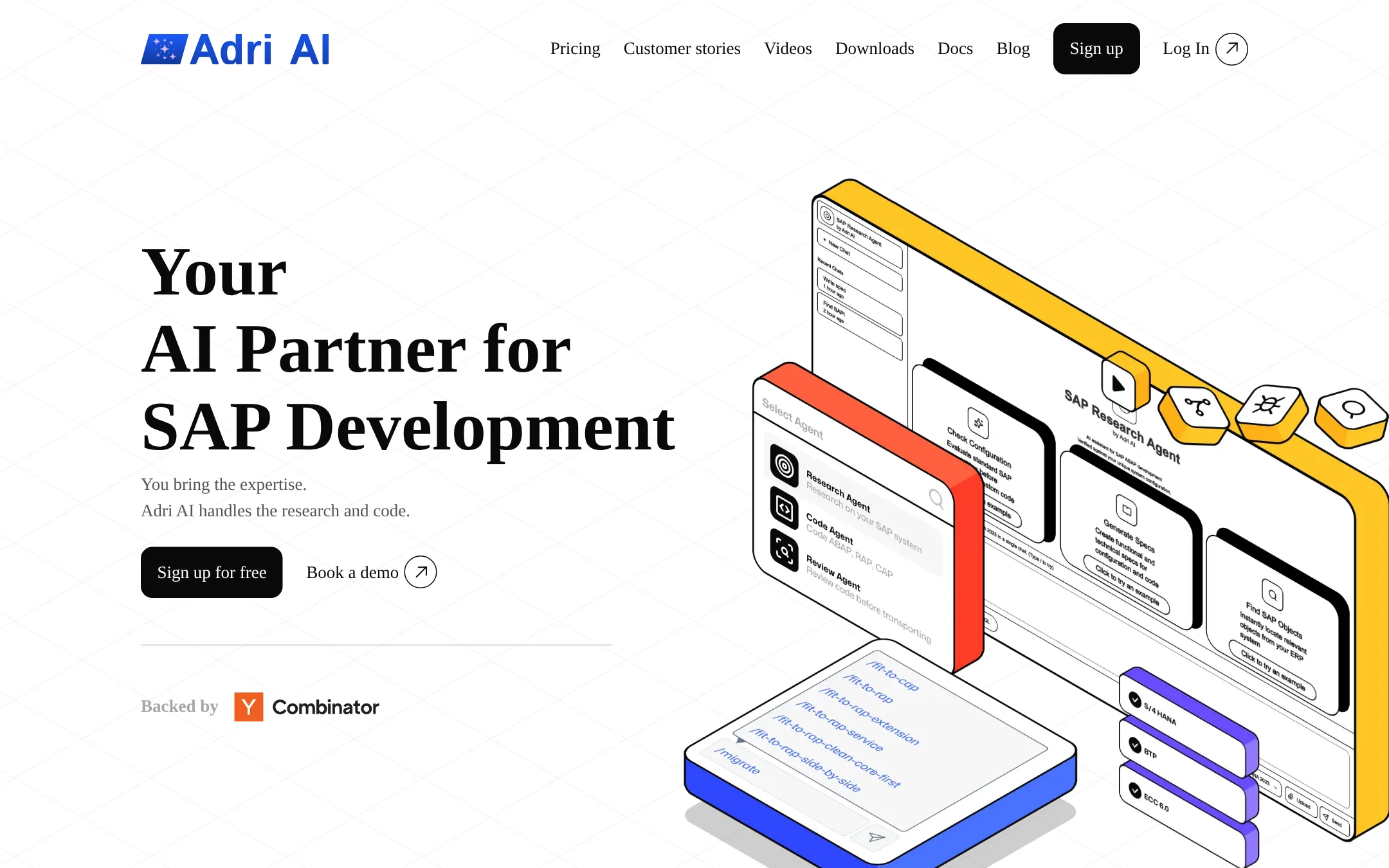
Adri AI is an agent platform for SAP development and S/4HANA migration. It runs technical assessments, searches over 50 million SAP objects to find what already exists before any custom code gets written, and generates ABAP code that it activates, debugs, and tests inside your own system. Its main claim to credibility is that the answers come from your actual system rather than generic training data.
Where it is strong
- Searches over 50 million SAP objects so teams can reuse standard functionality before writing custom code.
- Runs ATC checks and recommends a migration action for each custom object, such as retire, replace, or refactor.
- Works inside VS Code and through an MCP server, so developers can keep their existing tooling.
Where it falls short
- Connecting your own system costs extra on the Starter tier, and the free plan only covers learning and demo systems.
- Enterprise-level features like on-premise deployment and SSO sit behind custom pricing, so mid-sized buyers may not get them without a sales
- Pricing:
- A free plan includes one project and 300k tokens per conversation, Starter adds 5 million tokens for $100 per module to connect your own system, Professional offers 15 million tokens with unlimited projects, and Enterprise is custom.
- Free trial, Enterprise
4.PromptArmor
Best for: Vendor security and third-party risk teams that need to review many AI vendors and keep up with changes after onboarding.
- Pricing
- Free trial, Enterprise
- Category
- Security & Privacy
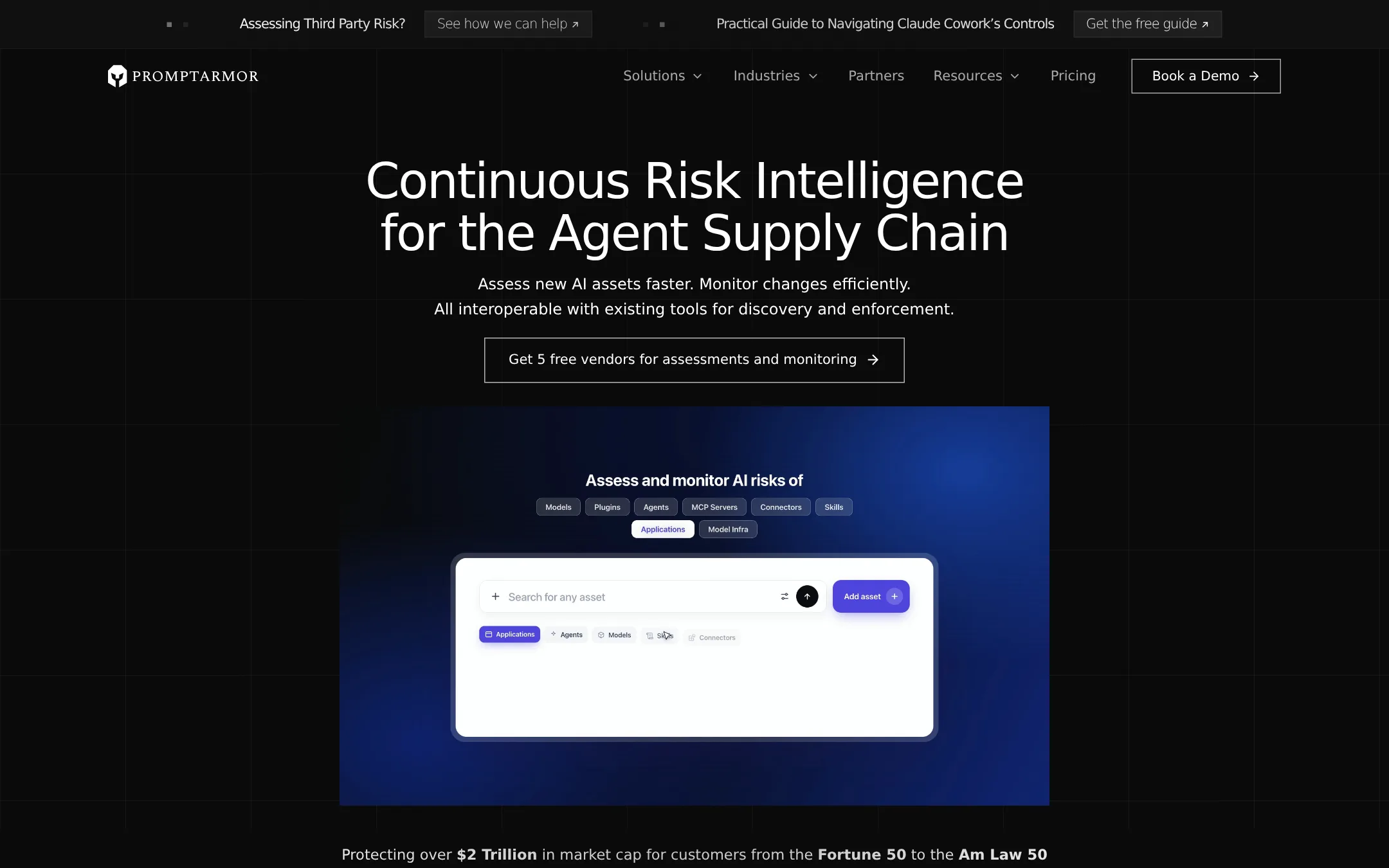
PromptArmor assesses and continuously monitors AI-related risk in third-party vendors, scoring each AI asset across 26 risk vectors. Its reports map findings to NIST AI RMF, OWASP LLM Top 10 and MITRE Atlas, which gives security teams a recognized basis for reviews. It also tracks vendor changes such as new models or expanded data access as they happen.
Where it is strong
- Scores AI assets across 26 risk vectors and maps results to NIST AI RMF and OWASP LLM Top 10
- Monitors vendor portfolios and alerts on changes such as default training opt-ins and new data access
- Offers API access, role-based access control and SSO/OAuth for existing workflows
Where it falls short
- Built for vendor risk review, so it does not secure your own internal LLM apps or prompts
- Enterprise pricing is not published, so budgeting requires a sales conversation
- Pricing:
- The free trial covers up to 5 AI applications with one month of continuous monitoring, and Enterprise coverage scales up to unlimited applications, but exact Enterprise prices are not published on the site.
- From $28/user/mo
5.Unbound
Best for: Engineering-heavy companies whose developers use AI coding agents and whose security team needs visibility and policy control over terminal and MCP access.
- Pricing
- From $28/user/mo
- Category
- Security & Privacy
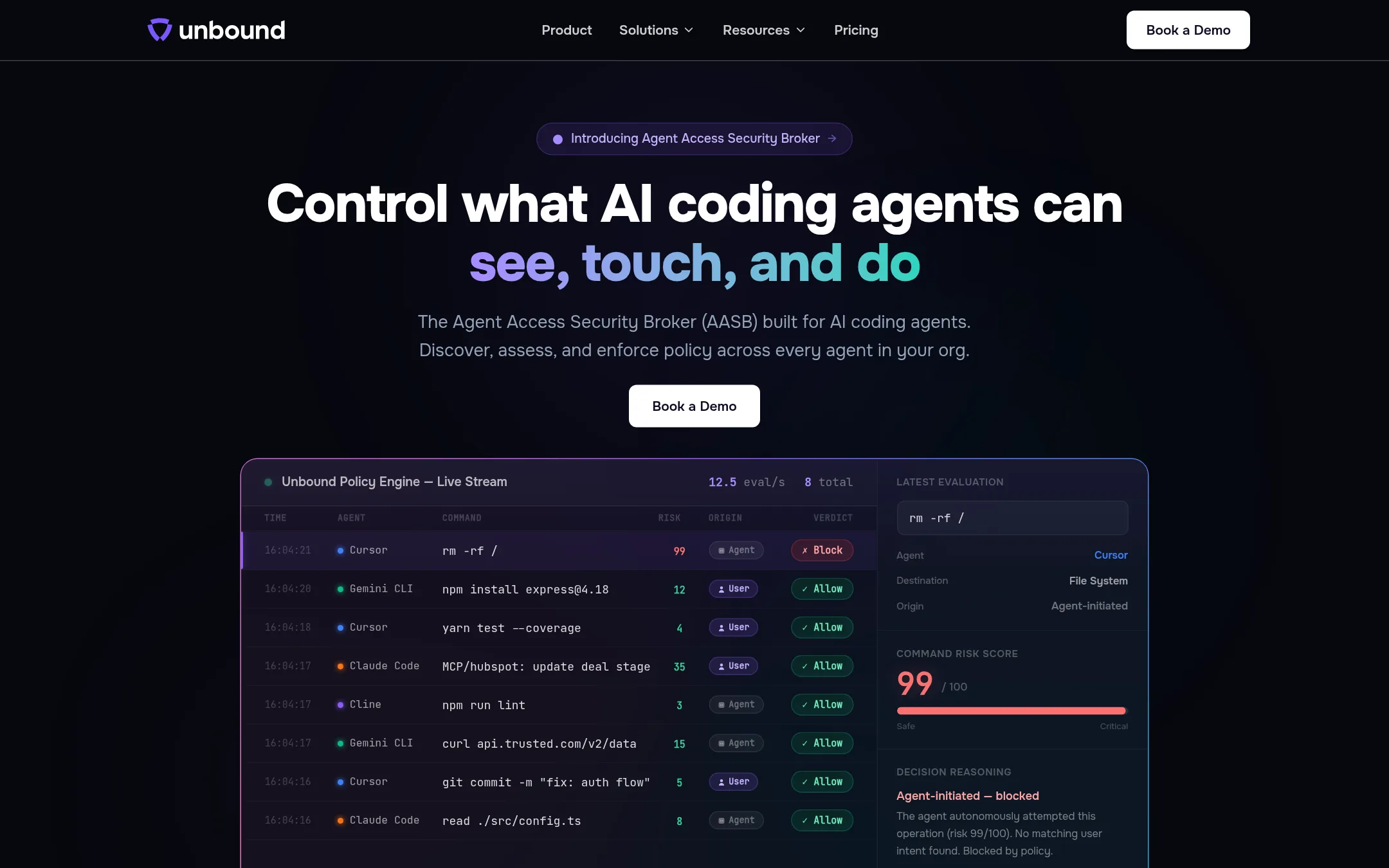
Unbound is an Agent Access Security Broker built for AI coding agents such as Claude Code, Cursor, Windsurf and GitHub Copilot. It inventories agents, MCP servers and IDE plugins across an engineering org, then enforces allow and deny rules on terminal commands and MCP actions. It works through native lifecycle hooks, so teams do not need a proxy or agent reinstall.
Where it is strong
- Finds Claude Code, Cursor, Windsurf, Copilot and Cline installs plus their MCP servers in a single scan.
- Lifecycle hooks work with no code changes or developer workflow disruption.
- Terminal and MCP policies can audit, warn, block or require human approval, with a full audit log.
Where it falls short
- Enterprise features like SSO, RBAC, SCIM and SIEM export sit behind the higher tier, and the 10% passthrough fee adds to the bill.
- Pro defaults to audit-only mode after usage limits, and its support is an email SLA of 48 hours, so it suits teams that can handle that resp
- Pricing:
- Pro is billed annually with no user minimum and includes 5,000 tool use evals per user per month, and Enterprise starts at $28 per user per month plus a 10% API governance fee on LLM passthrough.
- From $500 one-time
6.winfunc
Best for: Engineering and security teams that want exploitability proof and reviewable fixes instead of unverified scanner alerts.
- Pricing
- From $500 one-time
- Category
- Security & Privacy
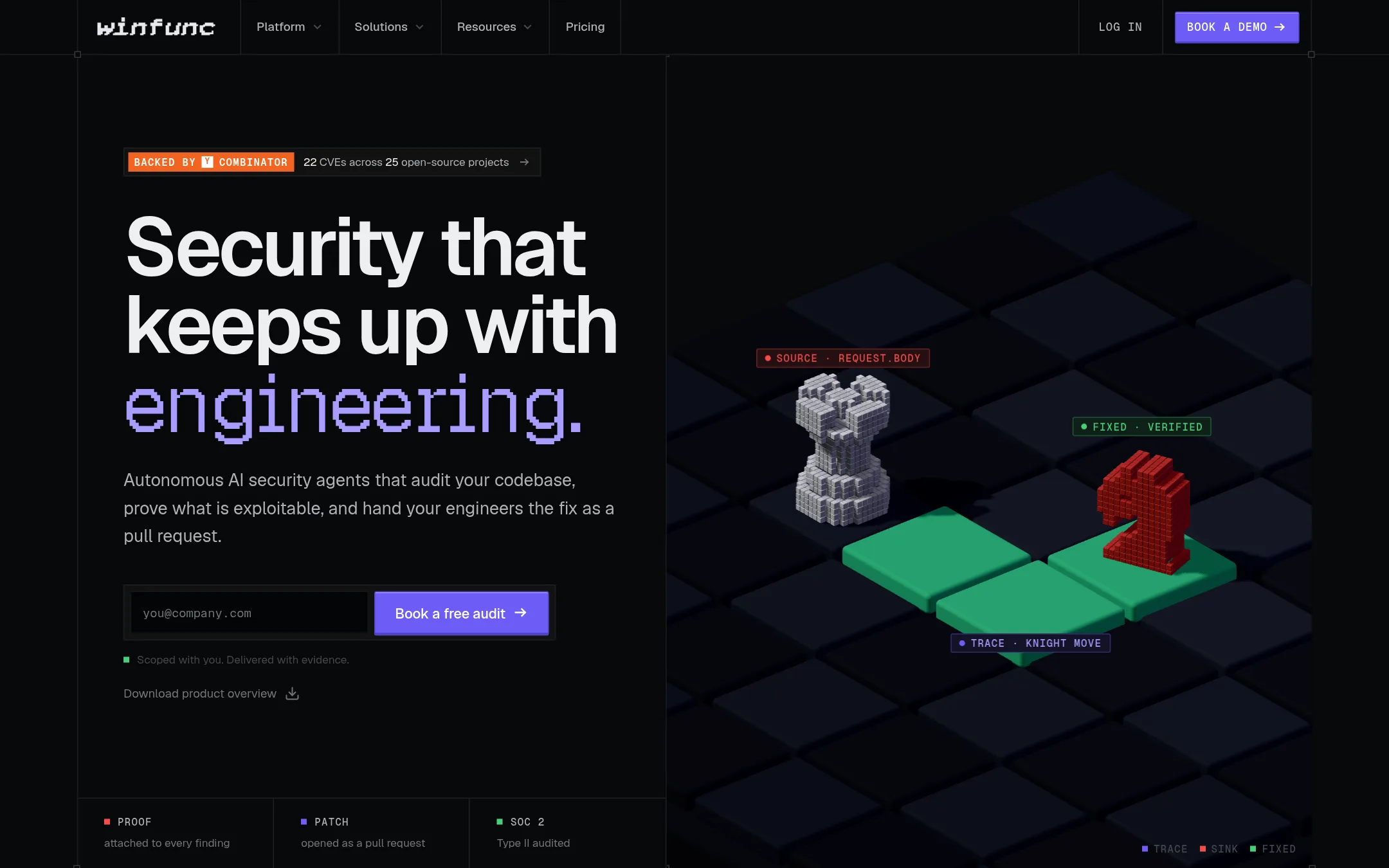
Winfunc uses autonomous AI agents to audit a codebase, trace untrusted input to dangerous operations, reproduce exploits in an isolated environment, and open the fix as a pull request. Every finding carries a code trace, a reproduction, and a patch, which makes it easier to judge than a raw alert list. Its public record includes disclosed issues in NGINX, Chromium, and Node.js, and the company reports SOC 2 Type II.
Where it is strong
- Attaches a code trace and isolated reproduction to each finding
- Opens suggested fixes as pull requests for engineers to review
- Reports SOC 2 Type II and offers revocable read-only MCP keys
Where it falls short
- Enterprise hosting, identity, and isolation terms are scoped by agreement rather than listed publicly
- Credits are estimated before each scan, so heavy usage on pay-as-you-go needs budgeting
- Pricing:
- A one-time surface scan starts at $500, with pay-as-you-go credits and monthly or annual recurring plans also offered, and Enterprise pricing is custom.
- From $100/mo, free tri
7.Gecko Security
Best for: Engineering and security teams that ship code weekly and want fewer repeat vulnerabilities, not just faster ticket closure.
- Pricing
- From $100/mo, free tri
- Category
- Security & Privacy
Gecko reads code, infrastructure and design docs together, so it can find business logic flaws and multi-step attack chains that pattern-matching scanners miss. It ranks findings by the attack path they form and opens one pull request that fixes the root cause and every variant it created. Customers quoted on the site include Chevron's CISO and a Fortune 500 financial institution, though those are testimonials, not independent verification.
Where it is strong
- Finds business logic flaws and multi-step attack chains, not just pattern matches
- Fixes the design decision behind a finding and its variants in one pull request
- Guardrails enforce the fix on every PR, including inside AI coding agents
Where it falls short
- Enterprise pricing is only available through a sales call, so budgeting ahead is harder
- The free trial is capped at 10 scans, which may run out quickly for larger repositories
- Pricing:
- The Pro plan is $100 per month and includes 100 scans, PR checks and Jira, Linear and Slack integrations, while Enterprise uses custom annual billing and a free trial covers 10 scans.
- Not published
8.Golf
Best for: Security and compliance teams at mid-size or larger companies that need to govern AI agents and MCP servers they did not set up themselves.
- Pricing
- Not published
- Category
- Security & Privacy
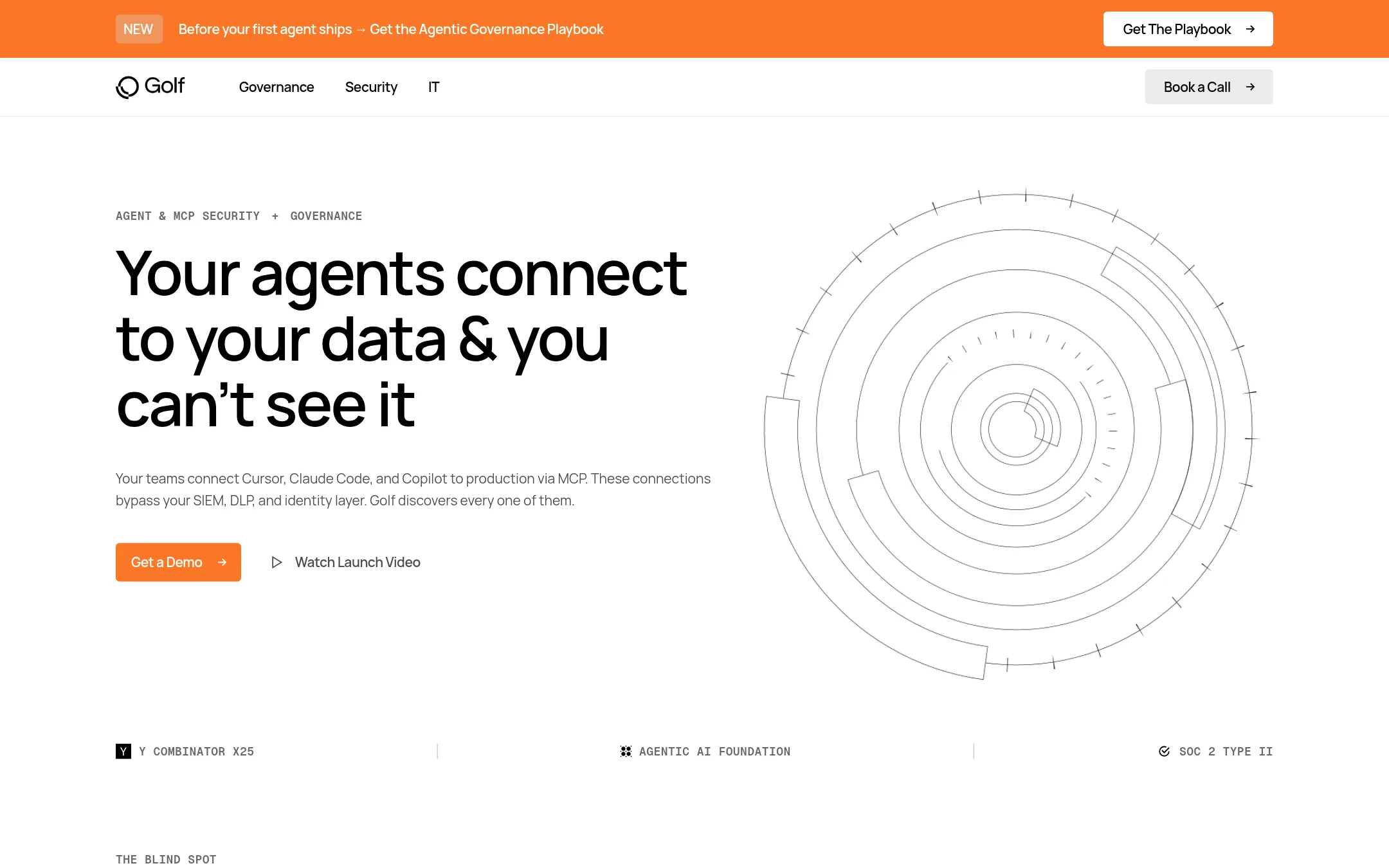
Golf discovers the AI agents and MCP connections running inside an organization, including ones IT never approved. It sits in the traffic path through an MCP Gateway, where teams set policies per tool, team, and data source to block PII exposure and credential leaks. A 90-day audit trail of prompts and actions, pre-mapped to SOC 2, ISO 27001 and NIST AI RMF, gives security teams evidence they can hand to auditors.
Where it is strong
- Finds shadow AI tools and MCP connections across endpoints
- Enforces policies with sub-millisecond latency at the gateway
- Exports audit evidence pre-mapped to SOC 2, ISO 27001, NIST AI RMF and FINRA
Where it falls short
- Pricing is not listed, so you need a sales conversation to compare costs
- Built for security-led rollouts, so it is a poor fit for small teams with a handful of AI tools
- Pricing:
- Pricing is not published on the site.
- Custom quote
9.Tinfoil
Best for: Legal, healthcare, and consumer AI teams that handle sensitive data and need verifiable privacy instead of vendor promises.
- Pricing
- Custom quote
- Category
- Security & Privacy
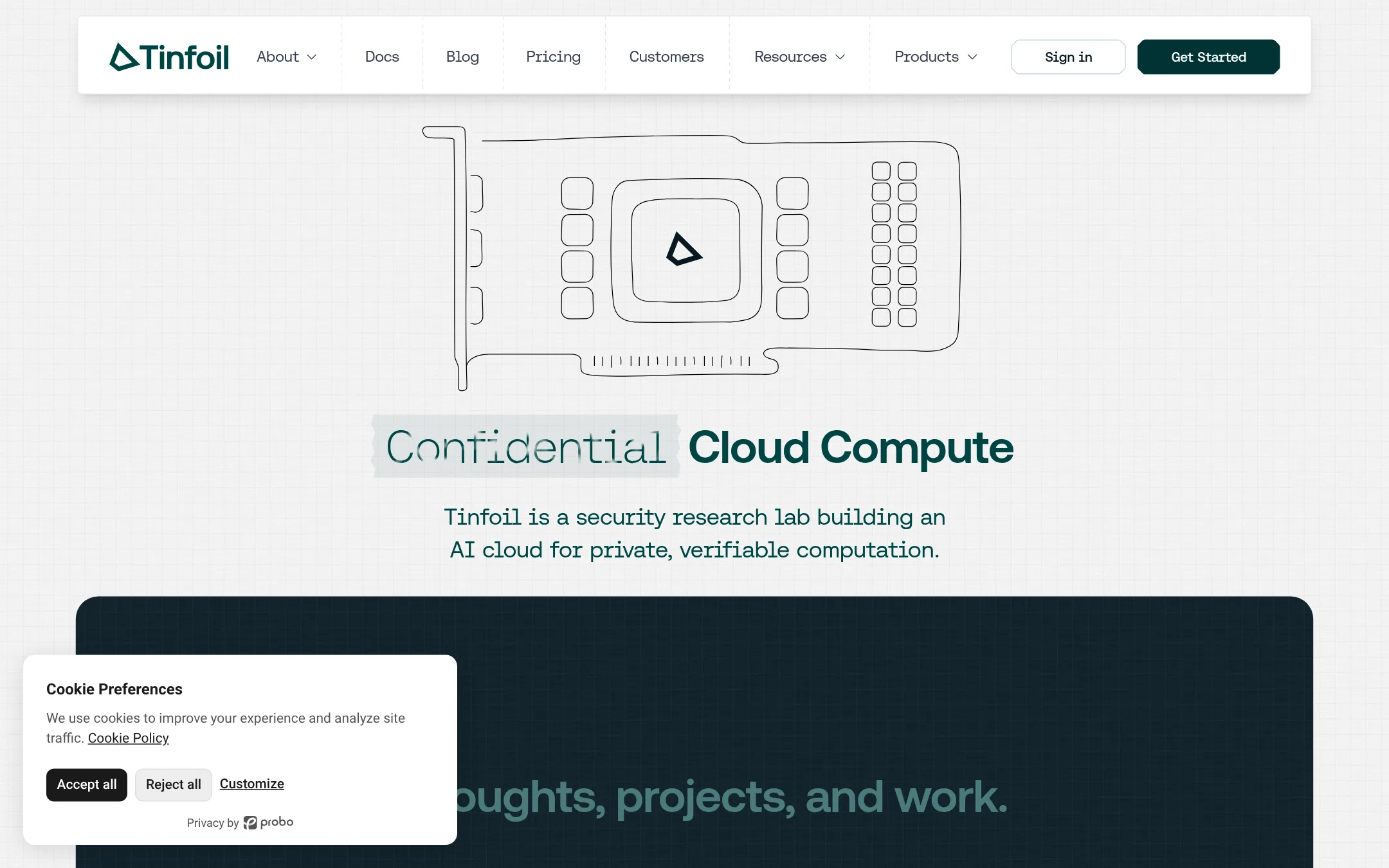
Tinfoil runs AI models inside secure hardware enclaves, so data is encrypted straight to the enclave and cannot be accessed or shared, not even by Tinfoil. The guarantees are cryptographically verifiable rather than resting on a policy promise. Its OpenAI-compatible, open-source inference API and Docker-based containers make it a credible option for teams that need private AI workloads.
Where it is strong
- Hardware enclaves keep data private, including from Tinfoil itself
- OpenAI-compatible API lets teams switch with minimal code changes
- Tinfoil Containers runs any Docker image in a secure enclave
Where it falls short
- GPU access requires a request, so self-serve pricing is not published
- Chat is consumer-focused and offers no enterprise compliance details on the page
- Pricing:
- Pricing is not published on the site for the full product line, which requires a request for GPU access. Only the Chat plan features are listed without figures.
- From $499/mo
10.MindFort
Best for: Engineering teams shipping often that want continuous penetration testing on live applications instead of an annual pentest report
- Pricing
- From $499/mo
- Category
- Security & Privacy
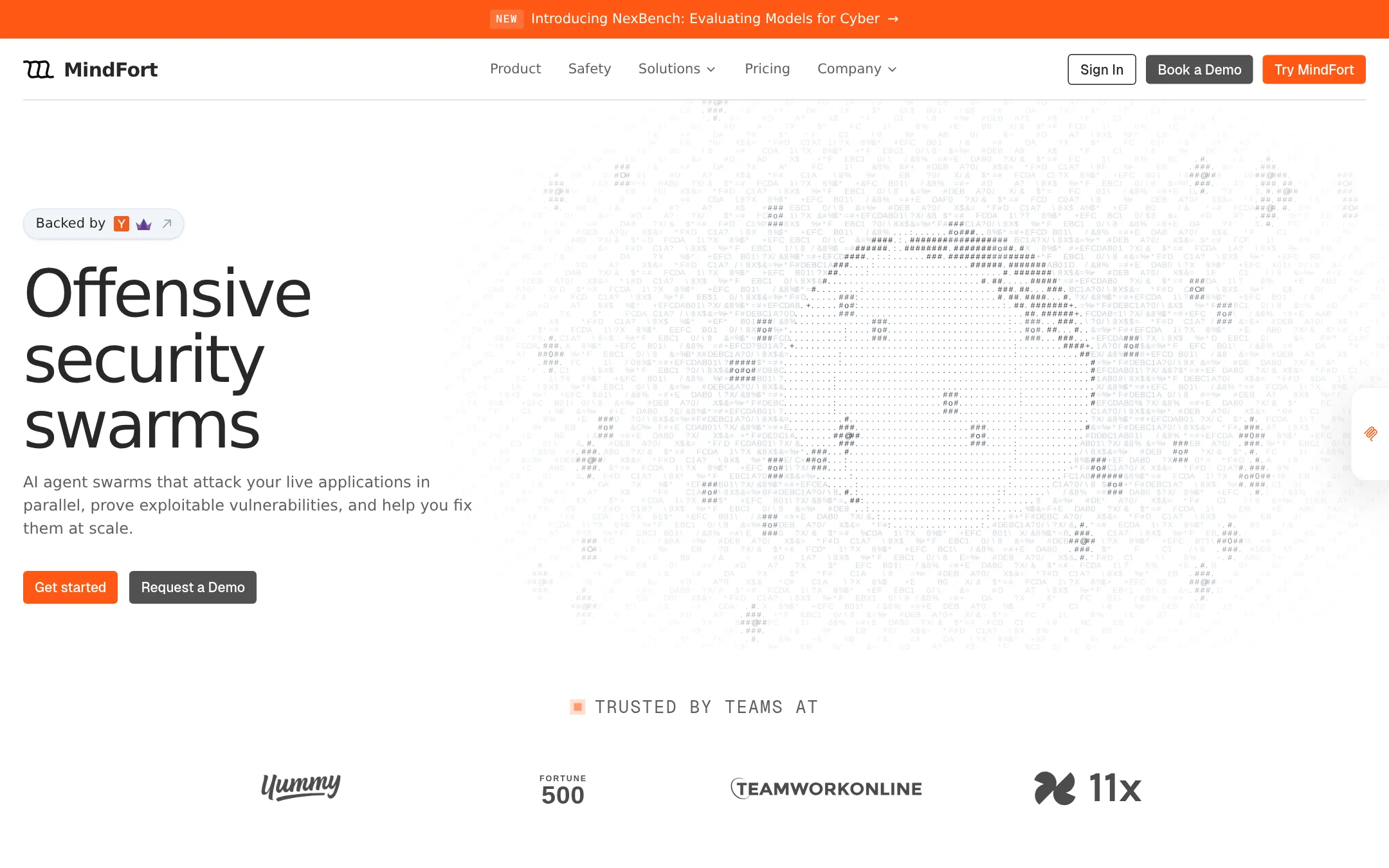
MindFort runs swarms of AI agents against live applications the way an attacker would, then proves each finding with a working exploit and steps to reproduce. It opens a patch pull request and retests with the original attack once the fix ships. Its public claim of under 1% false positives, with every finding backed by an exploit, is the detail that sets it apart from scanners that hand over a queue of possible issues.
Where it is strong
- Every finding comes with a working exploit and steps to reproduce, so triage is quick
- Results arrive in hours, and the site states under 8 hours to first verified findings
- Retesting with the original attack confirms that a fix actually holds
Where it falls short
- Costs run in credits, so heavy use of Ultra assessments can push spending well above the $499 starting price
- Teams wanting a human-led pentest with a named tester and a formal report may find it a poor fit
- Pricing:
- Starter costs $499 per month with 250 credits and one concurrent assessment, Scale costs $999 per month with 800 credits and up to five concurrent assessments, and Enterprise is custom quoted.
- Not published
11.Cotool
Best for: Security teams that want AI agents to handle detection and response and that want to read and edit the detection logic themselves.
- Pricing
- Not published
- Category
- Security & Privacy
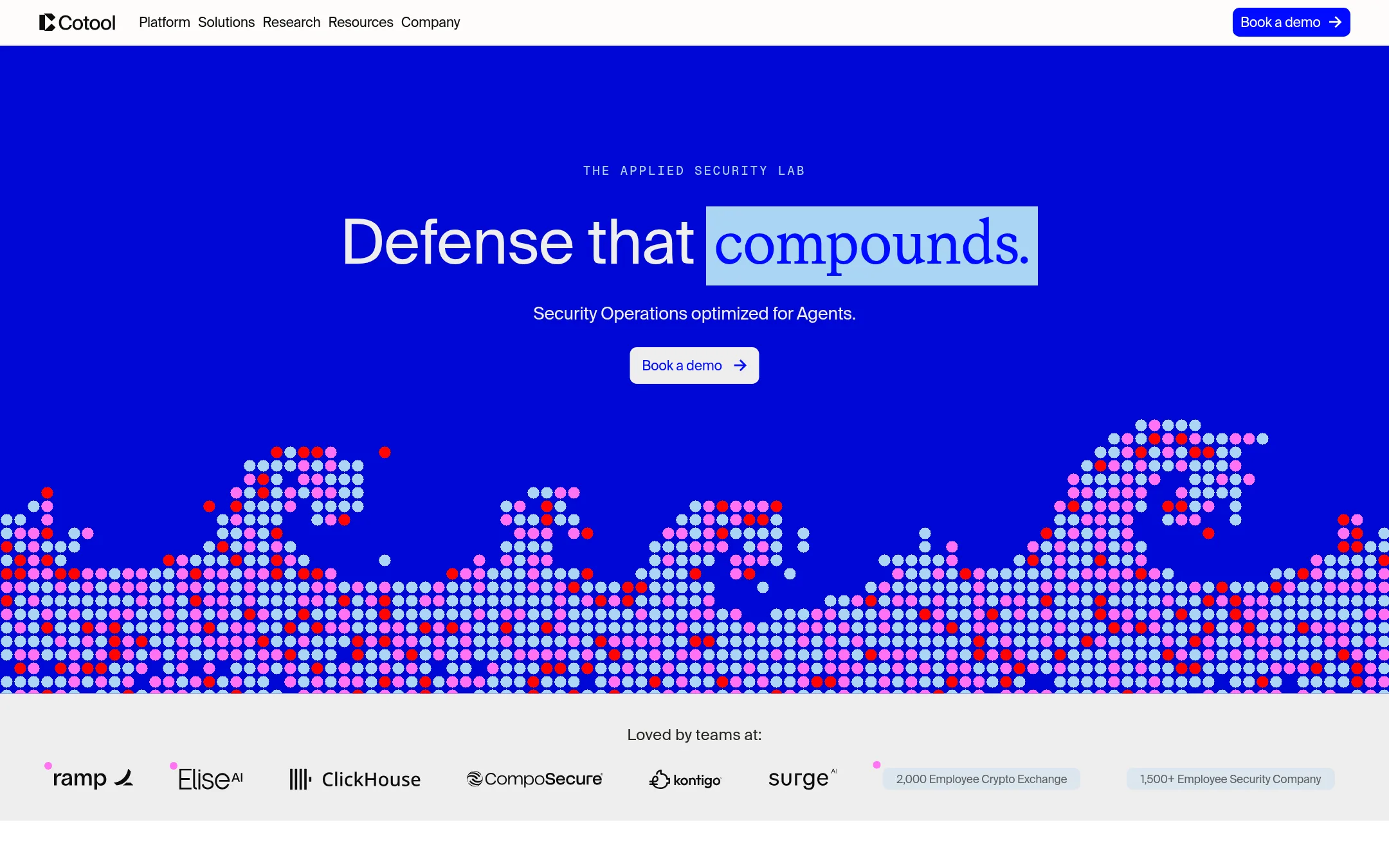
Cotool is a security operations platform that stores and searches logs in a format built for AI agents, with search that runs faster and costs less than many traditional SIEMs. Its detections are plain Python code that your team can read and edit, and agents can be tuned to your environment with natural language and human approval steps. It also turns curated threat intelligence into tuned detections and next steps, which sets it apart from products that only add a chat layer on top of a SIEM.
Where it is strong
- Detections are written in Python, so engineers can read, edit and version them.
- Agents can be built from natural language and include human approval steps at any stage.
- Automatic tuning targets false positives at the source to reduce alert fatigue.
Where it falls short
- Pricing is not published, so you will need to request a quote to compare costs.
- The site does not list a full set of log source integrations, so confirm your sources are supported before you commit.
- Pricing:
- Pricing is not published on the site.
How to choose AI Security Platforms
Start by identifying the job you need done. A vendor risk team, a platform trust team, an engineering team and a security operations team need very different products. Matching the category to your use case matters more than comparing feature lists.
Check how pricing is structured before you commit. Several products use credits, such as MindFort, where heavy use of higher-tier assessments can push spending well above the starting price. Others, such as Unbound, add a percentage fee on top of model usage. Many products on this list do not publish pricing, so budget for a sales conversation and ask for a full estimate.
Confirm that the product is built for your team size and technical depth. Cinder and Cotool need engineering work for integration. Golf is designed for security-led rollouts and suits mid-size or larger companies. Smaller teams may find that some tools require more setup than they can staff.
Look closely at integrations and what the product connects to. Adri AI works inside VS Code and through an MCP server. Gecko Security integrates with Jira, Linear and Slack on its Pro plan. Cotool supports a set list of log sources, so verify yours are covered before you buy.
Review data handling, compliance and contract terms. Tinfoil keeps data inside hardware enclaves, which matters for legal and healthcare work. Golf exports audit evidence mapped to SOC 2, ISO 27001 and NIST AI RMF. Unbound's Pro tier offers a 48-hour email SLA, and enterprise features like SSO and SIEM export sit at higher tiers, so read the support and contract terms carefully.
FAQ
Questions about AI Security Platforms
What is an AI security platform?
An AI security platform protects AI systems, the data they use, and the models or agents a company runs. Some products monitor external threats, others check AI vendors for risk, and others test applications for exploitable flaws. The right type depends on which problem you are solving.
Which AI security platform is best for vendor risk reviews?
PromptArmor is built for vendor security and third-party risk teams. It scores AI assets across 26 risk vectors and maps findings to NIST AI RMF and OWASP LLM Top 10. It is not designed to secure your own internal LLM apps or prompts.
How do AI security platforms price their products?
Pricing models vary across the list. Some products, such as Adri AI and Gecko Security, publish plan prices. MindFort uses credits with monthly tiers. Many others, including Cyble, Cinder and Golf, do not publish pricing and require a sales conversation.
Can AI security platforms secure AI coding agents?
Yes, a few products on this list target this need directly. Unbound inventories coding agents like Claude Code, Cursor and GitHub Copilot, and enforces allow and deny rules on terminal commands and MCP actions. Golf discovers AI agents and MCP connections across an organization and enforces policies at its gateway.
What should I check before choosing an AI security platform?
Check the pricing structure, who the product is built for, and which integrations it supports. Also review data handling, compliance certifications and support terms. Because many products keep pricing private, ask for a full quote and confirm your use case is supported before you commit.
Last updated November 8, 2026.