12 Best Integration Platforms in 2026
Updated November 7, 2026
The short answer
For a business integration platform, Tray.io suits enterprise IT and data teams that need to connect many systems, govern AI agents and keep audit trails in one place. Jitterbit suits mid-sized and enterprise teams that connect ERP, CRM and commerce systems and also need EDI and API management. Boomi suits mid-size and enterprise IT teams that want to connect many systems and govern AI agents from a single platform. Among embedded integration platforms for SaaS products, Nango and hotglue are strong options for developers and product teams building customer-facing integrations.
The shortlist, at a glance
Read the comparisons ↓ Tray.ioFrom $50/mo, usageEnterprise IT and data teams that need to connect many systems, govern AI agents and MCP tools, and keep audit trails in one platform.
 JitterbitCustom quoteMid-sized and enterprise teams that need to connect ERP, CRM and commerce systems and also want EDI and API management in one tool.
 BoomiNot publishedMid-size and enterprise IT teams that need to connect many systems and govern AI agents from one platform.
 ParagonCustom quoteSaaS and AI product teams that need many customer-facing integrations and want to avoid building and maintaining each one in-house.
 Alloy AutomationNot publishedSaaS product teams that want to offer a built-in integration marketplace to their own customers, and enterprises that need on-premise connectivity to systems like SAP or NetSuite.
hotglueCustom quoteSaaS product teams that need to offer native integrations to their own customers without tying up engineers on upkeep.
 NangoFree, $50/mo + usageDevelopers and small engineering teams building SaaS products or AI agents that must connect to many customer APIs without building auth and sync logic for each one.
 Tridium NiagaraNot publishedBuilding operators and system integrators who need to connect equipment from many manufacturers into one monitoring and control system.
 VersoriNot publishedEnterprise engineering teams with internal APIs and messy data that need complex integrations built faster than their own developers can manage.
 InteguruNot publishedDevelopers and product teams that need reliable, high-throughput integrations with web platforms that have no public API.
superglueNot publishedImplementation partners and consultancies that run fixed-fee ERP or SaaS rollouts and want to take on more projects without adding headcount
 ReJotNot publishedEngineering teams that already run custom API integrations and want to drop in prebuilt, full-stack libraries instead of wiring each one by hand.
About Integration Platforms
Integration platforms connect the software a business already uses so that data moves between systems without manual copying. They provide prebuilt connectors, workflow tools, and the authentication and sync logic needed to keep those connections running. Some are built for internal IT teams, others for SaaS companies that want to offer integrations to their own customers.
The products on this list differ in approach, scale and pricing. Tray.io, Jitterbit and Boomi are general enterprise platforms with broad connector libraries. Paragon, Alloy Automation, hotglue and Nango focus on embedding integrations inside a product, and Nango is developer-first with usage-based pricing. Tridium Niagara, Integuru, superglue and Versori serve narrower needs such as building systems, web platforms without an API, ERP rollouts and complex enterprise APIs.
The 12 best Integration Platforms, compared
- From $50/mo, usage
1.Tray.io
Best for: Enterprise IT and data teams that need to connect many systems, govern AI agents and MCP tools, and keep audit trails in one platform.
- Pricing
- From $50/mo, usage
- Category
- Developer Tools
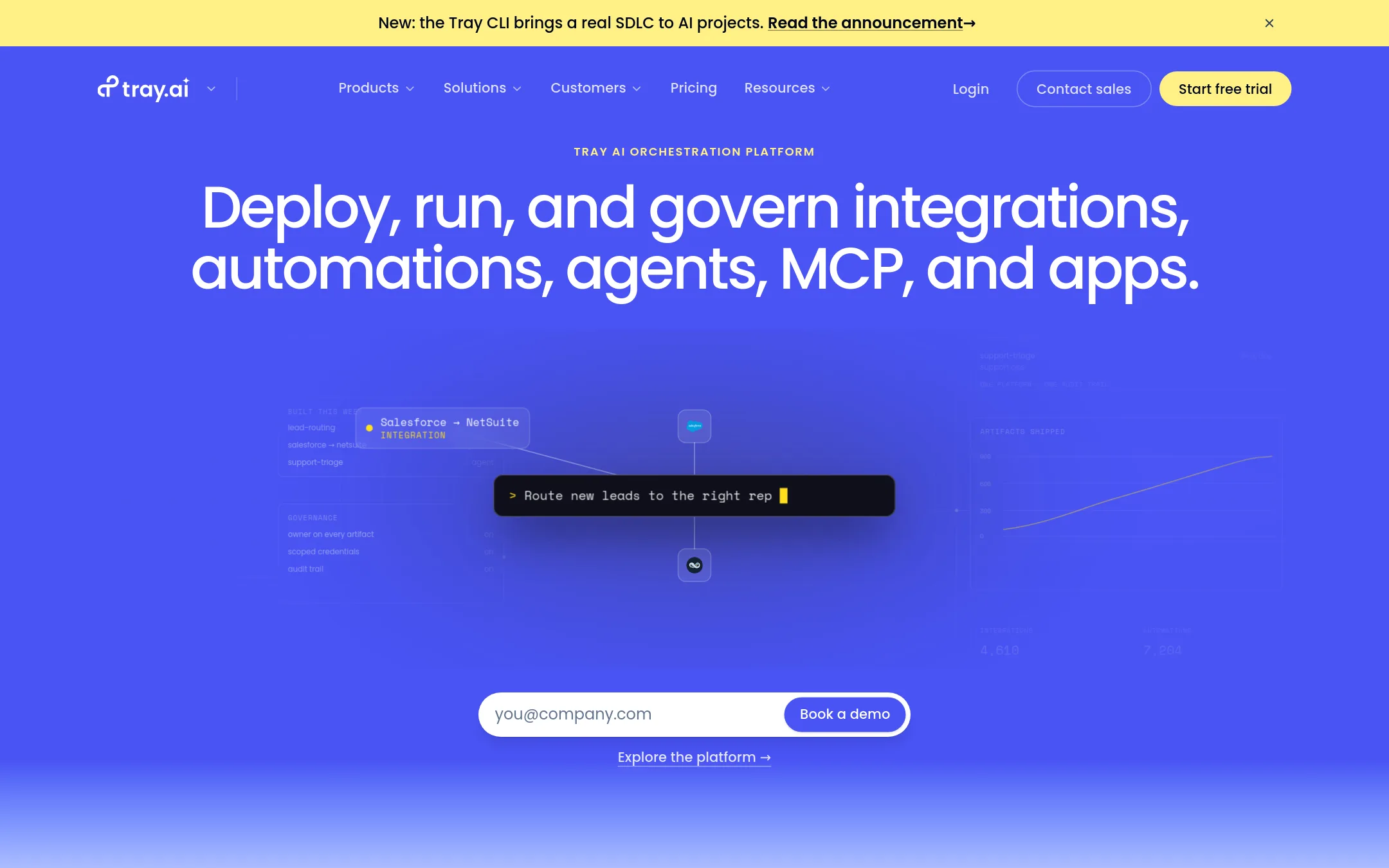
Tray.ai is an enterprise integration platform that combines data integration, process automation, AI agent building, and governance of Model Context Protocol (MCP) tool calls on one product. It connects to 700+ apps through its connectors, and every agent action, tool call and workflow run is covered by audit trails and role-based access. It is recognised by Gartner as a Visionary in the iPaaS Magic Quadrant, which gives it some credibility among integration platforms.
Where it is strong
- Connects to 700+ apps and can expose connectors as governed MCP tools.
- Audit trails, RBAC and SOC 2 Type 2 audit cover agent actions and workflow runs.
- Offers both a visual low-code builder and a headless option for coding assistants.
Where it falls short
- Enterprise features such as SSO, HIPAA, regional hosting and on-premise connectivity sit behind the Enterprise plan, so smaller teams may no
- Usage-based pricing through Tasks and Helix Compute Units can be hard to estimate before a trial.
- Pricing:
- Pricing starts at $50 a month, is usage-based through Tasks and Helix Compute Units with no per-user or per-connection fees, and Enterprise pricing is a custom quote.
- Custom quote
2.Jitterbit
Best for: Mid-sized and enterprise teams that need to connect ERP, CRM and commerce systems and also want EDI and API management in one tool.
- Pricing
- Custom quote
- Category
- E-commerce
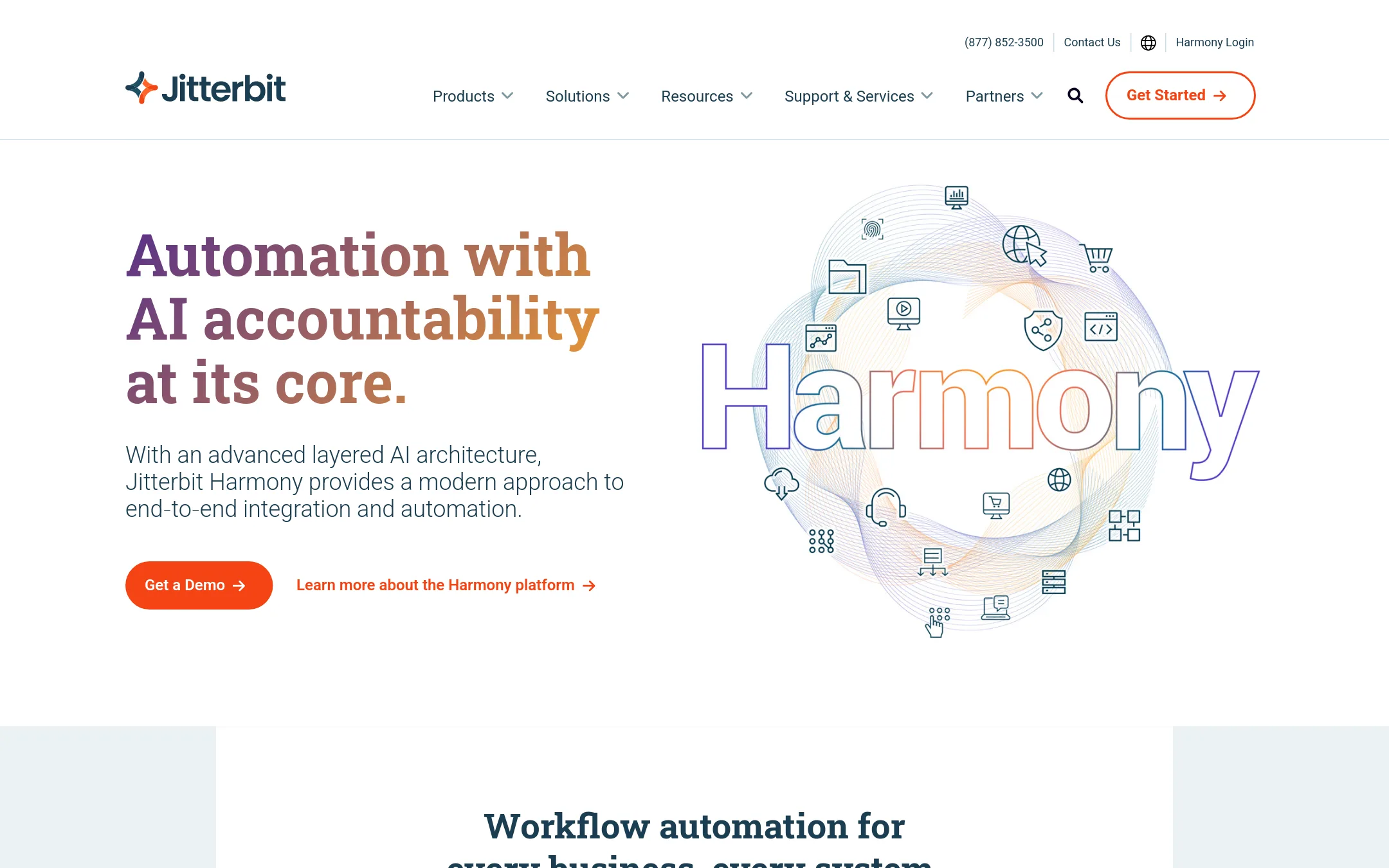
Jitterbit Harmony combines integration, EDI, API management, workflow automation and low-code app building on one platform. It ships with AI agents and assistants, and prebuilt connectors for systems like Salesforce, NetSuite, Shopify and Microsoft Dynamics. G2's Fall 2026 Enterprise Implementation Index ranked it #1 among iPaaS vendors, based on real-user scores for setup and time to go-live.
Where it is strong
- Covers iPaaS, EDI, API management and app building in one platform
- Prebuilt connectors for NetSuite, Salesforce, Shopify and Dynamics
- Ranked #1 in G2's Fall 2026 Enterprise iPaaS Implementation Index
Where it falls short
- Requires an annual contract and custom pricing, so budgeting takes a sales conversation
- Likely more platform than a small team needs for a handful of simple automations
- Pricing:
- Pricing is not published on the site, with custom quotes and annual contracts offered instead.
- Not published
3.Boomi
Best for: Mid-size and enterprise IT teams that need to connect many systems and govern AI agents from one platform.
- Pricing
- Not published
- Category
- E-commerce
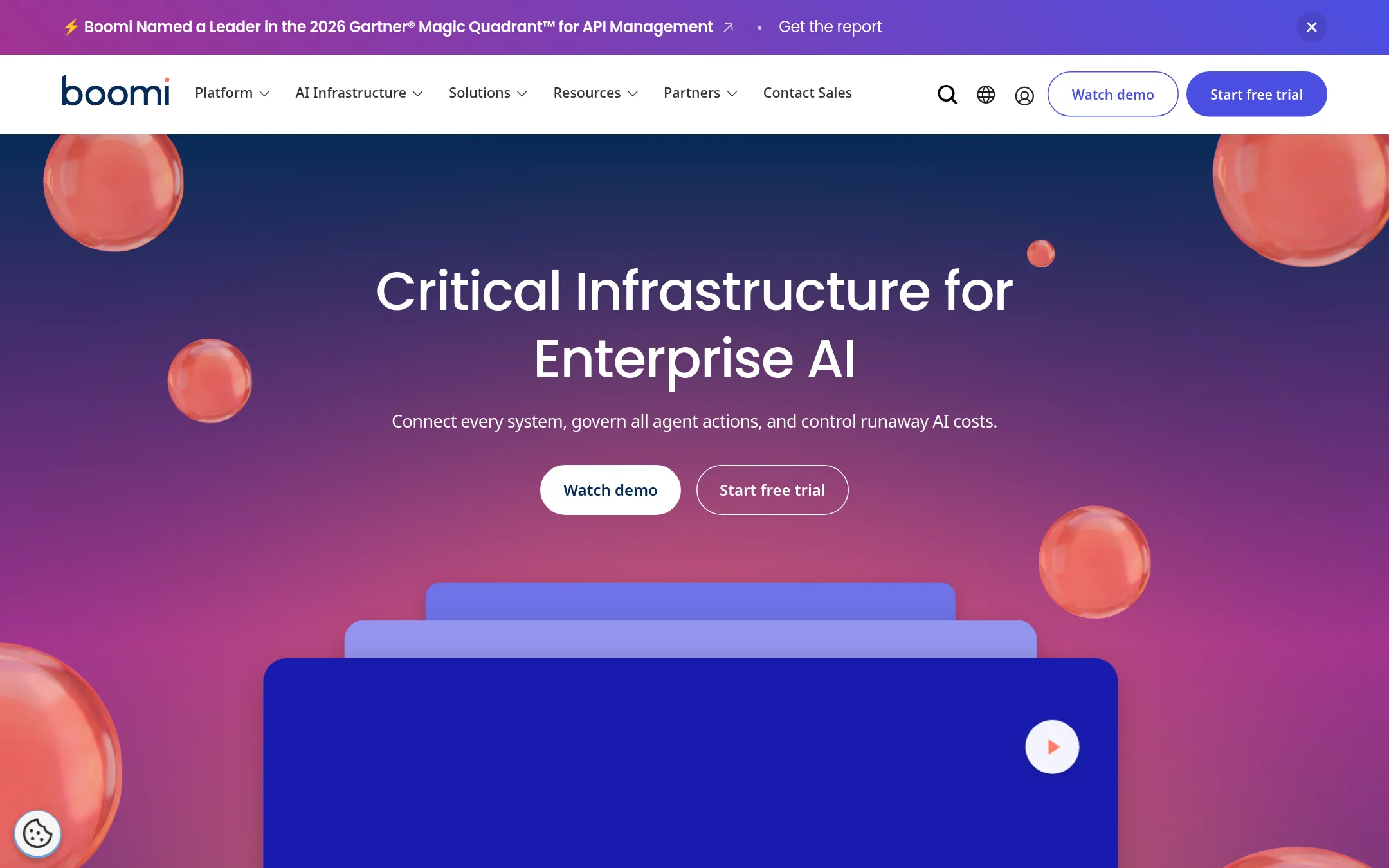
Boomi is a single platform that connects applications, APIs, data and AI agents, with 1000+ pre-built application connectors and governed MCP servers for AI agents. It is a credible pick because it is named a Leader in the 2026 Gartner Magic Quadrant for Integration Platform as a Service and 30,000+ customers use it.
Where it is strong
- Pre-built connectors to over 1000 enterprise applications, plus governed MCP servers for AI agents
- Covers integration, API management, data pipelines and agent governance in one platform
- Recognised as a Leader in the 2026 Gartner Magic Quadrant for Integration Platform as a Service
Where it falls short
- Its breadth of products can make it heavy for a small team with simple integration needs
- Pricing is not published, so you need to talk to sales to learn the cost
- Pricing:
- Pricing is not published on the site.
- Custom quote
4.Paragon
Best for: SaaS and AI product teams that need many customer-facing integrations and want to avoid building and maintaining each one in-house.
- Pricing
- Custom quote
- Category
- Developer Tools
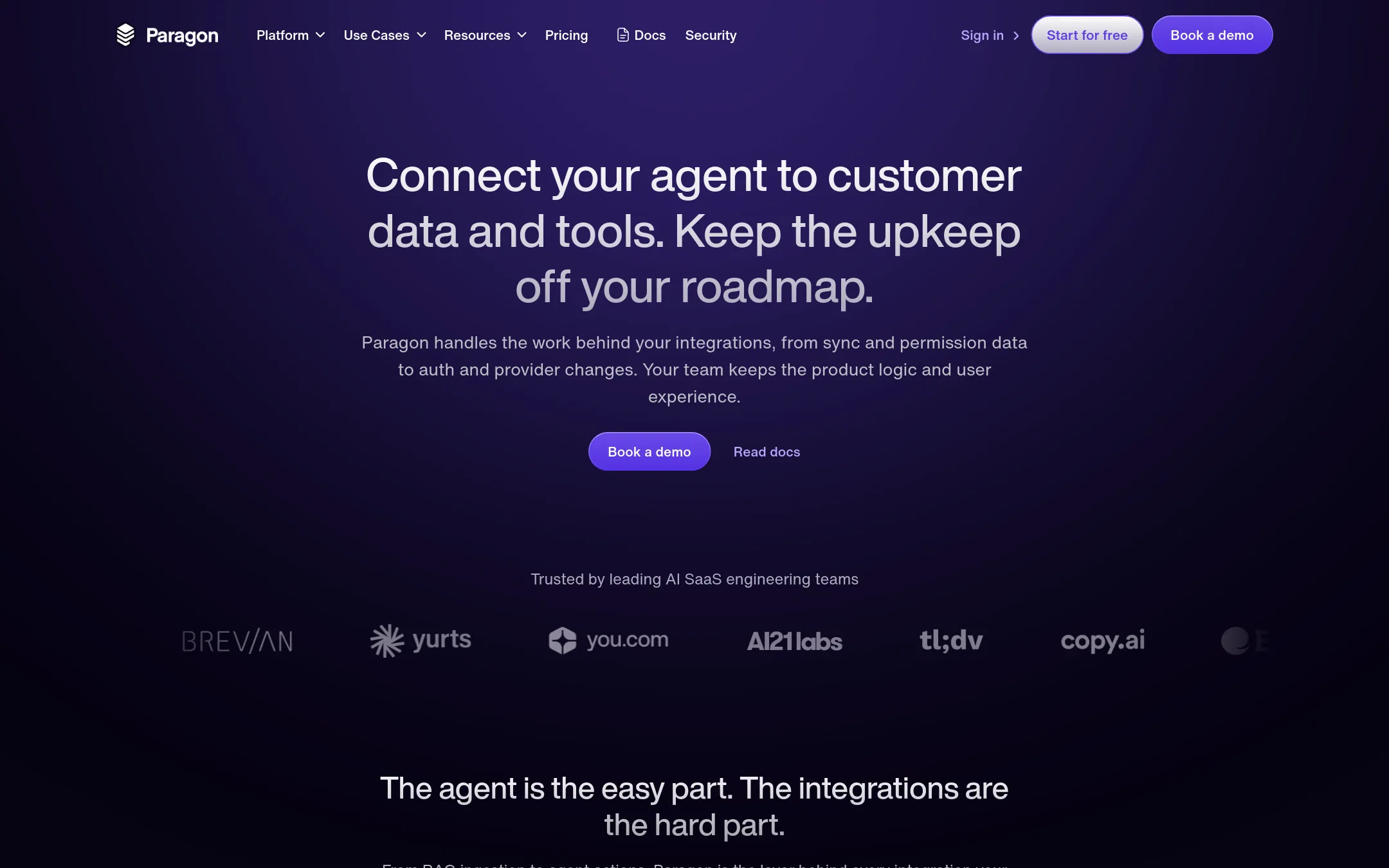
Paragon is an embedded integration platform aimed at SaaS products and AI agents. It handles authentication, provider changes, sync pipelines, and webhooks so a product team does not have to maintain each third-party API itself. It lists 130+ pre-built connectors and lets teams build custom connectors for any third-party API.
Where it is strong
- Managed sync pipelines with configurable frequency up to every minute and a Permissions API for access control in retrieval.
- One API and MCP server for synchronous CRUD actions across many integrations, with action schemas designed for agents.
- Deployment choices include cloud, self-hosted, and forward-deployed options, with SOC 2 Type 2 and GDPR compliance listed.
Where it falls short
- Cost scales with the number of customer orgs using integrations, so spend is hard to estimate before a sales conversation.
- Advanced features such as SAML SSO, RBAC, and dynamic field mapping sit in the Enterprise tier or on quote, so smaller teams may pay more fo
- Pricing:
- Pricing is not published on the site. The page describes custom quotes based on the number of Connected Users, which are customer orgs using integrations.
- Not published
5.Alloy Automation
Best for: SaaS product teams that want to offer a built-in integration marketplace to their own customers, and enterprises that need on-premise connectivity to systems like SAP or NetSuite.
- Pricing
- Not published
- Category
- Developer Tools
Alloy Automation is an integration platform aimed at SaaS companies and enterprises that need to connect systems to their product or to AI agents. It offers embedded iPaaS, on-premise connectors, ETL/ELT, and error handling with logging. Pre-built connectors exist for systems such as NetSuite, SAP, Salesforce, and Shopify.
Where it is strong
- Pre-built connectors for NetSuite, SAP, Salesforce, and Shopify.
- Supports on-premise connections, which many cloud-only tools do not.
- Covers embedded iPaaS, ETL/ELT, and error handling with logging in one platform.
Where it falls short
- Pricing is not published, so you will need to talk to sales to learn the cost.
- Its focus on enterprise connectivity and embedded use cases may be more than a small team needs for simple automations.
- Pricing:
- Pricing is not published on the site.
- Custom quote
6.hotglue
Best for: SaaS product teams that need to offer native integrations to their own customers without tying up engineers on upkeep.
- Pricing
- Custom quote
- Category
- Developer Tools
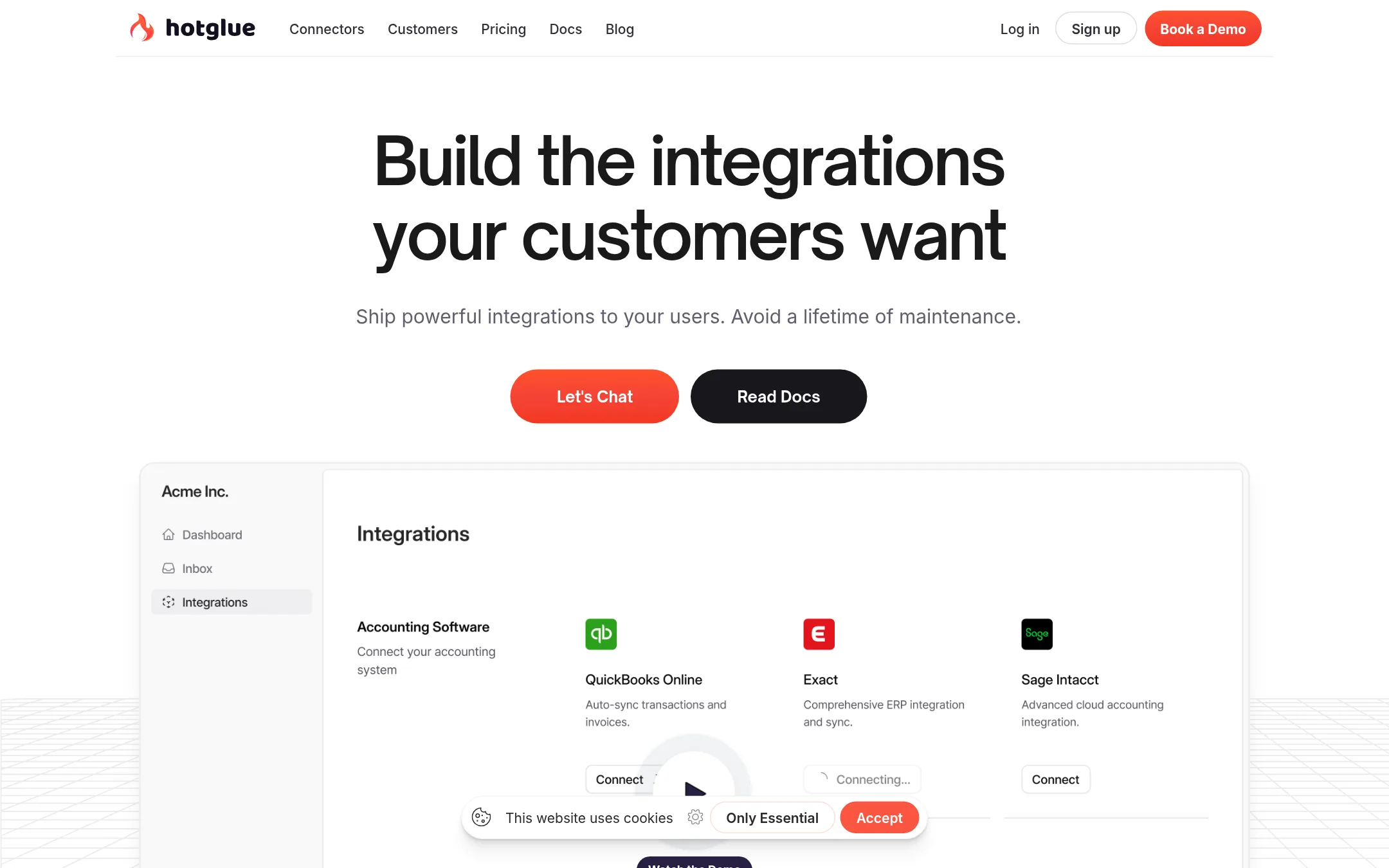
hotglue is an embedded iPaaS that lets SaaS teams ship native, user-facing integrations and read third-party data straight into the customer's warehouse. It supports over 600 open-source connectors, including all Singer and Airbyte YAML connectors, so most common tools are already covered. It is SOC 2 Type II and GDPR compliant and says it never stores customer data.
Where it is strong
- Over 600 open-source connectors, including all Singer and Airbyte YAML connectors
- Pricing is based on tenants rather than data volume, so bills do not spike with sync size
- Offers a no-code connector builder and a Python SDK for custom connectors
Where it falls short
- Pricing numbers are not published, so you must contact sales to see costs
- Its focus is embedded integrations for SaaS products, so it is a weaker fit for internal-only data pipelines
- Pricing:
- Pricing is based on active tenants, with Basic, Pro and Enterprise plans, a Startup plan for small companies, and annual plans with one month free, but no dollar figures are published on the site.
- Free, $50/mo + usage
7.Nango
Best for: Developers and small engineering teams building SaaS products or AI agents that must connect to many customer APIs without building auth and sync logic for each one.
- Pricing
- Free, $50/mo + usage
- Category
- Developer Tools
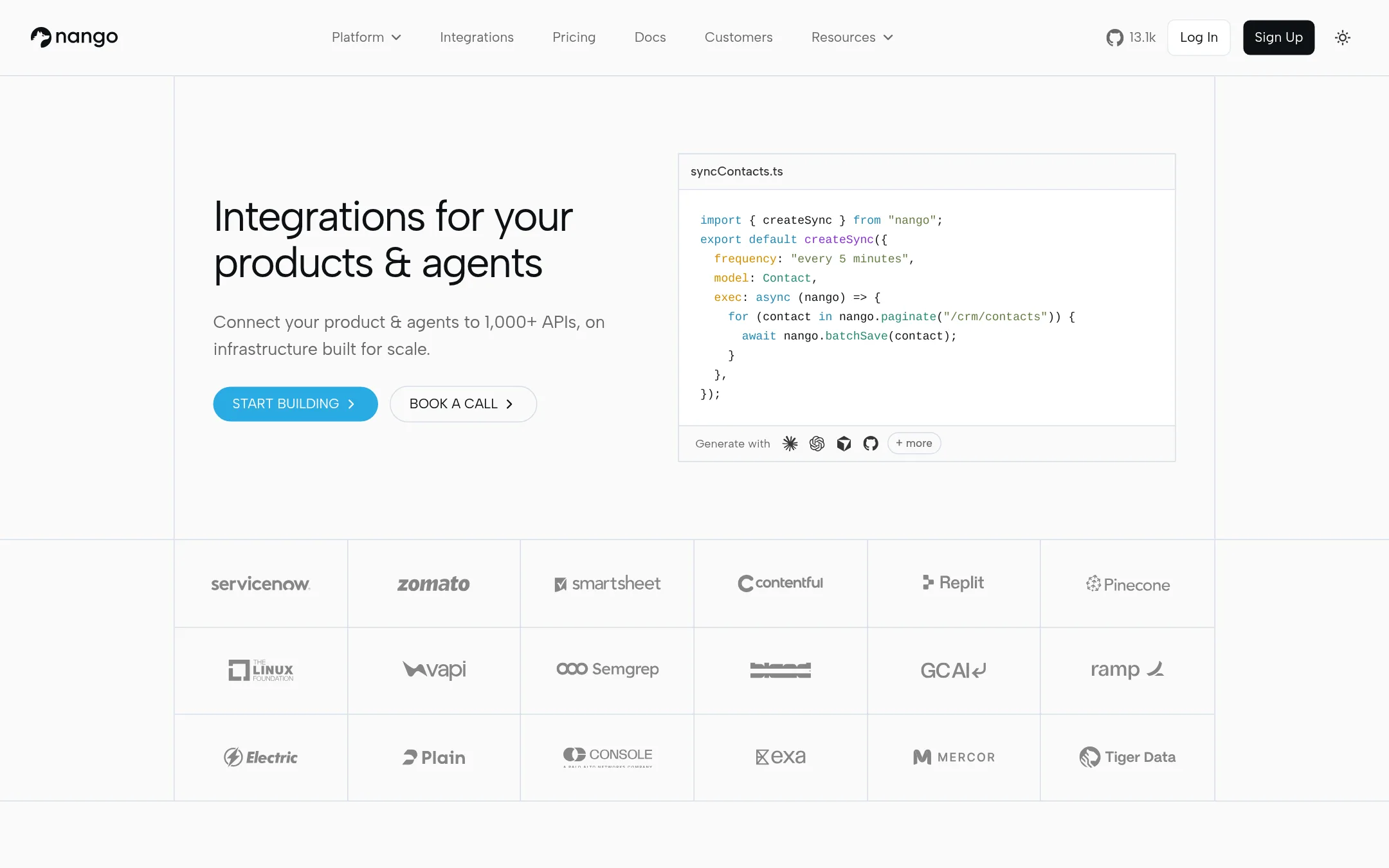
Nango gives developers one API layer for connecting their product and AI agents to more than 1,000 external APIs. It handles authentication, credential storage, token refreshing, syncs and webhooks, and it can generate integration code from a plain English description. It also ships with 10,000+ pre-built tools, triggers and syncs, which is why teams like Replit and Vapi cite it for going from zero to dozens of integrations.
Where it is strong
- Pre-built auth and token refresh for 1,000+ APIs, so you skip writing OAuth flows yourself.
- 10,000+ pre-built tools, triggers and syncs are available immediately.
- Open source and self-hostable, which helps teams with strict data requirements.
Where it falls short
- Usage-based billing per connection and compute time can be hard to forecast at scale.
- Some compliance and admin features, such as HIPAA, SAML SSO, SCIM and SLAs, sit in the Enterprise tier, so smaller teams may not reach them.
- Pricing:
- The free plan is $0/mo with hard-capped limits, pay-as-you-go is $50/mo plus $0.29 per connection, $0.72 per compute hour and $0.50 per GB of data transfer, and Enterprise is custom priced.
- Not published
8.Tridium Niagara
Best for: Building operators and system integrators who need to connect equipment from many manufacturers into one monitoring and control system.

- Pricing
- Not published
- Category
- Productivity & Project Management
Tridium's Niagara Framework is a software platform that connects and translates data from nearly any device or system, and it is used heavily in buildings. Its strength is openness: one common layer for monitoring and control across mixed equipment from different manufacturers. Niagara Cloud Suite extends it with remote access, secure historical trend storage, and a centralized asset view.
Where it is strong
- Connects data from nearly any device or system, not just one vendor's equipment
- Cloud Suite adds remote access, configuration, and secure storage of historical trend data
- Supports tenant utility billing and cyber defense tools as add-ons
Where it falls short
- Pricing is not listed, so budgeting requires a sales conversation
- Built for building and device automation, so it is a poor fit for typical SaaS or business integration needs
- Pricing:
- Pricing is not published on the site.
- Not published
9.Versori
Best for: Enterprise engineering teams with internal APIs and messy data that need complex integrations built faster than their own developers can manage.

- Pricing
- Not published
- Category
- Developer Tools
Versori is an agentic integration platform for enterprise teams. Its Plan Agent reads API docs, maps dependencies and generates workflows for you to approve before anything is built. It onboards REST, SOAP and GraphQL APIs, including internal ones, and deploys natively to GCP with support for AWS, Azure and on-prem.
Where it is strong
- The Plan Agent maps dependencies and drafts workflows from API docs for your approval.
- You can refine logic with prompts or edit integration code directly in the IDE.
- Deploys to GCP natively and also supports AWS, Azure and on-prem setups.
Where it falls short
- Built for enterprise scale, so smaller teams with simple integrations may find it more than they need.
- Pricing is not published, so you will need to request a quote to compare costs.
- Pricing:
- Pricing is not published on the site.
- Not published
10.Integuru
Best for: Developers and product teams that need reliable, high-throughput integrations with web platforms that have no public API.

- Pricing
- Not published
- Category
- Developer Tools
Integuru generates production-ready APIs for websites by analyzing each platform's network requests and writing direct HTTP calls, skipping browser automation and RPA. It handles branching logic and complex login flows such as session cookies and phone or email 2FA. It is credible because it reports 10,000,000+ monthly API calls and lists Penciled, which moved off browser automation and saw actions drop from 30+ seconds to under 3 seconds.
Where it is strong
- Direct HTTP requests avoid flaky browser automation and run faster.
- Covers branching logic and edge cases that appear in real usage.
- Generates full request and response schemas for every endpoint.
Where it falls short
- It only works with platforms that have a web interface, and it may not integrate some sites at all.
- Pricing is not published, so you need to talk to the team to estimate costs.
- Pricing:
- Pricing is not published on the site.
- Not published
11.superglue
Best for: Implementation partners and consultancies that run fixed-fee ERP or SaaS rollouts and want to take on more projects without adding headcount

- Pricing
- Not published
- Category
- Productivity & Project Management
superglue uses AI agents to connect, migrate and implement enterprise systems such as NetSuite, Sage Intacct and monday.com. It reads kickoff calls and emails, builds the project plan, and runs the work between your decisions. A Sage VAR handling 40 fixed-fee implementations reported cutting data migration hours per project by 80%.
Where it is strong
- Builds project plans from kickoff call transcripts and email threads
- Available cloud-hosted or on your own infrastructure
- Offers a proof of concept scoped around your own client project, delivered in two days
Where it falls short
- Pricing is not published, so you need a sales conversation before you can compare costs
- The listed examples lean toward ERP and implementation work, so teams doing simple app-to-app sync may find it more than they need
- Pricing:
- Pricing is not published on the site.
- Not published
12.ReJot
Best for: Engineering teams that already run custom API integrations and want to drop in prebuilt, full-stack libraries instead of wiring each one by hand.

- Pricing
- Not published
- Category
- Developer Tools
ReJot is an open-source project that turns complex API integrations into drop-in full-stack libraries. Its team publishes practical engineering essays, including a write-up on receiving Resend inbound email without webhooks, which shows how the library approach is applied in real code.
Where it is strong
- Open source, so the code can be read and inspected
- Packages integrations as full-stack libraries rather than thin client wrappers
- Founder-led team that writes openly about its engineering approach
Where it falls short
- The listing is not verified and the site shows no customer list or integration catalog
- Pricing and support terms are unknown, which makes budgeting harder for non-engineering buyers
- Pricing:
- Pricing is not published on the site.
How to choose Integration Platforms
Start with pricing structure, because the models vary widely. Tray.io and Nango publish starting prices but charge by usage, which can be hard to forecast. Jitterbit, Boomi, Paragon and Alloy Automation publish no prices and require a sales conversation, so ask for a full quote before comparing.
Consider who the platform is built for. Enterprise platforms like Boomi and Jitterbit can be heavy for a small team with a few simple automations. Embedded platforms like hotglue and Paragon make sense when your goal is to offer integrations to your own customers rather than to connect your internal systems.
Check the connectors that matter to you. Jitterbit lists prebuilt connectors for NetSuite, Salesforce, Shopify and Dynamics, and Alloy Automation lists NetSuite, SAP, Salesforce and Shopify. Boomi lists over 1000 application connectors, and Nango covers more than 1,000 external APIs. Confirm your specific systems are included before you commit.
Review data handling and compliance. Tray.io, Paragon and hotglue state SOC 2 compliance, and hotglue also states GDPR compliance and that it never stores customer data. Enterprise tiers often hold features such as SSO, HIPAA and regional hosting, so check which plan includes what you need.
Finally, look at support and contract terms. Jitterbit requires an annual contract, and many enterprise vendors negotiate terms directly. Ask about support levels, implementation help and what happens to pricing as your usage grows.
FAQ
Questions about Integration Platforms
What is an integration platform?
An integration platform is software that connects two or more business systems so data and actions can flow between them. It usually provides prebuilt connectors, workflow tools and the authentication and sync logic needed to keep the connections running. Some are aimed at internal IT teams and others at SaaS companies that want to offer integrations to their own customers.
What is the difference between an embedded integration platform and a general one?
A general platform, such as Tray.io or Boomi, is used by an internal team to connect the company's own systems. An embedded platform, such as Paragon, Alloy Automation or hotglue, lets a SaaS product offer integrations to its own customers inside the product. Choose based on whether the integrations are for your internal use or for your customers.
How is integration platform pricing usually structured?
Pricing varies. Tray.io starts at $50 a month and is usage-based with no per-user fees, while Nango has a free plan and charges per connection, compute hour and data transfer. Many enterprise vendors, including Jitterbit, Boomi and Paragon, do not publish prices and quote on request, often through annual contracts.
Which integration platform should a small team start with?
A small engineering team building SaaS products or AI agents may find Nango a good fit, since it provides prebuilt auth and sync for over 1,000 APIs and offers a free plan. A team that only needs simple internal automations may find enterprise platforms heavier than necessary. Test a shortlist against the specific systems you use before committing.
Do integration platforms handle compliance and security?
Many do, but the level varies by product and plan. Tray.io, Paragon and hotglue state SOC 2 compliance, and hotglue also states GDPR compliance. Features such as HIPAA, SSO and regional hosting often sit in enterprise tiers, so confirm which plan includes the controls your business requires.
Last updated November 7, 2026.